How Iapetus got its ridge
December 13, 2010

How Iapetus got its ridge

Enlarge

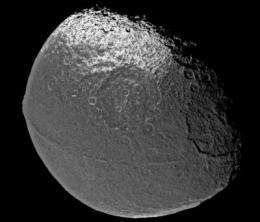
A ridge that follows the equator of Saturn's moon Iapetus gives it the appearance of a giant walnut. The ridge, photographed in 2004 by the Cassini spacecraft, is 100 kilometers (62 miles) wide and at times 20 kilometers (12 miles) high. (The peak of Mount Everest, by comparison, is 5.5 miles above sea level.) Scientists are debating how the ridge might have formed. Credit: NASA/JPL/SSI

For centuries, people wondered how the leopard got its spots. The consensus is pretty solid that evolution played a major role.

But it's only been five years since the arrival of high-resolution images of Saturn's bizarre Iapetus that the international planetary community has pondered the unique walnut shape of the large (735 kilometer radius) body, considered by many to be one of the most astonishing features in the solar system.

And there's no consensus as to how a mysterious large ridge that covers more than 75 percent of the moon's was formed. It's been a tough nut to crack.

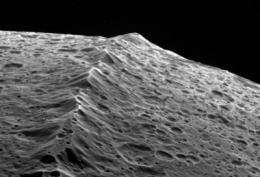
But now a team including an outer solar system specialist from Washington University in St. Louis has proposed a giant impact explains the ridge, up to 20 kilometers tall and 100 kilometers wide.

William B. McKinnon, PhD, Washington University professor of earth and planetary sciences in Arts & Sciences, and his former doctoral student, Andrew Dombard, PhD, associate professor of earth and environmental sciences at the University of Illinois Chicago (UIC), propose that at one time Iapetus itself had a satellite, or moon, created by a giant impact with another big body. The sub-satellite's orbit, they say, would have decayed because of tidal interactions with Iapetus, and it would have gradually migrated towards Iapetus. At some point, the researchers say, the tidal forces would have torn the sub-satellite apart, forming a ring of debris around Iapetus that would eventually slam into the moon near its equator.

"Imagine all of these particles coming down horizontally across the equatorial surface at about 400 meters per second, the speed of a rifle bullet, one after the other, like frozen baseballs," says McKinnon. "Particles would impact one by one, over and over again on the equatorial line. At first the debris would have made holes to form a groove that eventually filled up."

"When you have a debris ring around a body, the collisional interactions steal energy out of the orbit," explains Dombard. "And the lowest energy state that a body can be in is right over the rotational bulge of a planetary body — the equator. That's why the rings of Jupiter, , Uranus and Neptune are over the equator."

"We have a lot of corroborating calculations that demonstrate that this is a plausible idea," says Dombard, "but we don't yet have any rigorous simulations to show the process in action. Hopefully, that's next."

How Iapetus got its ridge
Enlarge

Saturn was photographed from near Iapetus by Cassini on Sept. 10, 2007, as the spacecraft prepared for its final approach to the moon. The spacecraft is about 3.3 million kilometers (2.1 million miles) from Saturn. As the image shows, Iapetus's orbit is tilted with respect to Saturn's. Since Saturn's other moons orbit in the same plane as the planet, they "see" Saturn's rings edge-on. Credit: NASA/JPL/SSI

Other planetary scientists believe the ridge was created by endogenic (within the planet) activity such as volcanism or mountain-building forces.

"Some people have proposed that the ridge might have been caused by a string of volcanic eruptions, or maybe it's a set of faults," McKinnon notes. "But to align it all perfectly like that — there is just no similar example in the solar system to point to such a thing."

"There are three critical observations that any model for the formation of the ridge has to satisfy," says Dombard. "They are: Why the feature is sitting on the equator; why only on the equator, and why only on Iapetus. I think we have something here that explains all those observations."

Dombard will make a presentation on the preliminary findings Wed., Dec. 15, 2010, at the fall meeting of the American Geophysical Union in San Francisco. The team also included Andrew F. Cheng of the Johns Hopkins Applied Physics Laboratory, and Jonathan P. Kay, a graduate student at UIC.

Dombard says that Iapetus's Hill sphere — the zone close to an astronomical body where the body's gravity dominates satellites — is far bigger than that of any other major satellite in the , accounting for why Iapetus is the only body known to have such a ridge.

"Only Iapetus could have had the orbital space for the sub-satellite to then evolve and come down toward its surface and break up and supply the ridge," he says.
How Iapetus got its ridge
Enlarge

In 2007 Cassini flew within a few thousand kilometers of Iapetus's surface to take this dramatic picture of the ridge. A movie of the flyby is available at the NASA site devoted to Saturn. Credit: NASA/JPL/SSI

One of the supporting calculations the team performed was an estimation for how long it would take the orbit to decay so that the material would reach the point where the tidal forces would tear it apart into a debris disk.

"We're looking at only 100,000 years for a sub-satellite relatively close (to Iapetus) to a billion years for a body that's at the limit of where you could have a stable satellite in orbit around Iapetus," Dombard says. "These time scales are certainly plausible considering we have several billion years of time to work with. And longevity is important, because if it happens too fast all geological trace will be lost."

McKinnon notes that there are other examples in the solar system of giant impacts creating moons that orbit planets, notably our own Moon and Pluto's moon Charon.

"Our Moon and Pluto's, too, are actually retreating from the Earth and Pluto," he says. "But if we were to bring our Moon inside what is called geosynchronous altitude, that special altitude where TV broadcast satellites (and other objects) are able to hover over one spot on Earth as they orbit, then the Moon would actually spiral in toward Earth. Eventually our Moon would break into a ring of particles as it got very close and was torn apart by tides, and then those particles would enter the atmosphere and bombard the Earth at the equator."

Provided by Washington University in St. Louis search and more info website

4.3 /5 (12 votes)  

Filter


Move the slider to adjust rank threshold, so that you can hide some of the comments.


Display comments: newest first

Au-Pu
Dec 13, 2010

Rank: not rated yet
Is it possible for a polar or near polar impact to create such a ridge?
genastropsychicallst
Dec 13, 2010

Rank: 1 / 5 (3)
Up relative any down moonsspeed strange realistic charm some top planetslight bottom realize, unriddels my website. Starring better then Einstein but worser then Hawking ...
Husky
Dec 13, 2010

Rank: 1 / 5 (1)
i think so, but it would show with a coriolis curl in it instead of a straight line, also the satellite would have to be nudged by another 3d body to appraoch the planet on a diffrent path than the energetically favoured gradual appoach, leading to the equator
Sonhouse
Dec 13, 2010

Rank: not rated yet
Up relative any down moonsspeed strange realistic charm some top planetslight bottom realize, unriddels my website. Starring better then Einstein but worser then Hawking ...

Up relative any down moonsspeed strange realistic charm some top planetslight bottom realize, unriddels my website. Starring better then Einstein but worser then Hawking ...

Does anyone here know just what this dude said?
AstrophysicsKid
Dec 13, 2010

Rank: 5 / 5 (2)
Up relative any down moonsspeed strange realistic charm some top planetslight bottom realize, unriddels my website. Starring better then Einstein but worser then Hawking ...


Does anyone here know just what this dude said?


It's not anyone, it's just a spambot programmed to take words and put them into a random configuration that's supposed to be meaningful (ex: Ray Kurzweil's Cybernetic Poetry Machine, or whatever it is, that uses your computer's idle time to write poetry ... you can download it as a screensaver, I think).

Notice that it's got all six quark flavors embedded in there: up / down, top / bottom, strange / charm. Interesting to watch them try to work, isn't it?
mysticshakra
Dec 14, 2010

Rank: not rated yet
Its amazing the nonsense that is passed off as rational science. This is about the dumbest explanation ever conceieved. These people need real jobs.
alq131
Dec 14, 2010

Rank: not rated yet
mysticshakra is a pretty good spambot too, much better than the genastropsychicallst one.
Rank 4.3 /5 (12 votes)
Relevant PhysicsForums posts
  • revamping general concept and cosmological principle
    created17 hours ago
  • Transiting Exoplanet Light Curve
    createdMay 25, 2012
  • Math behind Theoretical Physics
    createdMay 24, 2012
  • Do we know whats at the center of galaxies yet?
    createdMay 23, 2012
  • Structure of the Milky Way?
    createdMay 20, 2012
  • What would it take to terraform Pluto and Charon?
    createdMay 19, 2012
  • More from Physics Forums - General Astronomy

More news stories

Dragon arrives at space station in historic 1st (Update 2)

The privately bankrolled Dragon capsule made a historic arrival at the International Space Station on Friday, triumphantly captured by astronauts wielding a giant robot arm.

Space & Earth / Space Exploration

created 20 hours ago | popularity 5 / 5 (8) | comments 11

Dragon makes history with space station docking

The private company SpaceX made history Friday with the docking of its Dragon capsule to the International Space Station, the most impressive feat yet in turning routine spaceflight over to the commercial ...

Space & Earth / Space Exploration

created 13 hours ago | popularity 4.8 / 5 (6) | comments 0

Aliens don't want to eat us, says former SETI director

Alien life probably isn’t interested in having us for dinner, enslaving us or laying eggs in our bellies, according to a recent statement by former SETI director Jill Tarter.

Space & Earth / Space Exploration

created 21 hours ago | popularity 4.8 / 5 (10) | comments 26

SKA super telescope to be built in Australia, South Africa (Update 2)

A long-running joust to host a radio telescope that would give mankind its farthest peek into the Universe ended on Friday with a Solomon-like judgement to split the site between Australia and South Africa.

Space & Earth / Astronomy

created 21 hours ago | popularity 5 / 5 (5) | comments 2

NASA sees Hurricane Bud threaten western Mexico's coast

NASA satellites are providing rainfall, temperature, pressure, visible and infrared data to forecasters as Hurricane Bud is expected to make a quick landfall in western Mexico this weekend before turning back ...

Space & Earth / Earth Sciences

created 15 hours ago | popularity not rated yet | comments 0


Of mice and mental models: Neuroscientific implications of risk-optimized behavior in the mouse

(Medical Xpress) -- Regardless of an organism’s biological complexity, every encephalized animal continuously makes under-informed behavioral choices that can have serious consequences. Despite its ubiquity, ...

Landmark calculation clears the way to answering how matter is formed

(Phys.org) -- An international collaboration of scientists, including Thomas Blum, associate professor of physics, is reporting in landmark detail the decay process of a subatomic particle called a kaon – ...

High-speed method to aid search for solar energy storage catalysts

Eons ago, nature solved the problem of converting solar energy to fuels by inventing the process of photosynthesis.

It's in the genes: Research pinpoints how plants know when to flower

Scientists believe they've pinpointed the last crucial piece of the 80-year-old puzzle of how plants "know" when to flower.

Researchers solve structure of human protein critical for silencing genes

In a study published in the journal Cell on May 24, Cold Spring Harbor Laboratory (CSHL) scientists describe the three-dimensional atomic structure of a human protein bound to a piece of RNA that "guides" the pr ...

MIT researchers devise new means to synchronize a group of robots (w/ Video)

(Phys.org) -- For several years, roboticists have been working out ways to get a group of robots to perform synchronized activities as demonstrated most often in dance routines. It’s not just about trying ...