A 'stitch in time' could help damaged hearts
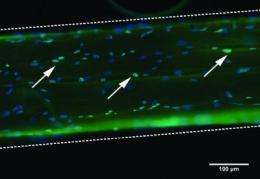
A research team at Worcester Polytechnic Institute (WPI) has demonstrated the feasibility of a novel technology that a surgeon could use to deliver stem cells to targeted areas of the body to repair diseased or damaged tissue, including cardiac muscle damaged by a heart attack. The technique involves bundling biopolymer microthreads into biological sutures and seeding the sutures with stem cells. The team has shown that the adult bone-marrow-derived stem cells will multiply while attached to the threads and retain their ability to differentiate and grow into other cell types.
The results are reported in the paper "Fibrin microthreads support mesenchymal stem cell growth while maintaining differentiation potential," which was published online, ahead of print, on Nov. 29, 2010, by the Journal of Biomedical Materials Research.
"We're pleased with the progress of this work," said Glenn Gaudette, assistant professor of biomedical engineering at WPI and lead author on the paper. "This technology is developing into a potentially powerful system for delivering therapeutic cells right to where they are needed, whether that's a damaged heart or other tissues."
Gaudette's lab is focused on cardiac function, exploring ways to heal damaged heart muscle and to develop cell-based methods to treat cardiac arrhythmias. Much of this work uses human mesenchymal stem cells (hMSCs), which come from the bone marrow and can grow into a range of other tissues in the body, including muscle, bone, and fat. Studies by Gaudette and others have shown that when hMSCs are delivered to damaged hearts, they moderately improve cardiac function. A major challenge in these studies, however, is getting sufficient numbers of the hMSCs to engraft into the damaged heart tissue. Prior methods of injecting the cells into the bloodstream, or directly into the heart muscle, have yielded low results, with 15 percent or less of the cells injected actually surviving and attaching to the heart muscle. Most of the hMSCs delivered by injection are washed away by the bloodstream.
To address the delivery problem, Gaudette teamed up with colleague George Pins, associate professor of biomedical engineering at WPI, who has developed the biopolymer microthread technology as a scaffold or a temporary structure to use in various applications of wound-healing and cellular therapy. The microthreads, which are about the thickness of a human hair, are made of fibrin, a protein that helps blood clot. The threads can be engineered to have different tensile strengths and to dissolve at different rates once implanted so they can be fine-tuned for a variety of uses. Pins is exploring the use of threads to produce replacement tendons and ligaments. Ray Page, assistant professor of biomedical engineering at WPI, leads a team using the microthreads as a platform for fibroblasts to induce skeletal muscle regeneration.
In the current study, Gaudette's team developed protocols to seed hMSCs on small bundles of the fibrin microthreads. Once the stem cells attached to the threads, they were cultured for five days and the data showed the cells began to multiply until the two-centimeter-long threads were virtually covered, with nearly 10,000 cells hMSCs on each ones. After the seeding and growing process, Gaudette's team attached the microthreads to a surgical needle and drew them through a collagen gel made to simulate human tissue. When the threads were drawn through the gel, the vast majority of the stem cells remained alive and attached to threads, suggesting they could be sutured into human tissue.
Gaudette's team also examined the hMSCs that had grown on the threads to see if they remained multipotent, meaning they retain the ability to grow into other types of cells. They removed the hMSCs from the threads and cultured them via established protocols known to prompt hMSCs to differentiate into fat cells and bones cells. In both cases, the cells taken from the microthreads began to differentiate along the pathways that lead to fat and bone tissue. "It appears that the cells we grew on the threads behave the same way we would expect mesenchymal stem cells would in vivo," Gaudette said. "So we believe these results are proof-of-principle—that we can now deliver these cells anywhere a surgeon can place a suture. That's exciting."
Gaudette's team is already at work on the next steps in this line of research, testing the stem cell–seeded microthreads in a rat model to see if they can engraft into heart tissue and improve cardiac function.
More information: http://onlinelibrary.wiley.com/doi/10.1002/jbm.a.32978/abstract


