German arrested in US spider smuggling sting
December 4, 2010

A tarantula

Enlarge

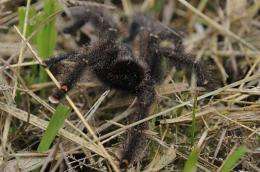
A tarantula makes its way through the grass on August 2010. US authorities have arrested a German man for smuggling hundreds of tarantulas and other spiders into the country, after mounting a sting operation to catch him, officials said Friday.

US authorities have arrested a German man for smuggling hundreds of tarantulas and other spiders into the country, after mounting a sting operation to catch him, officials said Friday.

Sven Koppler, 37, was arrested Thursday after arriving in Los Angeles to meet an associate, following a nine-month investigation dubbed "Operation Spiderman," prosecutors said.

The probe began in March when customs officers found 300 live tarantulas during a routine search of a package.

US Fish and Wildlife agents then intercepted a second package containing nearly 250 live tarantulas wrapped in colored plastic straws, as well as 22 Mexican red-kneed tarantulas.

In a bid to catch the organizers red-handed, agents ordered more tarantulas from Koppler, who sent a package containing 70 live ones and one dead spider.

Koppler, from Wachtberg in western Germany, allegedly earned some 300,000 dollars from sales to spider fanciers in dozens of countries, including nine in the United States.

According to an affidavit, a number of the packages included whose import was in breach of the Convention on International Trade in (CITES).

If found guilty he could face 20 years in jail and a fine of 250,000 dollars, according to prosecutors, ahead of the German man's expected initial appearance in court Friday.

"Sending light and small packages containing tarantulas is the best way to avoid customs detection around the world," Koppler allegedly claimed in email exchanges with an undercover US agent.

Koppler added that he could in theory smuggle tarantulas in his luggage when flying to Los Angeles, and would not be caught nine times out of 10. But he preferred not to take the risk.

"I am a foreigner and they will probably put me in prison. You have special laws. You have other laws that we don't have" in Germany, he said, according to the affidavit.

(c) 2010 AFP

3.7 /5 (3 votes)  

Rank 3.7 /5 (3 votes)
Relevant PhysicsForums posts

More news stories

It's in the genes: Research pinpoints how plants know when to flower

Scientists believe they've pinpointed the last crucial piece of the 80-year-old puzzle of how plants "know" when to flower.

Biology / Biotechnology

created 12 hours ago | popularity 4 / 5 (5) | comments 1 | with audio podcast

Researchers solve structure of human protein critical for silencing genes

In a study published in the journal Cell on May 24, Cold Spring Harbor Laboratory (CSHL) scientists describe the three-dimensional atomic structure of a human protein bound to a piece of RNA that "guides" the pr ...

Biology / Cell & Microbiology

created 13 hours ago | popularity 4.7 / 5 (6) | comments 0 | with audio podcast

Study uncovers secret to speedy burrowing by razor clams

(Phys.org) -- If you look at a razor burrowing clam sitting in a bucket, you’d never guess that it could burrow itself down into the soil, much less do it with any speed. Razor clams look like fat straws, ...

Biology / Plants & Animals

created 22 hours ago | popularity not rated yet | comments 3 | with audio podcast report

Copy of the genetic makeup travels in a protein suitcase

Scientists from the Institute for Physical and Theoretical Chemistry at the University of Bonn have succeeded for the first time in the real time filming of the transport of an important information carrier in biological ...

Biology / Cell & Microbiology

created 18 hours ago | popularity not rated yet | comments 0 | with audio podcast

'Transformer' protein makes different sized transport pods

These spheres may look almost identical, but subtle differences between them revealed a molecular version of the robots from Transformers. Each sphere is a vesicle, a pod that cells use to transport materials ...

Biology / Cell & Microbiology

created 19 hours ago | popularity not rated yet | comments 0


Of mice and mental models: Neuroscientific implications of risk-optimized behavior in the mouse

(Medical Xpress) -- Regardless of an organism’s biological complexity, every encephalized animal continuously makes under-informed behavioral choices that can have serious consequences. Despite its ubiquity, ...

Dragon arrives at space station in historic 1st (Update 2)

The privately bankrolled Dragon capsule made a historic arrival at the International Space Station on Friday, triumphantly captured by astronauts wielding a giant robot arm.

Landmark calculation clears the way to answering how matter is formed

(Phys.org) -- An international collaboration of scientists, including Thomas Blum, associate professor of physics, is reporting in landmark detail the decay process of a subatomic particle called a kaon – ...

High-speed method to aid search for solar energy storage catalysts

Eons ago, nature solved the problem of converting solar energy to fuels by inventing the process of photosynthesis.

MIT researchers devise new means to synchronize a group of robots (w/ Video)

(Phys.org) -- For several years, roboticists have been working out ways to get a group of robots to perform synchronized activities as demonstrated most often in dance routines. It’s not just about trying ...

Researchers demonstrate possible primitive mechanism of chemical info self-replication

(Phys.org) -- When scientists think about the replication of information in chemistry, they usually have in mind something akin to what happens in living organisms when DNA gets copied: a double-stranded molecule ...