Geminid meteor shower defies explanation
December 7, 2010 By Dr. Tony Phillips

Geminid meteor shower defies explanation

Enlarge

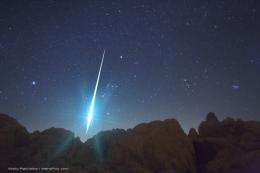
A Geminid fireball explodes over the Mojave Desert in 2009. Credit: Wally Pacholka / AstroPics.com / TWAN.

The Geminid meteor shower, which peaks this year on Dec. 13th and 14th, is the most intense meteor shower of the year. It lasts for days, is rich in fireballs, and can be seen from almost any point on Earth.

It's also astronomer Bill Cooke's favorite —but not for any of the reasons listed above.

"The Geminids are my favorite," he explains, "because they defy explanation."
Most meteor showers come from comets, which spew ample meteoroids for a night of 'shooting stars.' The Geminids are different. The parent is not a comet but a weird rocky object named 3200 Phaethon that sheds very little dusty debris—not nearly enough to explain the Geminids.

"Of all the debris streams passes through every year, the Geminids' is by far the most massive," says Cooke. "When we add up the amount of dust in the Geminid stream, it outweighs other streams by factors of 5 to 500."
Geminid meteor shower defies explanation
Enlarge

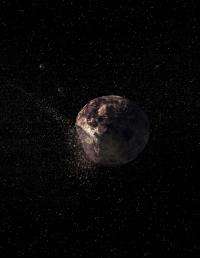
An artist's concept of an impact event on Pallas. Credit: B. E. Schmidt and S. C. Radcliffe of UCLA.

This makes the Geminids the 900-lb gorilla of meteor showers. Yet 3200 Phaethon is more of a 98-lb weakling.

3200 Phaethon was discovered in 1983 by NASA's IRAS satellite and promptly classified as an asteroid. What else could it be? It did not have a tail; its orbit intersected the main asteroid belt; and its colors strongly resembled that of other asteroids. Indeed, 3200 Phaethon resembles main belt asteroid Pallas so much, it might be a 5-kilometer chip off that 544 km block.

"If 3200 Phaethon broke apart from asteroid Pallas, as some researchers believe, then Geminid meteoroids might be debris from the breakup," speculates Cooke. "But that doesn't agree with other things we know."

Researchers have looked carefully at the orbits of Geminid meteoroids and concluded that they were ejected from 3200 Phaethon when Phaethon was close to the sun—not when it was out in the asteroid belt breaking up with Pallas. The eccentric orbit of 3200 Phaethon brings it well inside the orbit of Mercury every 1.4 years. The rocky body thus receives a regular blast of solar heating that might boil jets of dust into the Geminid stream.

Could this be the answer?

To test the hypothesis, researchers turned to NASA's twin STEREO spacecraft, which are designed to study solar activity. Coronagraphs onboard STEREO can detect sungrazing asteroids and comets, and in June 2009 they detected 3200 Phaethon only 15 solar diameters from the sun's surface.

What happened next surprised UCLA planetary scientists David Jewitt and Jing Li, who analyzed the data. "3200 Phaethon unexpectedly brightened by a factor of two," they wrote. "The most likely explanation is that Phaethon ejected dust, perhaps in response to a break-down of surface rocks (through thermal fracture and decomposition cracking of hydrated minerals) in the intense heat of the Sun."

Jewett and Li's "rock comet" hypothesis is compelling, but they point out a problem: The amount of dust 3200 Phaethon ejected during its 2009 sun-encounter added a mere 0.01% to the mass of the Geminid debris stream—not nearly enough to keep the stream replenished over time. Perhaps the rock comet was more active in the past …?

"We just don't know," says Cooke. "Every new thing we learn about the Geminids seems to deepen the mystery."

This month Earth will pass through the Geminid debris stream, producing as many as 120 meteors per hour over dark-sky sites. The best time to look is probably between local midnight and sunrise on Tuesday, Dec. 14th, when the Moon is low and the constellation Gemini is high overhead, spitting bright Geminids across a sparkling starry sky.

Bundle up, go outside, and savor the mystery.

More information: ACTIVITY IN GEMINID PARENT (3200) PHAETHON -- The Astronomical Journal, 140:1519–1527, 2010 November.

Provided by Science@NASA

4.9 /5 (9 votes)  

Filter


Move the slider to adjust rank threshold, so that you can hide some of the comments.


Display comments: newest first

zevkirsh
Dec 07, 2010

Rank: not rated yet
i drove with a rental car out of manhattan all the way to brookhaven state park deep in longisland, between the lights of nyc and boston. it was ok. still too much light out there---about 50-60 miles from the city.

i think i'm going to try for the delaware water gap this year.
gwrede
Dec 07, 2010

Rank: not rated yet
Please skip this post if you're busy right now.
The amount of dust 3200 Phaethon ejected during its 2009 sun-encounter added a mere 0.01% to the mass of the Geminid debris stream -— not nearly enough to keep the stream replenished over time.
Assuming Phaeton has "been around for quite some time", then we can safely surmise that the Debris Stream has a stable mass by now. Adding 0.01% should then compensate for the combined mass lost each 1.4 years, by Mercury, Venus, Earth and Mars.

If Phaeton lost mass at the furious rate that comets do, then a significant portion of the mass would be scattered outside the plane of the orbit and in directions not parallel to its motion. But Phaeton is rockier, hence a more conservative loss of materia from the orbit (and from the Geminids). More of it ends along its orbit, simply because of a much slower exit velocity.

All this should give a sharply defined high-peak regular meteor shower, with a combined mass much higher than that from comets.
Nyloc
Dec 08, 2010

Rank: not rated yet
Here's my theory ... Phaeton is really 2 large chunks of the same asteroid. Or to put it another way, one large asteroid that's fractured in two. As it gets too close to the sun, the two segments are pulled apart by tidal forces, then grind back together as their own gravity later becomes more prominent again. This repeated grinding action generates a continual source of debris, some of which brightens near the sun. Together with the remaining dark debris, this 'invisible' comet-like tail then travels in Phaeton's orbital path and we see it as the Geminid meteor shower. This theory not only explains how a constant source of undetected matter follows Phaeton's path but, fortuitously, alludes to the associated "Gemini twins" name of the shower.
Rank 4.9 /5 (9 votes)
Relevant PhysicsForums posts
  • revamping general concept and cosmological principle
    created16 hours ago
  • Transiting Exoplanet Light Curve
    createdMay 25, 2012
  • Math behind Theoretical Physics
    createdMay 24, 2012
  • Do we know whats at the center of galaxies yet?
    createdMay 23, 2012
  • Structure of the Milky Way?
    createdMay 20, 2012
  • What would it take to terraform Pluto and Charon?
    createdMay 19, 2012
  • More from Physics Forums - General Astronomy

More news stories

Dragon arrives at space station in historic 1st (Update 2)

The privately bankrolled Dragon capsule made a historic arrival at the International Space Station on Friday, triumphantly captured by astronauts wielding a giant robot arm.

Space & Earth / Space Exploration

created 19 hours ago | popularity 5 / 5 (8) | comments 11

Dragon makes history with space station docking

The private company SpaceX made history Friday with the docking of its Dragon capsule to the International Space Station, the most impressive feat yet in turning routine spaceflight over to the commercial ...

Space & Earth / Space Exploration

created 12 hours ago | popularity 4.8 / 5 (6) | comments 0

Aliens don't want to eat us, says former SETI director

Alien life probably isn’t interested in having us for dinner, enslaving us or laying eggs in our bellies, according to a recent statement by former SETI director Jill Tarter.

Space & Earth / Space Exploration

created 21 hours ago | popularity 4.8 / 5 (10) | comments 25

SKA super telescope to be built in Australia, South Africa (Update 2)

A long-running joust to host a radio telescope that would give mankind its farthest peek into the Universe ended on Friday with a Solomon-like judgement to split the site between Australia and South Africa.

Space & Earth / Astronomy

created 21 hours ago | popularity 5 / 5 (5) | comments 2

NASA sees Hurricane Bud threaten western Mexico's coast

NASA satellites are providing rainfall, temperature, pressure, visible and infrared data to forecasters as Hurricane Bud is expected to make a quick landfall in western Mexico this weekend before turning back ...

Space & Earth / Earth Sciences

created 15 hours ago | popularity not rated yet | comments 0


Of mice and mental models: Neuroscientific implications of risk-optimized behavior in the mouse

(Medical Xpress) -- Regardless of an organism’s biological complexity, every encephalized animal continuously makes under-informed behavioral choices that can have serious consequences. Despite its ubiquity, ...

Landmark calculation clears the way to answering how matter is formed

(Phys.org) -- An international collaboration of scientists, including Thomas Blum, associate professor of physics, is reporting in landmark detail the decay process of a subatomic particle called a kaon – ...

High-speed method to aid search for solar energy storage catalysts

Eons ago, nature solved the problem of converting solar energy to fuels by inventing the process of photosynthesis.

It's in the genes: Research pinpoints how plants know when to flower

Scientists believe they've pinpointed the last crucial piece of the 80-year-old puzzle of how plants "know" when to flower.

Researchers solve structure of human protein critical for silencing genes

In a study published in the journal Cell on May 24, Cold Spring Harbor Laboratory (CSHL) scientists describe the three-dimensional atomic structure of a human protein bound to a piece of RNA that "guides" the pr ...

MIT researchers devise new means to synchronize a group of robots (w/ Video)

(Phys.org) -- For several years, roboticists have been working out ways to get a group of robots to perform synchronized activities as demonstrated most often in dance routines. It’s not just about trying ...