Fourth planet foundin giant version of our solar system
December 8, 2010 by Anne M Stark

Fourth planet foundin giant version of our solar system

Enlarge

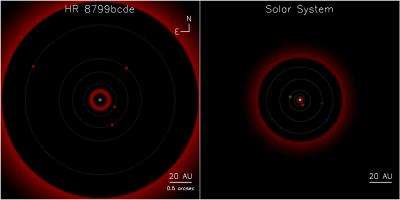
Schematic representation of the HR8799 system compared to our own solar system, showing the four HR8799 planets and Jupiter, Saturn, Uranus and Neptune in our solar system. Infrared observations made by space telescopes have shown that the HR8799 system has a massive, dusty asteroid belt, thousands of times more dense than our own, that is gravitationally shaped by HR8799e the same way Jupiter shapes our asteroid belt, and an outer belt of cometary debris similar to, but much more massive, than our own Kuiper belt. Credit: NRC-HIA, Christian Marois, and the W.M. Keck Observatory

(PhysOrg.com) -- Astronomers have discovered a fourth giant planet, joining three others that, in 2008, were the subject of the first-ever pictures of a planetary system orbiting another star other than our sun.

The solar system, discovered by a team from Lawrence Livermore National Laboratory and the National Research Council of Canada (NRC) Herzberg Institute of Astrophysics with collaborators at University of California, Los Angeles and Lowell Observatory, orbits around a dusty young star named HR8799, which is 129 light years away. All four are roughly five to seven times the mass of Jupiter.

Now, the same research team has discovered a fourth planet that is about seven times the mass of Jupiter. Using high-contrast, near infrared on the Keck II telescope in Hawaii, the astronomers imaged the fourth planet (dubbed HR8799e) in 2009 and confirmed its existence and orbit in 2010. The research appears in the Dec. 8 edition of the journal Nature.

"The images of this new inner planet in the system is the culmination of 10 years worth of innovation, making steady progress to optimize every observation and analysis step to allow the detection of planets located ever closer to their stars," said Christian Marois, a former LLNL postdoc now at NRC, and first author of the new paper.

If this newly discovered planet was located in orbit around our sun, it would lie between Saturn and Uranus. At about 30 million years old, this giant version of our solar system is young compared to our system, which is about 4.6 billion years old.

Though the system is very much like our own, it is much more extreme than our own -- the combined mass of the four giant planets may be 20 times higher, and the asteroid and comet belts are dense and turbulent. In fact, the massive planets' pull on each other gravitationally, and the system may be on the verge of falling apart.
Fourth planet foundin giant version of our solar system
Enlarge

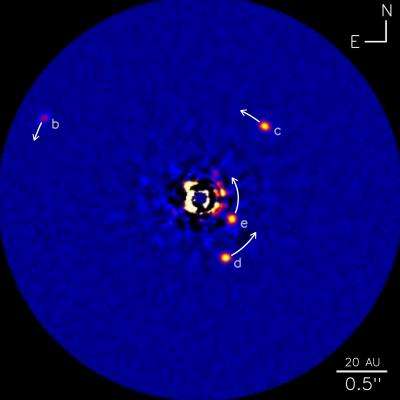
Infrared image of the HR8799 planetary system. This image shows planet HR8799b (five times the mass of Jupiter), planets HR8799c and HR8799d (seven times the mass of Jupiter) and the new planet HR8799e. The arrows show the predicted motion of the planets over the next 10 years. The scale bar at the bottom left shows 20 astronomical units (AU), about equal to the radius of the orbit of Uranus. Credit: NRC-HIA, Christian Marois, and the W.M. Keck Observatory

Lawrence Livermore scientists simulated millions of years of evolution of the system, and showed that to have survived this long, the three inner planets may have to orbit like clockwork, with the new planet going around the star exactly four times while the second planet finishes two orbits in the time it takes the outer planet to complete one. This behavior was first seen in the moons of Jupiter but has never before been seen on this scale.

Studying the planet's orbits also will help estimate their masses. "Our simulations show that if the objects were not planets, but supermassive "brown dwarfs," the system would have fallen apart already," said Quinn Konopacky, a postdoctoral researcher at LLNL's Institute of Geophysics and Planetary Physics and a key author of the paper. (Brown dwarfs are failed stars, too low in mass to sustain stable hydrogen fusion but larger than planets.)

"The implication is that we have truly found a unique new system of planets. We don't yet know if the system will last for billions of years, or fall apart in a few million more. As astronomers carefully follow the HR8799 planets during the coming decades, the question of just how stable their orbits are could become much clearer." (See the simulation showing thousands of years of evolution of the system if the planets are not in a clockwork orbit or are more massive brown dwarfs.)
Fourth planet foundin giant version of our solar system
Enlarge

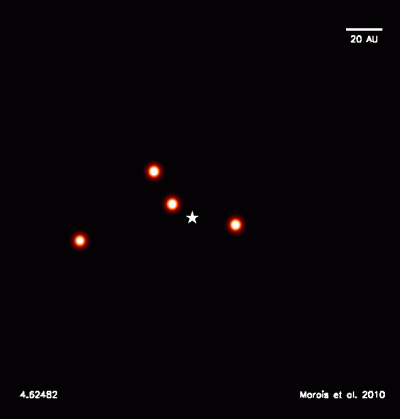
See the simulation showing thousands of years of evolution of the system if the planets are not in a clockwork orbit or are more massive brown dwarfs. (Click "Enlarge", the file is quite large, wait for it to download)

The origin of these four giant planets remains a puzzle. It neither follows the "core accretion" model, in which planets form gradually close to stars where the dust and gas are thick or the "disk fragmentation" model in which a turbulent planet-forming disk rapidly cools and collapses out at its edges. Bruce Macintosh, a senior scientist at LLNL and the principal investigator for the Keck Observatory program, said: "There's no simple model that can make all four planets at their current location. It's a challenge for our theoretical colleagues."

Previous observations had shown evidence for a dusty asteroid belt orbiting closer to the star -- the new planet's gravity helps account for the location of those asteroids, confining their orbits just like Jupiter does in our solar system. "Besides having four giant planets, both systems also contain two so-called "debris belts" composed of small rocky and/or icy objects along with lots of tiny dust particles, similar to the asteroid and Kuiper comet belts of our solar system," noted co-author Ben Zuckerman, a professor of physics and astronomy at UCLA. (See the movie.)

This video is not supported by your browser at this time.

"Images like these bring the exoplanet field into the era of characterization," said Travis Barman, a Lowell Observatory exoplanet theorist and co-author of the current paper. "Astronomers can directly examine the atmospheric properties of four orbiting another star that are all the same young age and that formed from the same building materials."

"I think there's a very high probability that there are more planets in the system that we can't detect yet," Macintosh said. "One of the things that distinguishes this system from most of the extrasolar planets that are already known is that HR8799 has its in the outer parts -- like our solar system does -- and so has 'room' for smaller terrestrial planets -- far beyond our current ability to see -- in the inner parts."

A team led by Macintosh is constructing the Gemini Planet Imager, a new system that will be up to 100 times more sensitive than current instruments and able to image planets similar to our own Jupiter around nearby stars.

"It's amazing how far we've come in a few years," Macintosh said. "In 2007, when we first saw the system, we could barely see two planets out past the equivalent of Pluto's orbit. Now we're imaging a fourth planet almost where Saturn is on our . It's another step to the ultimate goal -- still more than a decade away -- of a picture showing another planet like Earth."

Provided by Lawrence Livermore National Laboratory search and more info website

Filter


Move the slider to adjust rank threshold, so that you can hide some of the comments.


Display comments: newest first

DamienS
Dec 08, 2010

Rank: 5 / 5 (2)
This is great stuff. Can't wait for the Gemini Planet Imager to come online. More on this instrument here:
http://planetimag...iew.html
kevinrtrs
Dec 09, 2010

Rank: 1 / 5 (4)
Just how do they know that the system is only 30 million years old?

I'm so glad to see them trash the accretion theory model and ALSO are honest enough to admit they are floored when it comes to explaining just how these planets got to exist for so long in such a precarious balance. I suspect that the relatively young 30 million years has all to do with the fact that the balance could not be sustained for any long period of time BUT they are not going to acknowledge a creation story.
Interesting to note here is that I'm NOT saying that this particular system is only 6k years old!
MorituriMax
Dec 09, 2010

Rank: 5 / 5 (2)
kevinrtrs, why do we need to trash the accretion theory? Can't there be more than one way that solar systems form in a universe as large as ours, just as there are many different kinds of star or galaxy out there?
Rank 5 /5 (19 votes)
Relevant PhysicsForums posts
  • revamping general concept and cosmological principle
    created16 hours ago
  • Transiting Exoplanet Light Curve
    createdMay 25, 2012
  • Math behind Theoretical Physics
    createdMay 24, 2012
  • Do we know whats at the center of galaxies yet?
    createdMay 23, 2012
  • Structure of the Milky Way?
    createdMay 20, 2012
  • What would it take to terraform Pluto and Charon?
    createdMay 19, 2012
  • More from Physics Forums - General Astronomy

More news stories

Dragon arrives at space station in historic 1st (Update 2)

The privately bankrolled Dragon capsule made a historic arrival at the International Space Station on Friday, triumphantly captured by astronauts wielding a giant robot arm.

Space & Earth / Space Exploration

created 19 hours ago | popularity 5 / 5 (8) | comments 11

Dragon makes history with space station docking

The private company SpaceX made history Friday with the docking of its Dragon capsule to the International Space Station, the most impressive feat yet in turning routine spaceflight over to the commercial ...

Space & Earth / Space Exploration

created 12 hours ago | popularity 4.8 / 5 (6) | comments 0

Aliens don't want to eat us, says former SETI director

Alien life probably isn’t interested in having us for dinner, enslaving us or laying eggs in our bellies, according to a recent statement by former SETI director Jill Tarter.

Space & Earth / Space Exploration

created 21 hours ago | popularity 4.8 / 5 (10) | comments 25

SKA super telescope to be built in Australia, South Africa (Update 2)

A long-running joust to host a radio telescope that would give mankind its farthest peek into the Universe ended on Friday with a Solomon-like judgement to split the site between Australia and South Africa.

Space & Earth / Astronomy

created 21 hours ago | popularity 5 / 5 (5) | comments 2

NASA sees Hurricane Bud threaten western Mexico's coast

NASA satellites are providing rainfall, temperature, pressure, visible and infrared data to forecasters as Hurricane Bud is expected to make a quick landfall in western Mexico this weekend before turning back ...

Space & Earth / Earth Sciences

created 15 hours ago | popularity not rated yet | comments 0


Of mice and mental models: Neuroscientific implications of risk-optimized behavior in the mouse

(Medical Xpress) -- Regardless of an organism’s biological complexity, every encephalized animal continuously makes under-informed behavioral choices that can have serious consequences. Despite its ubiquity, ...

Landmark calculation clears the way to answering how matter is formed

(Phys.org) -- An international collaboration of scientists, including Thomas Blum, associate professor of physics, is reporting in landmark detail the decay process of a subatomic particle called a kaon – ...

High-speed method to aid search for solar energy storage catalysts

Eons ago, nature solved the problem of converting solar energy to fuels by inventing the process of photosynthesis.

It's in the genes: Research pinpoints how plants know when to flower

Scientists believe they've pinpointed the last crucial piece of the 80-year-old puzzle of how plants "know" when to flower.

Researchers solve structure of human protein critical for silencing genes

In a study published in the journal Cell on May 24, Cold Spring Harbor Laboratory (CSHL) scientists describe the three-dimensional atomic structure of a human protein bound to a piece of RNA that "guides" the pr ...

MIT researchers devise new means to synchronize a group of robots (w/ Video)

(Phys.org) -- For several years, roboticists have been working out ways to get a group of robots to perform synchronized activities as demonstrated most often in dance routines. It’s not just about trying ...