The fine art of producing chemicals and electricity: Researchers develop organometallic fuel cell
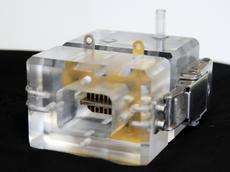
Together with Italian researchers, Swiss ETH Zurich Professor Hansjorg Grutzmacher and his group have developed a novel organometallic fuel cell. In addition to generating electrical energy, it also produces fine chemicals from renewable raw materials – with no waste.
Hansjörg Grützmacher holds a rectangular device made of transparent plastic, a little bigger than a fist. There is a rectangular recess on the front and two connections protrude from the top, one gold-coloured, the other silver. Two oversized-looking clamps hold together the two halves that make up the device. What you cannot tell from looking at this device is that it is the prototype of a novel so-called organometallic fuel cell, which Grützmacher’s group has developed in collaboration with an Italian research team.
”This fuel cell won’t solve the world’s energy problems,” says the ETH Zurich professor, “But I think the fact that it can be used to make fine chemicals from renewable raw materials with no waste products is an enormous step forward.” The new fuel cell’s achievement is really extraordinary. Firstly, it allows fine chemicals to be manufactured with no waste, while secondly it also generates CO2-free electrical energy. The aim of an environmentally friendly chemical industry must be to produce chemicals while creating less waste products or none at all, because according to Grützmacher, some of the these may be rather toxic and their disposal is therefore expensive and problematic.
The operating principle of the new organometallic fuel cell is entirely different to that of previous types. It is based on a special molecular complex containing the metal rhodium. This complex is molecularly embedded in the anode material. The anode of a fuel cell absorbs liberated charges and transfers them to the cathode, which releases them again. This process generates an electric current. The special feature of the organometallic fuel cell is that the molecular complex in the anode acts as a catalyst and its function can easily be optimised. The anode’s support material is carbon powder, to which the molecular complex is applied as a fine dispersion.
The active catalyst forms and changes progressively while the chemical reaction is taking place in the fuel cell. As a result, various catalysts specific to the individual reaction steps are formed from the metal complex. Thus an alcohol such as ethanol is converted into a corresponding aldehyde, and in the next step it is turned into the corresponding carboxylic acid, e.g. acetic acid. However, the use of this special catalyst enables not only alcohols but also sugars such as glucose to be transformed. The raw materials, i.e. the alcohols used, can be natural fermentation products or by-products from bio-diesel manufacture.
The chemists already knew that such reactions were possible. However, in these reactions Grützmacher and his colleagues needed to use a “sacrificial molecule”, which “absorbs” the hydrogen molecule formally created in the reaction. The inspirational idea to bypass this problem occurred to the ETH Zurich professor and his Italian colleague Claudio Bianchini while they were picking olives in Tuscany: an electrode, the anode, could be used instead of the sacrificial molecule to absorb the charges from the reaction and to convert them directly into electricity.
Hansjörg Grützmacher thinks the organometallic fuel cell has great potential. In an experimental context, for example, 1,2-propanediol, a dialcohol obtained from renewable raw materials, could be converted very selectively into lactic acid. Lactic acid is produced industrially on a large scale for use in the manufacture of biodegradable polymers. The only problem is that for every ton of lactic acid, most processes create approximately one ton of calcium sulphate, which requires expensive disposal. In contrast, the novel fuel cell leaves no residue when it converts the raw material.
However, Grützmacher also envisages other applications. The organometallic fuel cell could be miniaturised to power heart pacemakers. It could also contribute to reducing the metal demand of catalysts. Their construction often uses rare earths or noble metals such as platinum. The latter is not only expensive but also scarce. “If we succeed in constructing a catalyst molecularly, that would considerably improve the material efficiency,” stresses the ETH Zurich chemist. He says that the aim is to develop a fuel cell whose electrodes manage without metals, or at least use only abundant metals. Candidates include manganese, iron or cobalt, for example. Up to now the researchers have used rhodium in the organometallic fuel cells. Although this metal is often used in present-day catalysts, its availability is limited.
However, the organometallic fuel cell also has its disadvantages. The chemical reactions proceed more slowly than in solution because, due to a fuel cell’s construction, they only take place on surfaces. This is why the manufacture of larger quantities of fine chemicals will take longer than manufacturing in the conventional way. In addition, for the time being the system only functions with aqueous solutions. “However, the use of non-aqueous solvents is also conceivable, but we are only at the very beginning, and in the near future we really must first of all understand how a change in the process parameters affects the overall efficiency,” says Grützmacher.
More information: A Biologically Inspired Organometallic Fuel Cell (OMFC) that Converts Renewable Alcohols into Energy and Chemicals, S. P. Annen, V. Bambagioni, M. Bevilacqua, J. Filippi, A. Marchionni, W. Oberhauser, H. Schönberg, F. Vizza, C. Bianchini, H. Grützmacher, Angew. Chem. 2010, 7387–7391; Angew. Chem. Int. Ed. Engl. 2010, 7229–7233.
Provided by ETH Zurich


