Fighter pilots' brains are 'more sensitive'
December 14, 2010

Fighter pilots' brains are 'more sensitive'

Enlarge

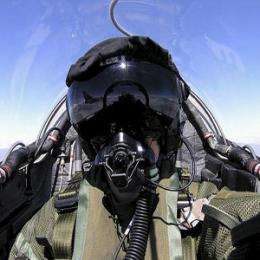
(PhysOrg.com) -- Cognitive tests and MRI scans have shown significant differences in the brains of fighter pilots when compared to a control group, according to a new study led by scientists from UCL.

The study, published today in the , compares the of 11 front-line RAF (Royal Air Force) Tornado fighter pilots to a control group of a similar IQ with no previous experience of piloting aircraft. All the participants completed two 'cognitive control' tasks which were used to investigate rapid decision making. (DTI), a type of MRI brain scan, was then used to examine the structure of white matter connections between associated with .

The researchers found that fighter pilots have superior cognitive control, showing significantly greater accuracy on one of the cognitive tasks, despite being more sensitive to irrelevant, distracting information. The revealed differences between pilots and controls in the microstructure of white matter in the right hemisphere of the brain.

Senior author Professor Masud Husain, UCL Institute of Neurology and UCL Institute of , said: "We were interested in the pilots because they're often operating at the limits of human cognitive capability – they are an expert group making precision choices at high speed.

"Our findings show that optimal cognitive control may surprisingly be mediated by enhanced responses to both relevant and irrelevant stimuli, and that such control is accompanied by structural alterations in the brain. This has implications beyond simple distinctions between fighter pilots and the rest of us because it suggests expertise in certain aspects of cognition are associated with changes in the connections between brain areas. So, it's not just that the relevant areas of the brain are larger – but that the connections between key areas are different. Whether people are born with these differences or develop them is currently not known."

The study tasks were designed to assess the influence of distracting information and the ability to update a response plan in the presence of conflicting visual information. In the first task, participants had to press a right or left arrow key in response to the direction of an arrow on a screen in front of them, which was flanked by other distracting arrows pointing in different directions. In the second task, they had to respond as quickly as possible to a 'go' signal, unless they were instructed to change their plan before they had even made a response.

The results of the first task showed that the expert pilots were more accurate than age-matched volunteers, with no significant difference in reaction time – so, the pilots were able to perform the task at the same speed but with significantly higher accuracy. In the second task, there was no significant difference between the pilots and volunteers, which the authors say suggests that expertise in cognitive control may be highly specialised, highly particular to specific tasks and not simply associated with overall enhanced performance.

These findings suggest that in humans some types of expert cognitive control may be mediated by enhanced response gain to both relevant and irrelevant stimuli, and is accompanied by structural alterations in the of the brain.

More information: The paper, 'Expert cognitive control and individual differences associated with frontal and parietal white matter microstructure' by Roberts RE, Anderson E & Husain M is published in the Journal of Neuroscience on Wednesday 15th December 2010.

Provided by University College London search and more info website

3.8 /5 (9 votes)  

Filter


Move the slider to adjust rank threshold, so that you can hide some of the comments.


Display comments: newest first

NotAsleep
Dec 14, 2010

Rank: 5 / 5 (1)
Pilots are sensitive? That explains why they get all upset when you call their flight suits "marble bags"
googleplex
Dec 14, 2010

Rank: 5 / 5 (5)
Sounds like professional video gamers would score higher too as they are conditioned to use a similar visual test. Pilots use a HUD which effectively is the same thing, albeit with more physiological distractions i.e. g-forces.
Quantum_Conundrum
Dec 14, 2010

Rank: 4 / 5 (3)
Sounds like professional video gamers would score higher too as they are conditioned to use a similar visual test. Pilots use a HUD which effectively is the same thing, albeit with more physiological distractions i.e. g-forces.


I was just about to say this with regards to the top ranked Starcraft and Starcraft 2 players.

The Koreans would probably be off the chart, maybe even higher than pilots.
scenage
Dec 14, 2010

Rank: 5 / 5 (3)
Sounds like professional video gamers would score higher too as they are conditioned to use a similar visual test. Pilots use a HUD which effectively is the same thing, albeit with more physiological distractions i.e. g-forces.


I was just about to say this with regards to the top ranked Starcraft and Starcraft 2 players.

The Koreans would probably be off the chart, maybe even higher than pilots.


Not just gamers of RTS gamers but particularly FPS gamers. A decade ago, I made the national team for Counterstrike and they recorded all our reaction times with simple interactive tests. Safe to say, our reactions were much faster then most people and was equivalent to elite athletes (clicking on objects within 0.3 seconds that they appear). It'd be interesting to measure pilots against atheletes and gamers.
mosahlah
Dec 15, 2010

Rank: 1 / 5 (1)
my kids are really good at xbox.
CreepyD
Dec 15, 2010

Rank: not rated yet
These fighter pilots are probably getting 'in the zone' much easier, as do gamers.
I can honestly say when playing FPS games and reaching 'the zone' time felt like it slowed down, opponents moved slower, it became easy as pie to hit people.
That state of mind is simply awesome.
Raveon
Dec 15, 2010

Rank: 5 / 5 (1)
How hard is it to figure out that we are all born with essentially the same equipment and that the choices we make in life continually rewire our brains? That's what makes some people smart and some people otherwise. Stupidity is a choice, a lifestyle. People who become the best at something have single minded focus, it rewires the brain for that single thing. That's what Einstein did. Read about him and you'll find that he focused all his thoughts and energy on math and developing his theories for years. He even told his prospective wife not to expect any social interaction.

It isn't surprising that fighter pilots are different. They probably started their rewiring long before they became a pilot and I'm sure it continued afterward too. This rewiring is not something that only the young can do. We all do it to some extent and most of us are capable of focused rewiring, all it takes is the intent and will. Anyone can become smarter, if they make the right choices
NotAsleep
Dec 15, 2010

Rank: not rated yet
Pilots must pass lots of reaction tests and stress tests before they get their wings, fighter pilots more so than heavy pilots. It would be safe to say that most people with less-than-excellent natural skills get weeded out early on.

Gamers are definitely in luck! The US Air Force sees them as valuable assets to fly UAVs. Right now, they're using regular pilots to fly most of them but the goal is to use non-pilot "gamers" that aren't already conditioned to flying under human constraints (esp in regards to G-forces)
damnfuct
Dec 15, 2010

Rank: not rated yet
No matter how hard you try, you can't train yourself to be taller. Likewise, you can't will yourself into being a person of the opposite sex. That being said, it's not surprising to find physiological differences in the elite members of any group; these differences give them an edge at their specialization. While it's true that anyone can become more intelligent or able, it's only a relative term; they become closer to their upper limit. This is not saying that some people are worthless; for the most part, everyone has a specific set of skills and traits that are suited for a certain task. Note that this doesn't imply that some people are inherently worthless. Not everyone is equal and it's horribly apparent. This "rewiring" talk is a load of crap. This is like saying slow running is a life choice, and that anyone rewire your muscles to beat a 9.58s 100m dash; ridiculous. The key is finding what suits your skill set, and then using your particular advantages to become one of the elite.
Raveon
Dec 15, 2010

Rank: not rated yet
Load of crap? Show me a real qualitative difference in the brain structures of genius and average. We all have the same neurons, it's how they are connected that makes us different and those connections change throughout our lives by our intellectual choices.

It isn't the same as slow running (you have the all too common bad analogy gene), there is a different physical structure to all our bodies, our brains are essentially all the same. And I can tell what choices you have made.

So in answer to my first question, it's very hard for some people to figure out because of the choices THEY have made.
Quantum_Conundrum
Dec 18, 2010

Rank: not rated yet
Load of crap? Show me a real qualitative difference in the brain structures of genius and average.


I can show you two that I know of immediately.

Einstein's brain was verifiably well above average size.

Then there's Daniel Tammet. Google if you can't get link to work.

http://www.youtub...-1YLGAS0

If I remember correctly, MRI scans have shown that he has "extra" brain structures on the left and right sides of his brain, which are believed to help facilitate his ability to perform memorization, mathematics, and logical operations.

Anyway, there's your two examples.
suntraider
Dec 19, 2010

Rank: not rated yet
...First person video gaming where you have the same condition without the g-force. Then you have depth perception and the ability easily see magic eye stereograms with g-force which relates to perceptions of out of body.

...something more happening for pilots and magic eye viewers. As well as people driving in the highway with tasking more than the use of the vehicle. For example, use of the timing of the windshield wiper fluid to the outside of the wiper to cause distraction. The flashing of lights on the other side of the highway. Or people in front pretending its a drive-in cinema feature.
Rank 3.8 /5 (9 votes)
Relevant PhysicsForums posts
  • A question about drug tolerance
    createdMay 23, 2012
  • Poor nutrition leading to overeating?
    createdMay 23, 2012
  • Math and dyslexia?
    createdMay 21, 2012
  • portable metabolism meter?
    createdMay 21, 2012
  • Rare medical conditions on 20/20 tonight
    createdMay 18, 2012
  • "Good" Cholesterol in Doubt
    createdMay 17, 2012
  • More from Physics Forums - Medical Sciences

More news stories

Of mice and mental models: Neuroscientific implications of risk-optimized behavior in the mouse

(Medical Xpress) -- Regardless of an organism’s biological complexity, every encephalized animal continuously makes under-informed behavioral choices that can have serious consequences. Despite its ubiquity, ...

Medicine & Health / Neuroscience

created 20 hours ago | popularity not rated yet | comments 0 | with audio podcast feature

Skp2 activates cancer-promoting, glucose-processing Akt

HER2 and its epidermal growth factor receptor cousins mobilize a specialized protein to activate a major player in cancer development and sugar metabolism, scientists report in the May 25 issue of Cell.

Medicine & Health / Cancer

created 14 hours ago | popularity not rated yet | comments 0 | with audio podcast

Tongue analysis software uses ancient Chinese medicine to warn of disease

For 5,000 years, the Chinese have used a system of medicine based on the flow and balance of positive and negative energies in the body. In this system, the appearance of the tongue is one of the measures used to classify ...

Medicine & Health / Other

created 12 hours ago | popularity 1 / 5 (1) | comments 0 | with audio podcast

Cancer may require simpler genetic mutations than previously thought

Chromosomal deletions in DNA often involve just one of two gene copies inherited from either parent. But scientists haven't known how a deletion in one gene from one parent, called a "hemizygous" deletion, can contribute ...

Medicine & Health / Cancer

created 18 hours ago | popularity not rated yet | comments 0 | with audio podcast

First study to suggest that the immune system may protect against Alzheimer's changes in humans

Recent work in mice suggested that the immune system is involved in removing beta-amyloid, the main Alzheimer's-causing substance in the brain. Researchers have now shown for the first time that this may apply in humans.

Medicine & Health / Alzheimer's disease & dementia

created 19 hours ago | popularity 5 / 5 (3) | comments 0 | with audio podcast


Dragon arrives at space station in historic 1st (Update 2)

The privately bankrolled Dragon capsule made a historic arrival at the International Space Station on Friday, triumphantly captured by astronauts wielding a giant robot arm.

Landmark calculation clears the way to answering how matter is formed

(Phys.org) -- An international collaboration of scientists, including Thomas Blum, associate professor of physics, is reporting in landmark detail the decay process of a subatomic particle called a kaon – ...

High-speed method to aid search for solar energy storage catalysts

Eons ago, nature solved the problem of converting solar energy to fuels by inventing the process of photosynthesis.

It's in the genes: Research pinpoints how plants know when to flower

Scientists believe they've pinpointed the last crucial piece of the 80-year-old puzzle of how plants "know" when to flower.

Researchers solve structure of human protein critical for silencing genes

In a study published in the journal Cell on May 24, Cold Spring Harbor Laboratory (CSHL) scientists describe the three-dimensional atomic structure of a human protein bound to a piece of RNA that "guides" the pr ...

MIT researchers devise new means to synchronize a group of robots (w/ Video)

(Phys.org) -- For several years, roboticists have been working out ways to get a group of robots to perform synchronized activities as demonstrated most often in dance routines. It’s not just about trying ...