Saving lives with fast sepsis testing
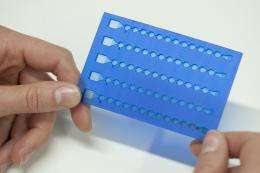
The magnetic nanoparticles transport the pathogen DNA into the detection chambers (on the right) on this plastic card. This is a prototype of the card for the fast sepsis test. Credit: Fraunhofer IZI
Blood poisoning can be fatal. If you suffer from sepsis, you used to have to wait as much as 48 hours for laboratory findings. A new diagnostic platform as big as a credit card will now supply the analysis after as little as an hour. This system is based on nanoparticles that are automatically guided by magnetic forces.
Although it is the third most frequent cause of death in Germany, blood poisoning is frequently underestimated. In this country, 60,000 persons die every year from some form of sepsis, almost as many as from heart attacks. The Sepsis Nexus of Expertise states that patients arriving at the intensive care ward with blood poisoning only have a 50% chance of surviving. One of the reasons for the high mortality rate is the fact that patients are not correctly treated due to late diagnosis. The doctor and the patient used to have to wait as much as 48 hours for the laboratory analysis.
In future, a new mobile diagnostics platform will be guaranteeing fast and low-cost infection diagnostics even while the patient is being transported to the hospital. Its called MinoLab and it consists of a plastic card the size of a credit card that is inserted in an analysis unit that is smaller than a notebook. This system provides findings in less than one hour to enable the doctor to prescribe the life-saving therapy. This is based on magnetic particles that dock onto the cells to be studied in a blood sample and run through the system fully automatically with magnetic force. At the end of the process, the diagnosis is made with magnetic sensors. MinoLab is presently being developed in a project of the German Federal Ministry of Education and Research by the Fraunhofer Institute for Cell Therapy and Immunology (IZI) in Leipzig, Germany in collaboration with Magna Diagnostics, a company hived off from the Fraunhofer Society. Other project partners are the Fraunhofer Institute for Reliability and Microintegration (IZM) in Berlin as well as the companies Siemens, Dice, microfluidic Chip Shop and the Austrian Institute of Technology.
Dr. Dirk Kuhlmeier, a scientist at the Fraunhofer Institute for Cell Therapy and Immunology, explains how all that works: After taking a sample of blood, magnetic nanoparticles bind themselves to the target cells in the blood sample through specific catcher molecules. We then use a simple magnet to transfer the particles onto the plastic card along with the pathogens and move them through various miniaturized reaction chambers which is where the polymerase chain reaction takes place. This is a method for copying even the smallest DNA sequences of pathogens millions of times. After it is copied, the nanoparticles transport the pathogen DNA into the detection chamber where a new type of magnetoresistive biochip can identify pathogens and antibiotics resistances. Our researcher goes on: All reactions starting from sample preparation through isolating the target molecules right down to documentation are carried out without any contact and fully automatically. This means that routine operation is made much simpler for the laboratory technician and it reduces the risk of contamination from bacteria introduced from the environment that set off false alarms. But there is another benefit, as Dr. Kuhlmeier explains: We not only save time with the combination of magnetic nanoparticles in a new type of micro-fluid. Miniaturization means we also save expensive apparatuses.
The experts have already been successful at using magnetic nanoparticles to isolate and document the sepsis pathogens, although Kuhlmeier says, it will be another two years or so until we are able to produce a prototype of the diagnostic platform. Platform technology is not only suited for sepsis tests. It will be able to back up doctors in hospitals and private practices answering a wide range of molecular biological issues ranging from genetic predisposition right down to cancer diagnostics.
Provided by
Fraunhofer-Gesellschaft
-
From lemons to lemonade: Reaction uses carbon dioxide to make carbon-based semiconductor,
28 comments
-
Thioridazine kills cancer stem cells in human while avoiding toxic side-effects of conventional cancer treatments,
3 comments
-
SpaceX private rocket blasts off for space station (Update),
41 comments
-
Climate scientists say they have solved riddle of rising sea,
30 comments
-
Scotland passes turbine test to harness tidal power,
40 comments
-
Why Do Dogs do Strange things...
14 hours ago
-
What does exophillic and endophillic mean in terms of mosquito and their control?
May 24, 2012
-
Semen stains glows under black lights (uv light)?
May 23, 2012
-
Question on Human Chromosome 2
May 23, 2012
-
How important is composition of TBST in diluting antibodies and Western Blotting?
May 22, 2012
-
Does the medulla monitor blood pH
May 20, 2012
- More from Physics Forums - Biology
More news stories
Synthetic nano-waste does not disappear
(Phys.org) -- Tiny particles of cerium oxide do not burn or change in the heat of a waste incineration plant. They remain intact on combustion residues or in the incineration system, as a new study by Swiss ...
Nanotechnology / Bio & Medicine
21 hours ago |
5 / 5 (1) |
1
|
Nanotechnology for solar energy conversion systems
EU researchers extensively characterised the self-organisation of nanotubes and developed novel compositions particularly appropriate to solar energy conversion applications.
Nanotechnology / Nanomaterials
19 hours ago |
not rated yet |
0
Nano-structured polymer-based materials from scrap
EU researchers developed polymer blends and processing techniques facilitating recovery of scrap from industrial processes. Advances in this area have the potential to decrease costs and waste while protecting ...
Nanotechnology / Nanomaterials
20 hours ago |
not rated yet |
0
Dopant gives graphene solar cells highest efficiency yet
(Phys.org) -- By taking advantage of graphenes favorable electrical and optical properties, and then adding an organic dopant, researchers have achieved the highest power conversion efficiency yet for ...
Nanomedicine: Quantum dots appear safe in pioneering study on primates
A pioneering study to gauge the toxicity of quantum dots in primates has found the tiny crystals to be safe over a one-year period, a hopeful outcome for doctors and scientists seeking new ways to battle diseases ...
Nanotechnology / Bio & Medicine
May 20, 2012 |
4.3 / 5 (3) |
8
|
Of mice and mental models: Neuroscientific implications of risk-optimized behavior in the mouse
(Medical Xpress) -- Regardless of an organism’s biological complexity, every encephalized animal continuously makes under-informed behavioral choices that can have serious consequences. Despite its ubiquity, ...
Dragon arrives at space station in historic 1st (Update 2)
The privately bankrolled Dragon capsule made a historic arrival at the International Space Station on Friday, triumphantly captured by astronauts wielding a giant robot arm.
Landmark calculation clears the way to answering how matter is formed
(Phys.org) -- An international collaboration of scientists, including Thomas Blum, associate professor of physics, is reporting in landmark detail the decay process of a subatomic particle called a kaon ...
High-speed method to aid search for solar energy storage catalysts
Eons ago, nature solved the problem of converting solar energy to fuels by inventing the process of photosynthesis.
It's in the genes: Research pinpoints how plants know when to flower
Scientists believe they've pinpointed the last crucial piece of the 80-year-old puzzle of how plants "know" when to flower.
Researchers solve structure of human protein critical for silencing genes
In a study published in the journal Cell on May 24, Cold Spring Harbor Laboratory (CSHL) scientists describe the three-dimensional atomic structure of a human protein bound to a piece of RNA that "guides" the pr ...