Early meteorological winter in the U.S. Midwest captured by NASA
Dec 09, 2010 By Rob Gutro
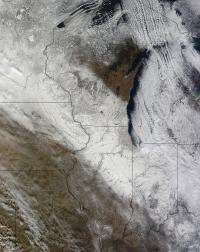
The MODIS instrument on NASA's Terra satellite captured this image of snow on December 7, 2010 at 17:05 UTC (12:05 EST). Snow appears on the ground in eastern Minnesota and Iowa, southwestern Wisconsin, northern Illinois, much of Indiana, northern Kentucky and western Ohio. The white area over Lake Michigan and southeast into northern Indiana and Ohio are clouds. Credit: NASA Goddard MODIS Rapid Response Team

NASA's Terra satellite captures daily visible and infrared images around the Earth and took a daytime image of a blanket of snow in the Upper Midwest this week. Even though astronomical winter is less than two weeks away, the central and eastern U.S. are already experiencing meteorological winter.

Meteorological winter is basically an identification of the winter season based on "sensible weather patterns" for record keeping purposes. That means "meteorological winter" happens whenever snow and ice occur, even before astronomical winter arrives on December 21, 2010. Astronomical winter is based on the position of the Earth in its orbit around the sun.

The residents of the upper Midwest are already feeling the effects of winter this week, with high temperatures in the 20s and 30s, and wind chills in the single numbers (Fahrenheit) or colder.

Today's satellite image of snow on the ground in the upper Midwest is proof of an early meteorological winter. It was captured by the or MODIS instrument on December 7, 2010 at 17:05 UTC (12:05 EST). MODIS is an instrument that flies aboard NASA's Aqua and Terra satellites.

On Saturday, December 4, a low pressure area moved through the Tennessee Valley and generated snowfall from eastern Iowa and Minnesota east through Wisconsin, northern Illinois, Indiana and through the Ohio Valley.

The MODIS image shows snow on the ground in eastern Minnesota and Iowa, southwestern Wisconsin, northern Illinois, much of Indiana, northern Kentucky and western Ohio. The extends farther east, but that area was out of path of the as it captured this image. What it does show, though, is that winter conditions have arrived before astronomical winter did. Residents in these areas of the U.S. hope it leaves early, too.

Explore further: Professor argues Earth's mantle affects long-term sea-level rise estimates

add to favorites email to friend print save as pdf

Related Stories

Use satellites to know your snow

Nov 05, 2010

(PhysOrg.com) -- As winter approaches, northern dwellers will get assistance from space to help them face the harsh weather. Satellite information on snow cover is now available through ESA's GlobSnow project ...

Image: Smoke over Western Russia

Aug 03, 2010

(PhysOrg.com) -- Hundreds of fires burned across western Russia on August 2, 2010, but it is the smoke that conveys the magnitude of the disaster in this true-color image from the Moderate Resolution Imaging ...

Recommended for you

Russia evacuates drifting Arctic research station

20 hours ago

Russia has ordered the urgent evacuation of the 16-strong crew of a drifting Arctic research station after ice floe that hosts the floating laboratory began to disintegrate, officials said Thursday.

Bacterium from Canadian High Arctic and life on Mars

22 hours ago

(Phys.org) —The temperature in the permafrost on Ellesmere Island in the Canadian high Arctic is nearly as cold as that of the surface of Mars. So the recent discovery by a McGill University led team of ...

User comments : 0

More news stories

A hidden population of exotic neutron stars

(Phys.org) —Magnetars – the dense remains of dead stars that erupt sporadically with bursts of high-energy radiation - are some of the most extreme objects known in the Universe. A major campaign using ...

Century-old science helps confirm global warming

(Phys.org) —Ocean measurements taken more than 135 years ago during the scientific expedition of HMS Challenger have provided further confirmation of human-produced global warming over the past century.

Hubble reveals the ring nebula's true shape

(Phys.org) —The Ring Nebula's distinctive shape makes it a popular illustration for astronomy books. But new observations by NASA's Hubble Space Telescope of the glowing gas shroud around an old, dying, ...

The long road to the 2000-watt society

The vision of a society in which each inhabitant of the earth manages to consume only 2000 watts has already been around for 15 years. During this time, there has been a steady increase in environmental awareness ...