Early Christmas treat: 2010's total lunar eclipse
December 19, 2010 By ALICIA CHANG , AP Science Writer
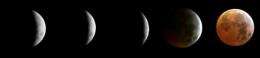
This five picture combination shows various stages of a total lunar eclipse over Baghdad, Iraq, between 1:30-2:30am local time on March 4, 2007. Weather permitting, skygazers in North and Central America and a tiny sliver of South America will boast the best seats to this year's only total eclipse of the moon, scheduled for Dec. 20, 2010. (AP Photo/Marko Drobnjakovic)
(AP) -- 'Twill be nights before Christmas and high overhead, the moon will turn brown or maybe deep red. The Earth and the sun with celestial scripts will conspire to make a lunar eclipse.
Weather permitting, sky gazers in North and Central America and a tiny sliver of South America will boast the best seats to this year's only total eclipse of the moon.
The eclipse will happen Monday night on the West Coast and during the wee hours Tuesday on the East Coast. Western Europe will only see the start of the spectacle while western Asia will catch the tail end.
The moon is normally illuminated by the sun. During a total lunar eclipse, the full moon passes through the shadow created by the Earth blocking the sun's light. Some indirect sunlight will still manage to pierce through and give the moon a ghostly color.
Since the eclipse coincides with winter solstice, the moon will appear high in the sky - a boon for skywatchers. With recent volcanic eruptions around the globe dumping tons of dust into the atmosphere, scientists predict the moon may appear darker than usual during the eclipse, glowing an eerie red or brown instead of the usual orange-yellow tinge.
North and Central America should be able to view the entire show, which is expected to last 3 1/2 hours if skies are clear. Total eclipse begins at 11:41 p.m. PST Monday or 2:41 a.m. EST Tuesday. The totality phase - when the moon is entirely inside Earth's shadow - will last a little over an hour.
"It's perfectly placed so that all of North America can see it," said eclipse expert Fred Espenak of NASA's Goddard Space Flight Center.
The Griffith Observatory perched on the south slope of Mount Hollywood in Los Angeles will host an eclipse party Monday evening although rain is forecast. Telescopes will be set out on the lawn for the public and astronomers will give free lectures on the eclipse's various stages.
If clouds or rain set in, the observatory plans to stream live video of the eclipse from the Internet. Among the various outfits that will show the eclipse live is NASA, which has a camera mounted at its Marshall Space Flight Center in Huntsville, Ala.
"Our event will go on rain or shine," said Griffith Observatory astronomer Anthony Cook.
Unlike solar eclipses which require protective glasses, lunar eclipses are safe to watch with the naked eye.
U.S. Naval Observatory spokesman Geoff Chester finds solar eclipses more exciting than the lunar counterpart. But solar eclipses tend to occur in remote parts of the world while lunar eclipses are usually visible from an entire hemisphere.
"If you get skunked by bad weather, all you have to do is wait a few years for the next one to come around," Chester said.
There are two total lunar eclipses in 2011 - in June and December. North America will miss the June show and witness only a part of next December eclipse.
More information: NASA eclipse page: http://eclipse.gsfc.nasa.gov/eclipse.html
Griffith Observatory: http://www.griffithobservatory.org
©2010 The Associated Press. All rights reserved. This material may not be published, broadcast, rewritten or redistributed.
-
From lemons to lemonade: Reaction uses carbon dioxide to make carbon-based semiconductor,
28 comments
-
Thioridazine kills cancer stem cells in human while avoiding toxic side-effects of conventional cancer treatments,
3 comments
-
SpaceX private rocket blasts off for space station (Update),
41 comments
-
Climate scientists say they have solved riddle of rising sea,
30 comments
-
Scotland passes turbine test to harness tidal power,
40 comments
-
revamping general concept and cosmological principle
14 hours ago
-
Transiting Exoplanet Light Curve
May 25, 2012
-
Math behind Theoretical Physics
May 24, 2012
-
Do we know whats at the center of galaxies yet?
May 23, 2012
-
Structure of the Milky Way?
May 20, 2012
-
What would it take to terraform Pluto and Charon?
May 19, 2012
- More from Physics Forums - General Astronomy
More news stories
Dragon arrives at space station in historic 1st (Update 2)
The privately bankrolled Dragon capsule made a historic arrival at the International Space Station on Friday, triumphantly captured by astronauts wielding a giant robot arm.
Space & Earth / Space Exploration
17 hours ago |
5 / 5 (8) |
11
Dragon makes history with space station docking
The private company SpaceX made history Friday with the docking of its Dragon capsule to the International Space Station, the most impressive feat yet in turning routine spaceflight over to the commercial ...
Space & Earth / Space Exploration
10 hours ago |
4.8 / 5 (6) |
0
Aliens don't want to eat us, says former SETI director
Alien life probably isnt interested in having us for dinner, enslaving us or laying eggs in our bellies, according to a recent statement by former SETI director Jill Tarter.
Space & Earth / Space Exploration
18 hours ago |
4.8 / 5 (10) |
24
SKA super telescope to be built in Australia, South Africa (Update 2)
A long-running joust to host a radio telescope that would give mankind its farthest peek into the Universe ended on Friday with a Solomon-like judgement to split the site between Australia and South Africa.
18 hours ago |
5 / 5 (5) |
2
NASA sees Hurricane Bud threaten western Mexico's coast
NASA satellites are providing rainfall, temperature, pressure, visible and infrared data to forecasters as Hurricane Bud is expected to make a quick landfall in western Mexico this weekend before turning back ...
Space & Earth / Earth Sciences
12 hours ago |
not rated yet |
0
Of mice and mental models: Neuroscientific implications of risk-optimized behavior in the mouse
(Medical Xpress) -- Regardless of an organism’s biological complexity, every encephalized animal continuously makes under-informed behavioral choices that can have serious consequences. Despite its ubiquity, ...
Landmark calculation clears the way to answering how matter is formed
(Phys.org) -- An international collaboration of scientists, including Thomas Blum, associate professor of physics, is reporting in landmark detail the decay process of a subatomic particle called a kaon ...
High-speed method to aid search for solar energy storage catalysts
Eons ago, nature solved the problem of converting solar energy to fuels by inventing the process of photosynthesis.
It's in the genes: Research pinpoints how plants know when to flower
Scientists believe they've pinpointed the last crucial piece of the 80-year-old puzzle of how plants "know" when to flower.
Researchers solve structure of human protein critical for silencing genes
In a study published in the journal Cell on May 24, Cold Spring Harbor Laboratory (CSHL) scientists describe the three-dimensional atomic structure of a human protein bound to a piece of RNA that "guides" the pr ...
MIT researchers devise new means to synchronize a group of robots (w/ Video)
(Phys.org) -- For several years, roboticists have been working out ways to get a group of robots to perform synchronized activities as demonstrated most often in dance routines. Its not just about trying ...