Shining new light on dark energy with galaxy clusters
December 9, 2010 By Catherine Meyers
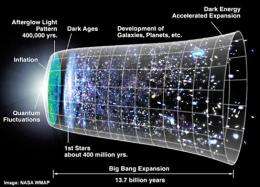
Dark energy, which is responsible for the accelerated expansion of the universe, holds the key to understanding the evolution of the universe following the Big Bang. (Image: NASA WMAP)
(PhysOrg.com) -- Scientists' murky understanding of dark energy may have just gotten a little clearer, thanks to recent work by a team of researchers that includes astrophysicist Neelima Sehgal of the Kavli Institute for Particle Astrophysics and Cosmology at SLAC. The team used observations from the Atacama Cosmology Telescope, or ACT, in the Chilean Andes to more narrowly define the properties of dark energy, that enigmatic entity that's thought to make up approximately 70 percent of the mass-energy of the universe and is pushing space apart.
The team's results are summarized online on the ArXiv.
Scientists have struggled to come up with a satisfactory explanation for the nature of dark energy ever since astronomical observations in 1998 first suggested its existence. Astronomers were surprised to discover that the universe's expansion was accelerating, a fact that could be explained only by a previously unknown source of energy.
"Basically the problem is that nobody knows what dark energy is," Sehgal said.
Dark energy may be the energy of the vacuum of space, which is one of the simplest theories to explain its existence. Vacuum energy is the background energy in otherwise empty space. Particle physicists theorize that this property of space could be the result of virtual particles constantly forming and disappearing. However, the virtual particle theory predicts a vacuum energy density that is 120 orders of magnitude larger than the observed dark energy density. The vast discrepancy has spurred the development of alternative dark energy theories, including dark energy whose density can vary in time or that results from a breakdown in the behavior of gravity at very large scales. To test competing theories, scientists need to gather more experimental data.
Sehgal, leading an effort by the ACT team, took an important step in this direction by analyzing the formation pattern of large galaxy clusters, enormous structures in the universe comprising dark matter, hot ionized gases and hundreds of thousands of galaxies. The formation of these galaxy clusters is governed by the interactions between dark energy and gravity. By examining the number of clusters and their distances from us, scientists can learn more about dark energy's properties.
The team harnessed the power of ACT to collect high-resolution microwave images of the night sky. Sehgal then identified large galaxy clusters by the telltale way the hot gases within the clusters dimmed or brightened the cosmic microwave background radiation at certain frequencies.
"The CMB acts as a backlight," Sehgal said. "The galaxy clusters scatter the microwave radiation as it passes through them, in effect casting 'shadows' that we have been able to identify. The really special thing about this shadow signal is that it does not fade with distance."
In its first season, the ACT team identified 23 clusters, approximately half of which were previously unknown. The discovery of new clusters highlights the power of CMB observations to spot extremely distant galaxy clusters. Once the galaxy clusters are discovered, optical wavelength observations are used to determine their distance. Sehgal led the effort to analyze the new data in order to distinguish between different competing dark energy theories.
"Each model for dark energy makes a prediction that you should see this many clusters, with this particular mass, this particular distance away from us," Sehgal said.
Sehgal tested these predictions by using data from the most massive galaxy clusters. The results support the standard, vacuum-energy model for dark energy.
These results are an important step toward settling the dark energy debate. Scientists will continue to probe the nature of dark energy by carrying out analyses similar to Sehgal's with additional sets of data, provided by new instruments such as the South Pole Telescope and the Planck satellite.
Provided by
SLAC National Accelerator Laboratory
-
From lemons to lemonade: Reaction uses carbon dioxide to make carbon-based semiconductor,
28 comments
-
Thioridazine kills cancer stem cells in human while avoiding toxic side-effects of conventional cancer treatments,
3 comments
-
SpaceX private rocket blasts off for space station (Update),
41 comments
-
Climate scientists say they have solved riddle of rising sea,
30 comments
-
Scotland passes turbine test to harness tidal power,
40 comments
-
revamping general concept and cosmological principle
14 hours ago
-
Transiting Exoplanet Light Curve
23 hours ago
-
Math behind Theoretical Physics
May 24, 2012
-
Do we know whats at the center of galaxies yet?
May 23, 2012
-
Structure of the Milky Way?
May 20, 2012
-
What would it take to terraform Pluto and Charon?
May 19, 2012
- More from Physics Forums - General Astronomy
More news stories
Dragon arrives at space station in historic 1st (Update 2)
The privately bankrolled Dragon capsule made a historic arrival at the International Space Station on Friday, triumphantly captured by astronauts wielding a giant robot arm.
Space & Earth / Space Exploration
16 hours ago |
5 / 5 (8) |
11
Dragon makes history with space station docking
The private company SpaceX made history Friday with the docking of its Dragon capsule to the International Space Station, the most impressive feat yet in turning routine spaceflight over to the commercial ...
Space & Earth / Space Exploration
9 hours ago |
4.8 / 5 (6) |
0
Aliens don't want to eat us, says former SETI director
Alien life probably isnt interested in having us for dinner, enslaving us or laying eggs in our bellies, according to a recent statement by former SETI director Jill Tarter.
Space & Earth / Space Exploration
18 hours ago |
4.8 / 5 (10) |
24
SKA super telescope to be built in Australia, South Africa (Update 2)
A long-running joust to host a radio telescope that would give mankind its farthest peek into the Universe ended on Friday with a Solomon-like judgement to split the site between Australia and South Africa.
18 hours ago |
5 / 5 (5) |
2
NASA sees Hurricane Bud threaten western Mexico's coast
NASA satellites are providing rainfall, temperature, pressure, visible and infrared data to forecasters as Hurricane Bud is expected to make a quick landfall in western Mexico this weekend before turning back ...
Space & Earth / Earth Sciences
12 hours ago |
not rated yet |
0
Of mice and mental models: Neuroscientific implications of risk-optimized behavior in the mouse
(Medical Xpress) -- Regardless of an organism’s biological complexity, every encephalized animal continuously makes under-informed behavioral choices that can have serious consequences. Despite its ubiquity, ...
Landmark calculation clears the way to answering how matter is formed
(Phys.org) -- An international collaboration of scientists, including Thomas Blum, associate professor of physics, is reporting in landmark detail the decay process of a subatomic particle called a kaon ...
High-speed method to aid search for solar energy storage catalysts
Eons ago, nature solved the problem of converting solar energy to fuels by inventing the process of photosynthesis.
It's in the genes: Research pinpoints how plants know when to flower
Scientists believe they've pinpointed the last crucial piece of the 80-year-old puzzle of how plants "know" when to flower.
Researchers solve structure of human protein critical for silencing genes
In a study published in the journal Cell on May 24, Cold Spring Harbor Laboratory (CSHL) scientists describe the three-dimensional atomic structure of a human protein bound to a piece of RNA that "guides" the pr ...
MIT researchers devise new means to synchronize a group of robots (w/ Video)
(Phys.org) -- For several years, roboticists have been working out ways to get a group of robots to perform synchronized activities as demonstrated most often in dance routines. Its not just about trying ...
Dec 09, 2010
Rank: 4.3 / 5 (3)
Recent theories have proposed that our universe itself could be a black hole. ... If that's the case, then what would be so strange about a black hole expanding irregularly? I expect that a black hole expands whenever it encounters and absorbs any kind of matter-energy.
Imagine: a black hole deflates steadily through Hawking radiation. Then, all of a sudden, it comes in contact with a nearby star, which it absorbs. What happens? It expands.
Our universe may have come in contact with some kind of matter/energy, which it is currently absorbing. This absorption could be occurring on a higher dimensional level, which to us is perceived as particles coming into existence, self-annihilating and thereby converting to energy (which continues the expansion). In fact, the movement of time itself could be attributed to this absorption (if space is expanding, why not time?)
Dec 09, 2010
Rank: 4 / 5 (2)
Read a bit into M-Theory, specifically Membrane / Brane theories ie: Our observable universe may be one of many 3 (dimensional) "branes". As our universe approaches heat death, our "3 brane" may collide with another brane and (re)produce a big bang. This is sort of like a cyclical universe model except it isn't just 1 universe expanding/contracting, it takes into account other dimensions and a recreation of sorts for our observable universe. It isn't exactly the same universe restarting. But this has nothing to do with our universe being a black whole.
Dec 09, 2010
Rank: 4 / 5 (1)
I kind of view the universe as an informational system. Within any physical space the number of permutations depend on four things: space, time, matter and energy. Increase any of these, and you have more potential arrangements.
So the "size" of the universe may actually a measure of how many permutations are possible, which is a function of how much time/space/energy/matter is available. Time moving forward then becomes an expansion. Space getting more spacious is more expansion. And the same with energy and matter.
If the universe's expansion is merely the unravelling of permutations, however, it could mean that the "big crunch" isn't real, since it's just time moving backwards from a state of maximum permutations to minimum. In other words, the universe may be a static "cone" of possibilities that only grows when it comes into contact with another system.
Dec 09, 2010
Rank: 5 / 5 (1)
Dec 09, 2010
Rank: 3.3 / 5 (3)
That's not quite right. Perhaps you're thinking of black holes as conduits to other universes, which is highly speculative at best and pretty much unprovable. Or perhaps you're thinking of the holographic principle/universe, which, IMO has great potential, especially as it relates to information exchange among physical processes.
Dec 09, 2010
Rank: 3.3 / 5 (3)
Actually amateur is correct (mostly). There was a theory proposed relating to the origin of Gamma Ray Bursts. They were suggesting that our Universe could be located inside a higher dimensional wormhole which is part of a Black Hole. The Gamma Ray Burts were explained as discharges of matter from alternate Universes. See this article:
http://news.natio...rmholes/
I'm not sure how much math they had behind this, but its an interesting concept nonetheless.
Dec 10, 2010
Rank: 4 / 5 (1)
In addition to what Zed123 said, I don't remember exactly who, but I read a book several years ago with a chapter entitled "Are we living in a black hole?"
The author argued that in the case of a very large, very old black hole it wouldn't be possible to detect that you were actually inside one. Essentially, as I understood it, space-time would be so warped that the region between the event horizon and the singularity could then be "stretched out," producing light years, or even billions of light years worth of "arbitrarily flat" space-time, even inside the black hole.
Dec 10, 2010
Rank: 4 / 5 (2)
The third paragraph from that article states:
which was precisely my point of distinction: "black holes as conduits to other universes". This also alludes to white-holes, which again, have no observational evidence.
Dec 11, 2010
Rank: 1 / 5 (3)
Dec 14, 2010
Rank: not rated yet
Amateur,
Whether fact or fiction, I love your ideas. Moreover, your writing style is incredibly clear and concise. If you're not a professional writer, you should be.
Thanks for sharing your thoughts!
Dec 15, 2010
Rank: not rated yet
Dec 16, 2010
Rank: 1 / 5 (1)
I would say if they can detect "dark matter" then they will be able to see Spirits in the 4th dimension and further?