Time running out to save climate record held in unique eastern European Alps glacier
December 9, 2010 by Earle Holland
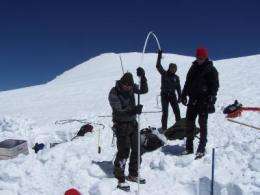
Researchers are installing an ablation stick, near a recently dug snow pit, to help in establishing the mass balance of the ice field. Credit: Paolo Gabrielli, Ohio State University
A preliminary look at an ice field atop the highest mountain in the eastern European Alps suggests that the glacier may hold records of ancient climate extending back as much as a thousand years.
Researchers warn, however, that the record may soon be lost as global warming takes its toll on these high-altitude sites, according to a new study in the Journal of Glaciology.
The glacier, Alto dell'Ortles, is the highest large ice body in the eastern Alps, reaching an altitude of 12,812 feet (3,905 meters) above sea level. It is small, though, measuring barely 0.4 square miles (1.04 square kilometers), and only 10 percent of that is likely to hold a good climate record, the researchers said.
"This is a mountain that is very difficult to climb and that has probably prevented researchers and glaciologists from Europe from going up there to study the ice," explained Paolo Gabrielli, a research scientist with the School of Earth Sciences and the Byrd Polar Research Center, both at Ohio State University.
"But it is an ideal observatory to have monitored climatic change in the region in the past as well as currently."
Scientists from Ohio State and five European universities made two exploratory visits to the glacier site in the summers of 2007 and 2008 and then, with logistical support from the Fire Protection and Civil Division of the Autonomous Province of Bolzano, used helicopters to carry the team to the site in 2009.
While there, the researchers drilled a shallow 10-meter core at the surface and dug snow pits to gauge how well the ice had been preserved over time. Later analysis showed that while some surface melting had partially degraded the recent record, ice formed before 1980 is likely to be unharmed.
The team also used ground-penetrating radar to map the thickness of the glacier. Based on that, they hope to be able to retrieve a 70-meter-long core through the ice to bedrock. "There is a possibility that we could find ice reaching back 5,000 years, but that's just speculation until we actually drill," Gabrielli said.
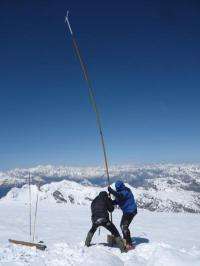
Researchers atop Mount Ortles in the eastern Alps are using a manual hand auger to drill a shallow core for later analysis. Credit: Paolo Gabrielli, Ohio State University
The Ortles site is unique in the Eastern Alps, they say, since it offers the chance to reconstruct the human history of the region along with the past ecosystems and climate, and show, perhaps, the relationship between the three.
"We hope to find out how these three factors interacted. We'd like to find evidence of whether climate conditions influenced the development of agriculture here, or even the start of primitive mining and smelting operations. We may even be able to see indications in the ice record of when people came to the region," he said.
Once full cores were retrieved, the ice samples would be analyzed for a host of climate signals, including oxygen isotope ratios, heavy metals, organic material, sulfates, chlorides, dust, pollen and volcanic ash that offer indications of past climate conditions. That record would then be compared to records from other cores drilled from ice caps around the globe.
The research team has submitted a proposal to the National Science Foundation to support the planned drilling project.
"This is basically the only hope of finding a record of changing climate conditions at high elevations in this part of Europe," he said, adding, "but unfortunately, time is running out to save this ice."
Provided by
The Ohio State University
-
From lemons to lemonade: Reaction uses carbon dioxide to make carbon-based semiconductor,
28 comments
-
Thioridazine kills cancer stem cells in human while avoiding toxic side-effects of conventional cancer treatments,
3 comments
-
SpaceX private rocket blasts off for space station (Update),
41 comments
-
Climate scientists say they have solved riddle of rising sea,
30 comments
-
Scotland passes turbine test to harness tidal power,
40 comments
-
More human population = greater mass?
15 hours ago
-
Conversion from aircraft bearing to normal degrees
May 23, 2012
-
Interpretation/Analysis of the Lab results(HEPA filter)
May 22, 2012
-
Has anyone here attended the The Urbino Summer School in Paleoclimatology?
May 22, 2012
-
Earthquakes: Mag 6 N. Italy and Mag 5.6 W. Bulgaria
May 21, 2012
-
determining time frame for most recent geological layers
May 17, 2012
- More from Physics Forums - Earth
More news stories
Dragon arrives at space station in historic 1st (Update 2)
The privately bankrolled Dragon capsule made a historic arrival at the International Space Station on Friday, triumphantly captured by astronauts wielding a giant robot arm.
Space & Earth / Space Exploration
16 hours ago |
5 / 5 (8) |
11
Dragon makes history with space station docking
The private company SpaceX made history Friday with the docking of its Dragon capsule to the International Space Station, the most impressive feat yet in turning routine spaceflight over to the commercial ...
Space & Earth / Space Exploration
9 hours ago |
4.8 / 5 (6) |
0
Aliens don't want to eat us, says former SETI director
Alien life probably isnt interested in having us for dinner, enslaving us or laying eggs in our bellies, according to a recent statement by former SETI director Jill Tarter.
Space & Earth / Space Exploration
17 hours ago |
4.8 / 5 (10) |
24
SKA super telescope to be built in Australia, South Africa (Update 2)
A long-running joust to host a radio telescope that would give mankind its farthest peek into the Universe ended on Friday with a Solomon-like judgement to split the site between Australia and South Africa.
17 hours ago |
5 / 5 (5) |
2
NASA sees Hurricane Bud threaten western Mexico's coast
NASA satellites are providing rainfall, temperature, pressure, visible and infrared data to forecasters as Hurricane Bud is expected to make a quick landfall in western Mexico this weekend before turning back ...
Space & Earth / Earth Sciences
11 hours ago |
not rated yet |
0
Of mice and mental models: Neuroscientific implications of risk-optimized behavior in the mouse
(Medical Xpress) -- Regardless of an organism’s biological complexity, every encephalized animal continuously makes under-informed behavioral choices that can have serious consequences. Despite its ubiquity, ...
Landmark calculation clears the way to answering how matter is formed
(Phys.org) -- An international collaboration of scientists, including Thomas Blum, associate professor of physics, is reporting in landmark detail the decay process of a subatomic particle called a kaon ...
High-speed method to aid search for solar energy storage catalysts
Eons ago, nature solved the problem of converting solar energy to fuels by inventing the process of photosynthesis.
It's in the genes: Research pinpoints how plants know when to flower
Scientists believe they've pinpointed the last crucial piece of the 80-year-old puzzle of how plants "know" when to flower.
Researchers solve structure of human protein critical for silencing genes
In a study published in the journal Cell on May 24, Cold Spring Harbor Laboratory (CSHL) scientists describe the three-dimensional atomic structure of a human protein bound to a piece of RNA that "guides" the pr ...
MIT researchers devise new means to synchronize a group of robots (w/ Video)
(Phys.org) -- For several years, roboticists have been working out ways to get a group of robots to perform synchronized activities as demonstrated most often in dance routines. Its not just about trying ...
