Climate goal may spell end for some coral reefs
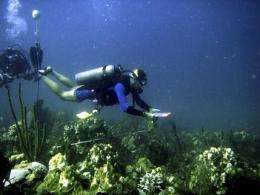
(AP) -- The once-vibrant coral reef shielding these sun-soaked beaches from the wrath of the sea is withering away under the stress of pollution and warmer water.
It's not likely to get much help from world governments meeting in Cancun for talks on a new climate pact. Their so-far elusive goal to limit global warming to 2 degrees C (3.6 F) is too little too late, says coral expert Roberto Iglesias.
"That represents the end of the coral reefs in the world," says the Mexican scientist, who works at a marine research station in Puerto Morelos, 12 miles (about 20 kilometers) south of the beach resort hosting the annual U.N. climate conference.
Coral reefs are like underwater jungles that host 25 percent of marine species and provide food and income to hundreds of millions of people, mostly in the developing world. They also serve as shock absorbers to storm surges whipped up by hurricanes.
But many reefs, including the one off this hotel-packed coastline, have been damaged by water pollution and overfishing, leaving them vulnerable to a warming ocean that "bleaches" corals and sometimes kills them, Iglesias said.
This year, preliminary reports show global coral bleaching reached its worst level since 1998, when 16 percent of the world's reefs were killed off, said Mark Eakin, a coral reef specialist at the U.S. National Oceanic and Atmospheric Administration.
"Clearly, we are on track for this to be the second worst (bleaching) on record," he said. "All we're waiting on now is the body count."
The 700-mile (1,100-kilometer) Mesoamerican reef that runs along Mexico's Yucatan Peninsula - suffering under other stresses - was spared the bleaching this year, but other parts of the Caribbean were hit hard, including Tobago, Curacao, Panama and islands north of Venezuela.
Some of the biggest impacts were in Southeast Asia. In Indonesia's Aceh province, surveys showed some 80 percent of the bleached corals died. In July, Malaysia closed several popular dive sites after virtually all the corals in those areas were damaged by bleaching.
Bleaching occurs when warmer temperatures disturb the symbiotic relationship between the corals and tiny algae that live inside them. When the algae are spit out, rainbow-colored reefs are turned into pale and lifeless skeletons - a "hideous" sight for veteran scuba divers like 52-year-old Eakin.
"You can't imagine what it's like to jump in the water and expect beautiful vibrant colors and all the corals are white," he said.
One or 2 degrees C (1.8-3.6 degrees F) above normal can be enough to cause bleaching. Corals may recover if the water cools and the algae return, but they're still significantly weaker and more vulnerable to disease. If the warmer temperatures persist, the corals die.
Bleaching occurs due to natural variability; both the 1998 and 2010 events were linked to the El Nino weather phenomenon. But the gradual rise of ocean temperatures means "it doesn't take much to push them over the edge," Eakin said.
The World Meteorological Organization says most tropical waters already have seen surface temperatures rise by up to 0.5 C (1 F) in the past 50 years. The Intergovernmental Panel on Climate Change, the U.N. climate-science network, projects an increasing frequency of bleaching episodes that "is very likely to further reduce both coral cover and diversity on reefs over the next few decades."
Many reefs have already been degraded by disease and the impact of human activities, including discharges of fertilizers and waste as well as overfishing of parrotfish and other species that help keep the corals clean and healthy.
The global area covered by coral reefs has shrunk by 20 percent since 1950 and another 35 percent could disappear in the next 40 years, even without the impact of climate change, according to a report released in October by the World Meteorological Organization and the Convention on Biological Diversity.
Off the Riviera Maya coast south of Cancun, where large swaths of mangrove forests have been cut down to make room for an endless row of beachfront resorts, only 15 percent of the coral reefs are alive, down from about 45 percent in 1995, said Fernando Secaira, who coordinates a Mesoamerican Reef program for the U.S.-based environmental group Nature Conservancy.
The biggest problem, he said, is the rapid development, with tens of thousands of hotel rooms added only in the past decade. Fertilizers from lawns and golf courses and sewage from the developments filters through the limestone rock and is washed out onto the reef by underground rivers, altering the balance of the sensitive ecosystem.
Secaira said such unhealthy reefs will find it difficult to adjust to warming waters, raising the risk they will be destroyed by bleaching or diseases. The priority for conservationists is identifying the most resilient reefs, and protecting them as climate change sets in with full force, raising temperatures and acidifying the ocean, which limits the carbonate minerals that help corals grow.
Scientists say no emissions cuts being considered by world governments will suffice to prevent that from happening.
"We're going to lose more corals and more reefs before this is all over," said Eakin, of NOAA. "The question at this point is how many can we save."
©2010 The Associated Press. All rights reserved. This material may not be published, broadcast, rewritten or redistributed.


