Review: Chrome OS gives a peek at computing future
December 22, 2010 By RACHEL METZ , AP Technology Writer
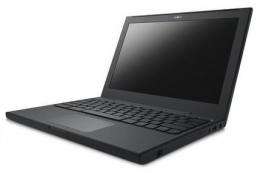
In this product image provided by Google Inc., the Cr-48 Chrome notebook is displayed. (AP Photo/Google Inc.) NO SALES
What if nearly everything you usually keep on your computer - photos, documents, music and software - was stored online? Your machine would be speedier and perhaps less vital because you could simply use another machine to recoup your digital life should you lose your laptop.
This premise - somewhat scary, yet liberating - is behind Google Inc.'s upcoming Chrome OS, which will make notebook computers more like netbooks than most actual netbooks.
The software powering Chrome OS, which is based on the search giant's eponymously named browser, serves mainly as a tool for connecting your computer to the Web. That's where nearly everything you use is housed and linked to your Google username and password. It's a concept known as cloud computing.
A peek at the upcoming operating system and its vision of cloud computing shows a promising idea that could make computing faster and more convenient. But it still needs a lot of work.
Google expects the first computers powered by Chrome OS to be released this summer, and initially they'll be made by Acer Inc. and Samsung Electronics Co.
For now, though, Google is operating a pilot for some individuals and companies to test an unbranded laptop that runs Chrome OS. The company lent The Associated Press one of these machines, which aren't going to be sold to the public.
The laptop itself, called the Cr-48, doesn't really deserve to be critiqued, because it is a stripped-down machine that is chiefly a frame for Google's OS oeuvre. The shell is entirely matte black plastic, without a hint of branding. It has a webcam, a screen that is about 12 inches diagonally and a full-sized keyboard with a search key in place of the caps lock key.
The machine also has 16 gigabytes of flash memory for storing files, if you feel absolutely compelled to download something. Downloads are obviously discouraged, though; my music collection alone would nearly fill this allotment.
Moving on to the main event, Chrome OS brings a few clear benefits: Starting up the notebook takes just seconds - roughly 13 of them, according to my stopwatch - and waking the closed notebook from "sleep" mode is as quick as opening it up (almost too quick, as the notebook couldn't regain its wireless service quite as fast). By contrast, my Windows machine at work takes more than two minutes to boot up.
After you sign in with your Google account, the same username and password you would use to access Gmail, you can pull up a home page showing all the apps you've installed from the Chrome Web Store. Assuming you're connected to the Web, you can just start using apps and surfing the Web right away.
There were plenty of free and paid Web apps and browser extensions available when I tested the notebook. Some are only for the Chrome OS; others also work with Google's Chrome Web browser for other computers.
I installed a range of the free ones, some of which seemed to be just links to existing Web pages. The apps I snagged included Web-based office suite Google Docs, the chatting service Google Talk, Aviary's Advanced Image Editor and balloon-popping puzzle game Poppit.
As with smart phones and tablets such as Apple Inc.'s iPad, publications are also making Chrome apps. USA Today, The New York Times and The Wall Street Journal are among them.
On my work computer, it can take ages to open up applications that are stored on my hard drive. With the Cr-48, I could immediately start editing a Google Docs spreadsheet or tweak the colors in a photo using Aviary because the programs are all running online. I only needed a strong Internet connection.
Surfing the Web was a pretty normal experience, with most websites loading speedily, though the Cr-48 was not that good at displaying Flash videos.
But I felt constrained because I had to use the lone browser that comes with the system and the Web-based apps I obtained. Apps loaded slowly when my Internet connection wasn't stellar. This wouldn't be a problem with programs stored on a regular computer's hard drive.
If a Chrome OS-based laptop becomes my primary computer, a data plan would be a must.
I feel anxious just thinking about the possibility that I couldn't access my documents at any time, and I don't even keep anything that important on my own laptop.
I mostly used the notebook with Wi-Fi at home and at the office, though I also tried out its 3G network service, which is provide by Verizon Wireless.
So what happens if you don't have any Internet access? The Cr-48 is pretty useless.
I could still write in an already-open Google Docs document, add notes in Scratchpad and look at photos I'd downloaded. But I couldn't use apps that are not yet opened because they're all connected to the Web.
If you lose your connection while using an app, you may be able to view some information that has been temporarily stored in memory, as I could when browsing The New York Times' app. But you'll need to get online as soon as possible to really use the machine. Faced with this situation, I'd probably just search frantically for an Internet connection or simply put away my laptop.
In its current state, the Chrome OS is far from ready to take over as my main computer, even if I were using it on a more powerful machine than the Cr-48.
Sure, I spend most of my time on the Web already, but I'm not quite ready to rely on having Internet access to do almost anything with my computer.
I can imagine getting comfortable with that in the not-so-distant future, though, and I'm curious to see if Google can make it happen.
More information: http://www.google.com/chromeos/pilot-program.html
©2010 The Associated Press. All rights reserved. This material may not be published, broadcast, rewritten or redistributed.
-
From lemons to lemonade: Reaction uses carbon dioxide to make carbon-based semiconductor,
28 comments
-
Thioridazine kills cancer stem cells in human while avoiding toxic side-effects of conventional cancer treatments,
3 comments
-
SpaceX private rocket blasts off for space station (Update),
41 comments
-
Climate scientists say they have solved riddle of rising sea,
30 comments
-
Scotland passes turbine test to harness tidal power,
40 comments
-
length of wire in a coil of known dimensions?
13 hours ago
-
India Engineering Powerhouse
21 hours ago
-
electromagnet core dereference between hard and soft iron
22 hours ago
-
Measuring water pressure in an open tank
May 24, 2012
-
Question from a non-engineer: Pulley Systems
May 24, 2012
-
Formula to calculate psi required to deliver gpm through nozzel
May 23, 2012
- More from Physics Forums - General Engineering
More news stories
Yahoo kills 'Livestand' just 6 months after debut
(AP) -- Yahoo is killing a tablet magazine called Livestand just six months its debut on the iPad.
9 hours ago |
not rated yet |
1
Computers excel at identifying smiles of frustration (w/ Video)
(Phys.org) -- Researchers at the Massachusetts Institute of Technology (MIT) in the US have trained computers to recognize smiles, and they have turned out to be more adept at recognizing smiles of frustration ...
Yahoo! ditches digital newsstand for iPads
Yahoo! shuttered its fledgling digital newsstand for iPads on Friday in what it said was the start of a product purge intended to make the floundering Internet pioneer more nimble.
10 hours ago |
not rated yet |
0
Facebook IPO debacle raises investor dander
The spate of complaints and investigations over the Facebook stock offering suggests big institutions had an edge over small investors, raising questions about the process.
11 hours ago |
not rated yet |
0
Apple CEO Cook gives up $75M in stock dividends
(AP) -- Apple CEO Tim Cook is giving up $75 million in dividends on restricted stock that the company is awarding to all of its employees.
14 hours ago |
1.8 / 5 (4) |
2
Of mice and mental models: Neuroscientific implications of risk-optimized behavior in the mouse
(Medical Xpress) -- Regardless of an organism’s biological complexity, every encephalized animal continuously makes under-informed behavioral choices that can have serious consequences. Despite its ubiquity, ...
Dragon arrives at space station in historic 1st (Update 2)
The privately bankrolled Dragon capsule made a historic arrival at the International Space Station on Friday, triumphantly captured by astronauts wielding a giant robot arm.
Landmark calculation clears the way to answering how matter is formed
(Phys.org) -- An international collaboration of scientists, including Thomas Blum, associate professor of physics, is reporting in landmark detail the decay process of a subatomic particle called a kaon ...
High-speed method to aid search for solar energy storage catalysts
Eons ago, nature solved the problem of converting solar energy to fuels by inventing the process of photosynthesis.
It's in the genes: Research pinpoints how plants know when to flower
Scientists believe they've pinpointed the last crucial piece of the 80-year-old puzzle of how plants "know" when to flower.
Researchers solve structure of human protein critical for silencing genes
In a study published in the journal Cell on May 24, Cold Spring Harbor Laboratory (CSHL) scientists describe the three-dimensional atomic structure of a human protein bound to a piece of RNA that "guides" the pr ...
Dec 22, 2010
Rank: 4.2 / 5 (5)
Then I'd be unable to work. My ISP would ban me for over-use and I'd be spending an awful lot of time waiting for stuff to load. I have Terabytes of data and do lots of video editing and programming. Using a remote storage device is just not practical. Also, what the heck would I do when the internet goes down?
The best solution is local (large and fast) storage with remote backup, which is what I have with my 4+TB of data and carbonite.com holding backups of my most critical stuff.
Also, I can't use a rinky dinky little laptop except for temporary, minimal use. I need large monitors with high resolution and very powerful processors and lots of RAM. The internet's got a LOOOOOOONG way to go before my work can be done with remote storage.
Dec 22, 2010
Rank: 3 / 5 (2)
See other article here.
Dec 22, 2010
Rank: 3.7 / 5 (3)
Have you seen the limits the companies like Time Warner, Comcast and others want to impose? And that's not even considering the glaring weakness of this whole idea. Access to the Internet.
Until you can be guaranteed unlimited secure access to the internet anywhere, wired AND wireless, putting all your data on the net and making people access it there is NEVER going to happen. I know places right now where you have NO access wirelessly to the internet.
And I sure am not heartened by the quality of that access today and it sure doesn't seem like it's any kind of priority of the ISPs and Telcos to improve it to the 100% dependable level needed to peg our lives to.
Dec 22, 2010
Rank: 3.8 / 5 (5)
Not only that, remote storage isn't really practical anyway, except as an emergency backup. It will never, ever be as fast as loading directly to/from a local hard drive or other storage device, and certainly never as secure.
Think how many people would have at least a "chance" to steal your data if you upload through the ISP, then to a cloud server. anybody working for either company could potentially become a security risk.
I'm not saying there's no use for cloud computing, but this is ridiculous. Google already has the whole world mapped in 3d accurate to a few tenths of an inch, and now they expect people to literally store ALL of their files on their servers.
4th ammendment anyone? You don't trust the government to search your home, or monitor you even if it really is for your own safety, but you'll freely upload a terrabyte of data about yourself to Google?
Have they lost their minds?
Dec 22, 2010
Rank: 5 / 5 (2)
Dec 22, 2010
Rank: 5 / 5 (1)
Users have collectively spent billions of dollars on local machine storage over the decade... now Google thinks that' their servers are the way to go... so if they get hacked or crash... loosing anyone's data.... that's acceptable...
Dec 22, 2010
Rank: 3 / 5 (3)
This isn't the half of it.
in ten or 15 years we're all going to need to develop some sort of counter measures for mass produced flea sized and roach sized spy bots armed with cameras and microphones...
They won't be content with mapping your street, or the outside of your house, they'll start taking data from camera phones and spy bots to map the inside of your house and your car and your work place and your wife's vag, and even your own body.
Dec 22, 2010
Rank: 1 / 5 (1)
Dec 22, 2010
Rank: 3.7 / 5 (3)
Suppose you got it precisely like you want. Then, using your gadget would make you feel you've got your data (i.e. your files) right there. But when the gadget drops and breaks, or someone steals it, you'd like to go to the nearest store and buy another gadget, and just pick up from where you left with your data. (And later, show your receipt to the insurance company.)
Now, that's how it should be.
One way or another, that is what it will become, in a few years. Chrome, Microsoft, Android, -- who cares. Name or not, that is what the world is going to. And any operating system that doesn't understand this, will become obsolete.
Dec 22, 2010
Rank: 5 / 5 (1)
Dec 22, 2010
Rank: 3.7 / 5 (3)
What you fail to realize is that in several years computers are going to be so cheap relative to what they are now it's a joke.
Seriously, by the time Intel starts making their 10 to 11nm process chips, around 2018, you aren't going to need offsite storage, and even if you do, you can store it on a hard drive and put in the safety deposit box at a bank, instead of on the internet for wikileaks to steal.
Look at some of the other articles on this site. They just made a laser that can cut computer circuitry features ten times smaller than anything in the past, which means there will be 100 times less wasted space on a chip.
We're going to have so much processing power and storage capacity even on local, privately owned pcs and handheld gadgets that you won't even care about cloud computing.
What will be the point of that when we're buying 32 core PCs in 2018, and 64 core pcs in 2022? Server farms as we know them will be almost obsolete.
Dec 22, 2010
Rank: 2.3 / 5 (3)
From whiny programmers who should know better than rant about a product that isn't marketed for their business to the scared children thinking all of their files will be accessed by Wikileaks. Absolutely pathetic.
This product will be marketed to businesses and students who need less power than a traditional laptop and more functionality than a glass window that lets you download from the iTunes store. They will market to people who can store documents, projects/presentations, spreadsheets online on any server who may also need to edit them sporadically.
Hell, they could be making these cheap laptops for people in third-world countries. Just open your eyes and not your mouth the next time a company tries something a little different than the norm.
Dec 22, 2010
Rank: 3.7 / 5 (3)
Who watches the watchmen?
Dec 22, 2010
Rank: not rated yet
Perhaps I'm a traditionalist, but the whole concept simply doesn't appeal to me.
Wikileaks didn't steal anything. They're no different than traditional newspapers who receive and print leaked information, usually from government sources. The only difference is that the internet medium has wider bandwidth and dissemination potential.
Dec 22, 2010
Rank: not rated yet
Dec 23, 2010
Rank: 5 / 5 (2)
What? Um, your machine at work SUCKS!
Yeah, I'm gonna use cloud computing to run Adobe Lightroom and edit my RAW photo files. Sure!
Dec 23, 2010
Rank: 3 / 5 (2)
Dec 23, 2010
Rank: 5 / 5 (1)
I do think it's cool that they named the laptop that was built for this Cr-48.
Dec 23, 2010
Rank: 2 / 5 (1)
I agree. Folks, this is a product for a specific market...which probably isn't YOU. look at how many people communicate only through Facebook, write emails, store photos. Or Google Docs... Yes, it's not the solution for everyone, and I for one prefer to keep it local, but there are things that a cloud PC can do that can appeal to a broad market.
I do think that within a few years, there will be a significant and serious "incident" which leads us to question the security of the Cloud. Right now, Google only works because there is still a belief in "Do no evil". The instant that is lost, it could all crumble. And think about it...what companies are around from 50 or 100 years ago? What DOES happen when Google is replaced by the competition? Where does YOUR data go? Where is Netscape? Compuserve? Prodigy? MUD's? BBS's?
Dec 23, 2010
Rank: 5 / 5 (1)
Remember that "if you're honest who needs secrets" may seem like a good thing, but remember that people's and society's interests change. Remember 1930's Germany or a host of other countries...
BenignAGENCY: "Just fill out this form. Please be honest. Report your Religion, whether or not you own a firearm, what your income is, etc."
Then a few years later....
PEOPLE: "Hey let's elect a person that will kill all the people of XXXX religion, and take their guns and money"
SIMPLICITUS: "How would we ever know who is what religion, if they have guns, or how much money they have!!!??"
PEOPLE: "Hey, we found these forms that everyone filled out a few years ago. We could see if they were honest..."
Insert Genocide...
Dec 23, 2010
Rank: not rated yet
Heinz
Ford
Boeing
Prudential
Nabisco
Well, really, there's so many I'm surprised you ask. There's more old companies than new ones really.
Apple still around even though everyone was using the intel pentium and similar brands, with Microsoft's OS for years.
It's unlikely that you could simply put something the size of Google out of business, even as technologies change, particularly since they have their hands in all the technologies in the first place. The thing about tech sector companies and data centers, etc, is they are the ones most equipped to change and diversify, because they either invent the technologies, or become the first to know about it.
Netscape always sucked, so uh, fail to see a comparison.
Dec 23, 2010
Rank: 5 / 5 (1)
____________________________
Really I think I'll pass, I prefer storing things on my computer in a secured fashion unless they are public documents that I can afford to have other people looking at. That and the future is a torrent underweb, not whatever spyware offering google has in it's spyware operating system.
Dec 23, 2010
Rank: not rated yet
My point was that the products and services from many companies and the companies themselves are no longer around(yes there are many that ARE still around).
Meaning, what happens when google discontinues Picasa? Do they send you a hard drive with your photos? do they sell them to someone who can change the terms of service and use them publicly?
and discontinued products like:
Heinz Sweet Pickles
Ford Mercury Brand
Connexion by Boeing
Prudential's Discovery Life Plus
or my favorite--In 2009 (after over 110 years), Nabisco discontinued the Uneeda biscuit out of concern that the product was not as profitable as others
might not have affected many...
My point was that.. who knows? You may say something sucks. Or it doesn't suck now, but give tech a few years and then it sucks...and the company sells it or kills it. For products listed above, the impact might be minimal, but for YOUR data it might not be.
Maybe it isn't something to worry about...
Dec 23, 2010
Rank: not rated yet
The article asked a question. I answered it. What's your problem?
The hype for this product is that it's a solution that EVERYONE will want to move to. I countered that false impression with realistic usage information. Why do you have such a problem with that?
HungOnGravity, you should read this:
Research shows what you say about others says a lot about you...
http://www.physor...319.html
Dec 23, 2010
Rank: 4.5 / 5 (2)
I like possession... If I possess it it is mine... it will take a lot of convincing to get me to give up the notion of possession with ownership.
Having said that, I can see the use of cloud-distributed applications... just not data.
Dec 23, 2010
Rank: 4 / 5 (1)
"Chaotic" encryption. They said this of Novel before Microsoft sent them into third party VMWare tool vendor land.
Dec 25, 2010
Rank: 5 / 5 (1)
Dec 25, 2010
Rank: not rated yet
Dec 26, 2010
Rank: not rated yet
That's why it isn't yet practical.
Some applications simply cannot ever be practical as a cloud-based application.
Almost everything I can think of would still need a two-tiered system to be portable enough to be practical in the modern world. But then, if you need a copy of everyhtnig locally that's the same thing we already do, and then the "cloud" is doing nothing but data backup anyway, which defeats the whole purpose.
There are some theoretical solutions, such as distributed non-localization of the "cloud", but this only works in "perfect land" where you don't have hackers and other criminals, so that's a non-possibility too.
What might be more practial is if your mobile device could be permanently networked to your PC. Then you could tap into 4/6/8 cores processor from anywhere.
Dec 28, 2010
Rank: not rated yet
Dec 29, 2010
Rank: not rated yet