Carbon's magnetic personality: Persistent, but only skin-deep
December 17, 2010 by Lori Ann White
Researchers have shown that graphite, the carbon-rich material used as pencil lead, can act as a permanent magenet—at the material's surface. (Image courtesy Hendrik Ohldag.)
(PhysOrg.com) -- It's a mainstay in biological molecules, but carbon isn't the kind of element you'd expect to find in a permanent magnet. Until now. Not only does carbon become magnetized with a little doctoring, as discovered in 2007, but new findings show this behavior comes naturallyno special treatment requiredat the surface of a carbon-based material called graphite.
Researchers used both the Stanford Synchrotron Radiation Lightsource at SLAC and the Advanced Light Source at Lawrence Berkeley National Laboratory to discover not only carbon's innate magnetization, but also that only the surface becomes magnetized, a discovery that may bode well for future applications in electronics and computing. SSRL Staff Scientist Hendrik Ohldag and colleagues from the University of Leipzig and LBNL detailed their research in last week's New Journal of Physics. Their goal was to determine how carbon can be permanently magnetizeda property until recently thought to be confined to iron, nickel, cobalt and a handful of rare alloys. After confirming that their samples contained negligible amounts of magnetic impurities, the researchers got to work.
"We looked at what electrons and electronic states are involved," Ohldag explained. Using a variety of imaging techniques, they examined samples of graphite, the same material used in pencil lead. One sample had been bombarded with protons, as in their 2007 discovery of carbon magnetization, and one sample had not. The scientists also subjected both types of graphite samples to magnetic fields. Not only did the proton-irradiated sample turn magneticno surprise, since that was the result of the initial experimentbut so did the untouched sample. Further examination revealed another surprise.
"The magnetism at the [graphite] surface was as strong as in a classic ferromagnetic metal," Ohldag said.
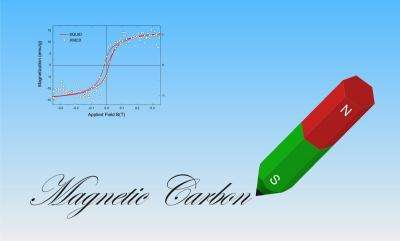
Magnetization of an untreated graphite sample (vertical axis) increases in magnitude, then levels off, as an external magnetic field increases in strength toward north or south (horizontal axis). In addition, the separate red line starting at the center shows the magnetization remaining after the field was removed, a sign of a permanent magnet. (Image courtesy Hendrik Ohldag.)
The collaboration tracked the source of the magnetism to hydrogen atoms that had bonded to the surface of the carbon. "There's always a lot of H2 [molecular hydrogen] stored in graphite," Ohldag said. This hydrogen, especially when broken apart into single molecules, disturbs the neat precision of carbon's electronic structure, making magnetization possible. This can be seen in any graphite, but judiciously bombarding the surface with protons increases the effect. And not just protons, but anything that breaks apart the molecular hydrogenfor example, electrons or ionswill do.
In fact, the solid, five-millimeter cubes of graphite examined by Ohldag's group never developed into very strong magnets overall, but "locally, there was a big magnetic moment," Ohldag said. In other words, results showed that the magnetism on the surface of a proton-bombarded graphite sample might reach strengths comparable to nickel. This surface restriction hints at one suitable application: nanodevices, leading to even smaller, lighter electronics, or even basic components in quantum computers.
"The fact that the magnetism is strong only on the surface doesn't matter anymore if you make things small," Ohldag said, "because then you have only surface."
One of the next goals of the collaboration, according to Ohldag, is to investigate the magnetic properties of graphene, the one-molecule-thick form of carbon that truly is all surface.
Provided by
SLAC National Accelerator Laboratory
-
From lemons to lemonade: Reaction uses carbon dioxide to make carbon-based semiconductor,
28 comments
-
Thioridazine kills cancer stem cells in human while avoiding toxic side-effects of conventional cancer treatments,
3 comments
-
SpaceX private rocket blasts off for space station (Update),
41 comments
-
Climate scientists say they have solved riddle of rising sea,
30 comments
-
Scotland passes turbine test to harness tidal power,
40 comments
-
Transparency of molten substances?
May 25, 2012
-
saturated paramagnetic and ferromagnetic
May 24, 2012
-
How to calculate the bandstructure of Twisted Bilayer Graphene
May 23, 2012
-
vast computational richness from swapping one proton
May 22, 2012
-
Oscillator strength of mixed LH- and HH-excitons
May 22, 2012
-
2D Quantum Well and k-values
May 21, 2012
- More from Physics Forums - Atomic, Solid State, Comp. Physics
More news stories
Landmark calculation clears the way to answering how matter is formed
(Phys.org) -- An international collaboration of scientists, including Thomas Blum, associate professor of physics, is reporting in landmark detail the decay process of a subatomic particle called a kaon ...
20 hours ago |
4.8 / 5 (12) |
29
|
Is a classical electrodynamics law incompatible with special relativity?
(Phys.org) -- The laws of classical electromagnetism that were developed in the 19th century are the same laws that scientists use today. They include Maxwell’s four equations along with the Lorentz la ...
Lying in wait for WIMPs: Researchers seek to dramatically increase sensitivity of Large Underground Xenon detector
Although it's invisible, dark matter accounts for at least 80 percent of the matter in the universe. No one knows what it is, but most scientists would bet on weakly interacting massive particles, or WIMPs.
May 23, 2012 |
4 / 5 (5) |
14
|
Hall effect at the speed of light: How can you demonstrate relativistic effects with your mobile phone?
The relativistic Hall effect describing objects rotating at speeds comparable with the speed of light has been reported.
May 21, 2012 |
4.3 / 5 (3) |
8
Cloak of invisibility: Engineers use plasmonics to create an invisible photodetector
A team of engineers at Stanford and the University of Pennsylvania has for the first time used "plasmonic cloaking" to create a device that can see without being seen - an invisible machine that detects light. It is the first ...
May 21, 2012 |
4.8 / 5 (16) |
7
|
Of mice and mental models: Neuroscientific implications of risk-optimized behavior in the mouse
(Medical Xpress) -- Regardless of an organism’s biological complexity, every encephalized animal continuously makes under-informed behavioral choices that can have serious consequences. Despite its ubiquity, ...
Dragon arrives at space station in historic 1st (Update 2)
The privately bankrolled Dragon capsule made a historic arrival at the International Space Station on Friday, triumphantly captured by astronauts wielding a giant robot arm.
High-speed method to aid search for solar energy storage catalysts
Eons ago, nature solved the problem of converting solar energy to fuels by inventing the process of photosynthesis.
It's in the genes: Research pinpoints how plants know when to flower
Scientists believe they've pinpointed the last crucial piece of the 80-year-old puzzle of how plants "know" when to flower.
Researchers solve structure of human protein critical for silencing genes
In a study published in the journal Cell on May 24, Cold Spring Harbor Laboratory (CSHL) scientists describe the three-dimensional atomic structure of a human protein bound to a piece of RNA that "guides" the pr ...
MIT researchers devise new means to synchronize a group of robots (w/ Video)
(Phys.org) -- For several years, roboticists have been working out ways to get a group of robots to perform synchronized activities as demonstrated most often in dance routines. Its not just about trying ...

Dec 17, 2010
Rank: 4 / 5 (1)
Dec 17, 2010
Rank: not rated yet
Dec 19, 2010
Rank: not rated yet