Better control of building blocks for quantum computer
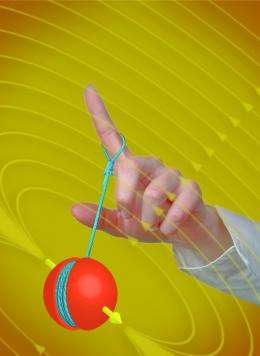
Artist’s impression of the spin-orbit qubit. Like in a yo-yo toy, by moving the electron one controls its spin. Credit: Gemma Plum
Dutch scientists from the Kavli Institute of Nanoscience at Delft University of Technology and Eindhoven University of Technology have succeeded in controlling the building blocks of a future super-fast quantum computer. They are now able to manipulate these building blocks (qubits) with electrical rather than magnetic fields, as has been the common practice up till now. They have also been able to embed these qubits into semiconductor nanowires. The scientists findings have been published in the current issue of the science journal Nature (23 December).
A qubit is the building block of a possible, future quantum computer, which would far outstrip current computers in terms of speed. One way to make a qubit is to trap a single electron in semiconductor material. A qubit can, just like a normal computer bit, adopt the states '0' and '1'. This is achieved by using the spin of an electron, which is generated by spinning the electron on its axis. The electron can spin in two directions (representing the '0' state and the '1' state).
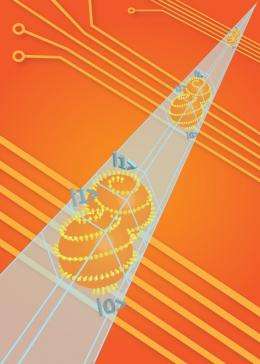
Nanowire-1-WEB: Artist's impression of nanowire qubits. Credit: Gemma Plum
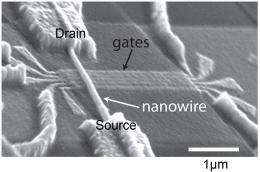
Until now, the spin of an electron has been controlled by magnetic fields. However, these field are extremely difficult to generate on a chip. The electron spin in the qubits that are currently being generated by the Dutch scientists can be controlled by a charge or an electric field, rather than by magnetic fields. This form of control has major advantages, as Leo Kouwenhoven, scientist at the Kavli Institute of Nanoscience at TU Delft, points out: "These spin-orbit qubits combine the best of both worlds. They employ the advantages of both electronic control and information storage in the electron spin."Scanning electron image of the nanowire device with gate electrodes used to electrically control qubits, and source and drain electrodes used to probe qubit states.
There is another important new development in the Dutch research: the scientists have been able to embed the qubits (two) into nanowires made of a semiconductor material (indium arsenide). These wires are of the order of nanometres in diameter and micrometres in length. Kouwenhoven: "These nanowires are being increasingly used as convenient building blocks in nanoelectronics. Nanowires are an excellent platform for quantum information processing, among other applications."More information: Nadj-Perge, S, et al. (2010) Spin-Orbit qubit in a semiconductor nanowire. Nature 468, 1084 1087.
Provided by
Delft University of Technology
-
From lemons to lemonade: Reaction uses carbon dioxide to make carbon-based semiconductor,
28 comments
-
Thioridazine kills cancer stem cells in human while avoiding toxic side-effects of conventional cancer treatments,
3 comments
-
SpaceX private rocket blasts off for space station (Update),
41 comments
-
Climate scientists say they have solved riddle of rising sea,
30 comments
-
Scotland passes turbine test to harness tidal power,
40 comments
-
What capacitors to use in a Tesla coil...?
14 hours ago
-
Work done by us on the spring
16 hours ago
-
Surface current density
18 hours ago
-
Work done on body moving in a circle
22 hours ago
-
Crest or Trough?
22 hours ago
-
Origin of magnetism
May 25, 2012
- More from Physics Forums - Classical Physics
More news stories
Landmark calculation clears the way to answering how matter is formed
(Phys.org) -- An international collaboration of scientists, including Thomas Blum, associate professor of physics, is reporting in landmark detail the decay process of a subatomic particle called a kaon ...
20 hours ago |
4.8 / 5 (12) |
29
|
Is a classical electrodynamics law incompatible with special relativity?
(Phys.org) -- The laws of classical electromagnetism that were developed in the 19th century are the same laws that scientists use today. They include Maxwell’s four equations along with the Lorentz la ...
Lying in wait for WIMPs: Researchers seek to dramatically increase sensitivity of Large Underground Xenon detector
Although it's invisible, dark matter accounts for at least 80 percent of the matter in the universe. No one knows what it is, but most scientists would bet on weakly interacting massive particles, or WIMPs.
May 23, 2012 |
4 / 5 (5) |
14
|
Hall effect at the speed of light: How can you demonstrate relativistic effects with your mobile phone?
The relativistic Hall effect describing objects rotating at speeds comparable with the speed of light has been reported.
May 21, 2012 |
4.3 / 5 (3) |
8
Cloak of invisibility: Engineers use plasmonics to create an invisible photodetector
A team of engineers at Stanford and the University of Pennsylvania has for the first time used "plasmonic cloaking" to create a device that can see without being seen - an invisible machine that detects light. It is the first ...
May 21, 2012 |
4.8 / 5 (16) |
7
|
Of mice and mental models: Neuroscientific implications of risk-optimized behavior in the mouse
(Medical Xpress) -- Regardless of an organism’s biological complexity, every encephalized animal continuously makes under-informed behavioral choices that can have serious consequences. Despite its ubiquity, ...
Dragon arrives at space station in historic 1st (Update 2)
The privately bankrolled Dragon capsule made a historic arrival at the International Space Station on Friday, triumphantly captured by astronauts wielding a giant robot arm.
High-speed method to aid search for solar energy storage catalysts
Eons ago, nature solved the problem of converting solar energy to fuels by inventing the process of photosynthesis.
It's in the genes: Research pinpoints how plants know when to flower
Scientists believe they've pinpointed the last crucial piece of the 80-year-old puzzle of how plants "know" when to flower.
Researchers solve structure of human protein critical for silencing genes
In a study published in the journal Cell on May 24, Cold Spring Harbor Laboratory (CSHL) scientists describe the three-dimensional atomic structure of a human protein bound to a piece of RNA that "guides" the pr ...
MIT researchers devise new means to synchronize a group of robots (w/ Video)
(Phys.org) -- For several years, roboticists have been working out ways to get a group of robots to perform synchronized activities as demonstrated most often in dance routines. Its not just about trying ...


Dec 23, 2010
Rank: not rated yet
When do we start to see the first quantum chips?