Building blocks of life created in 'Impossible' place
December 16, 2010 by Nancy Neal-Jones and Bill Steigerwald
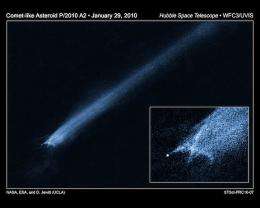
This is a NASA Hubble Space Telescope picture of what was first thought to be a comet but is probably an asteroid collision. The inset picture shows a complex structure that suggests the object is not a comet but instead the product of a head-on collision between two asteroids traveling five times faster than a rifle bullet (about three miles per second). Credit: NASA, ESA, and D. Jewitt (UCLA)
(PhysOrg.com) -- NASA-funded scientists have discovered amino acids, a fundamental building block of life, in a meteorite where none were expected.
"This meteorite formed when two asteroids collided," said Dr. Daniel Glavin of NASAs Goddard Space Flight Center, Greenbelt, Md. "The shock of the collision heated it to more than 2,000 degrees Fahrenheit, hot enough that all complex organic molecules like amino acids should have been destroyed, but we found them anyway." Glavin is lead author of a paper on this discovery appearing December 15 in Meteoritics and Planetary Science. "Finding them in this type of meteorite suggests that there is more than one way to make amino acids in space, which increases the chance for finding life elsewhere in the Universe."
Amino acids are used to make proteins, the workhorse molecules of life, used in everything from structures like hair to enzymes, the catalysts that speed up or regulate chemical reactions. Just as the 26 letters of the alphabet are arranged in limitless combinations to make words, life uses 20 different amino acids in a huge variety of arrangements to build millions of different proteins. Previously, scientists at the Goddard Astrobiology Analytical Laboratory have found amino acids in samples of comet Wild 2 from NASAs Stardust mission, and in various carbon-rich meteorites. Finding amino acids in these objects supports the theory that the origin of life got a boost from space -- some of lifes ingredients formed in space and were delivered to Earth long ago by meteorite impacts.
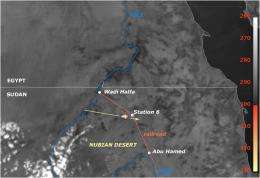
Infrared image taken by the Meteosat 8 satellite of asteroid 2008 TC3 exploding. The path of the asteroid is shown with a yellow arrow; red-yellow blob on arrow is infrared from the explosion. Credit: EUMESTAT
When Dr. Peter Jenniskens of the SETI Institute, Mountain View, Calif., and NASA's Ames Research Center, Moffett Field, Calif., approached NASA with the suggestion to search for amino acids in the carbon-rich remnants of asteroid 2008 TC3, expectations were that nothing was to be found. Because of an unusually violent collision in the past, this asteroid's ingredients for life were a "culinary disaster" and now mostly in the form of graphite. The small asteroid, estimated at six to fifteen feet across, was the first to be detected in space prior to impact on Earth on October 7, 2008. When Jenniskens and Dr. Muawia Shaddad of the University of Khartoum recovered remnants in the Nubian Desert of northern Sudan, the remnants turned out to be the first Ureilite meteorites found in pristine condition.
A meteorite sample was divided between the Goddard lab and a lab at the Scripps Institution of Oceanography at the University of California, San Diego. "Our analyses confirm those obtained at Goddard," said Professor Jeffrey Bada of Scripps, who led the analysis there. The extremely sensitive equipment in both labs detected small amounts of 19 different amino acids in the sample, ranging from 0.5 to 149 parts per billion. The team had to be sure that the amino acids in the meteorite didnt come from contamination by life on Earth, and they were able to do so because of the way amino acids are made. Amino acid molecules can be built in two ways that are mirror images of each other, like your hands. Life on Earth uses left-handed amino acids, and they are never mixed with right-handed ones, but the amino acids found in the meteorite had equal amounts of the left and right-handed varieties.
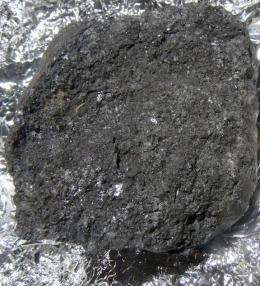
A typical example of a meteorite remnant linked to asteroid 2008 TC3, with a dark scruffy texture. Credit: Peter Jenniskens
The sample had various minerals that only form under high temperatures, indicating it was forged in a violent collision. It's possible that the amino acids are simply leftovers from one of the original asteroids in the collision an asteroid that had better conditions for amino acid formation. Dr. Jennifer Blank of SETI has done experiments with amino acids in water and ice, showing they survive pressures and temperatures comparable to a low-angle comet-Earth impact or asteroid-asteroid collisions.However, the team thinks it's unlikely amino acids could have survived the conditions that created the meteorite, which endured higher temperatures more than 2,000 degrees Fahrenheit (over 1,100 Celsius) over a much longer period. "It would be hard to transfer amino acids from an impactor to another body simply because of the high-energy conditions associated with the impact," said Bada.
Instead, the team believes theres an alternate method for making amino acids in space. "Previously, we thought the simplest way to make amino acids in an asteroid was at cooler temperatures in the presence of liquid water. This meteorite suggests theres another way involving reactions in gases as a very hot asteroid cools down," said Glavin. The team is planning experiments to test various gas-phase chemical reactions to see if they generate amino acids.
Fragments of 2008 TC3 are collectively called "Almahata Sitta" or "Station Six" after the train stop in northern Sudan near the location where pieces were recovered. They are prized because they are Ureilites, a rare type of meteorite. "An interesting possibility is that Ureilites are thought by some researchers to have formed in the solar nebula and thus the findings of amino acids in Almahata Sitta might imply that amino acids were in fact synthesized very early in the history of the solar system," adds Bada.
Provided by
NASA's Goddard Space Flight Center
-
From lemons to lemonade: Reaction uses carbon dioxide to make carbon-based semiconductor,
28 comments
-
Thioridazine kills cancer stem cells in human while avoiding toxic side-effects of conventional cancer treatments,
3 comments
-
SpaceX private rocket blasts off for space station (Update),
41 comments
-
Climate scientists say they have solved riddle of rising sea,
30 comments
-
Scotland passes turbine test to harness tidal power,
40 comments
-
revamping general concept and cosmological principle
15 hours ago
-
Transiting Exoplanet Light Curve
May 25, 2012
-
Math behind Theoretical Physics
May 24, 2012
-
Do we know whats at the center of galaxies yet?
May 23, 2012
-
Structure of the Milky Way?
May 20, 2012
-
What would it take to terraform Pluto and Charon?
May 19, 2012
- More from Physics Forums - General Astronomy
More news stories
Dragon arrives at space station in historic 1st (Update 2)
The privately bankrolled Dragon capsule made a historic arrival at the International Space Station on Friday, triumphantly captured by astronauts wielding a giant robot arm.
Space & Earth / Space Exploration
18 hours ago |
5 / 5 (8) |
11
Dragon makes history with space station docking
The private company SpaceX made history Friday with the docking of its Dragon capsule to the International Space Station, the most impressive feat yet in turning routine spaceflight over to the commercial ...
Space & Earth / Space Exploration
11 hours ago |
4.8 / 5 (6) |
0
Aliens don't want to eat us, says former SETI director
Alien life probably isnt interested in having us for dinner, enslaving us or laying eggs in our bellies, according to a recent statement by former SETI director Jill Tarter.
Space & Earth / Space Exploration
20 hours ago |
4.8 / 5 (10) |
24
SKA super telescope to be built in Australia, South Africa (Update 2)
A long-running joust to host a radio telescope that would give mankind its farthest peek into the Universe ended on Friday with a Solomon-like judgement to split the site between Australia and South Africa.
20 hours ago |
5 / 5 (5) |
2
NASA sees Hurricane Bud threaten western Mexico's coast
NASA satellites are providing rainfall, temperature, pressure, visible and infrared data to forecasters as Hurricane Bud is expected to make a quick landfall in western Mexico this weekend before turning back ...
Space & Earth / Earth Sciences
14 hours ago |
not rated yet |
0
Of mice and mental models: Neuroscientific implications of risk-optimized behavior in the mouse
(Medical Xpress) -- Regardless of an organism’s biological complexity, every encephalized animal continuously makes under-informed behavioral choices that can have serious consequences. Despite its ubiquity, ...
Landmark calculation clears the way to answering how matter is formed
(Phys.org) -- An international collaboration of scientists, including Thomas Blum, associate professor of physics, is reporting in landmark detail the decay process of a subatomic particle called a kaon ...
High-speed method to aid search for solar energy storage catalysts
Eons ago, nature solved the problem of converting solar energy to fuels by inventing the process of photosynthesis.
It's in the genes: Research pinpoints how plants know when to flower
Scientists believe they've pinpointed the last crucial piece of the 80-year-old puzzle of how plants "know" when to flower.
Researchers solve structure of human protein critical for silencing genes
In a study published in the journal Cell on May 24, Cold Spring Harbor Laboratory (CSHL) scientists describe the three-dimensional atomic structure of a human protein bound to a piece of RNA that "guides" the pr ...
MIT researchers devise new means to synchronize a group of robots (w/ Video)
(Phys.org) -- For several years, roboticists have been working out ways to get a group of robots to perform synchronized activities as demonstrated most often in dance routines. Its not just about trying ...


Dec 16, 2010
Rank: 5 / 5 (14)
Dec 16, 2010
Rank: 2.4 / 5 (14)
God's design is perfect...
Dec 16, 2010
Rank: 3.8 / 5 (4)
Dec 16, 2010
Rank: 5 / 5 (3)
Dec 16, 2010
Rank: 3 / 5 (4)
It is inspiring that humans have the curiosity and wondrous intensity to attempt analysis of all this immensity and variation. Essentially infinite, always changing. The faster we acquire data, the more theories are conjured to help scratch the vast surface of reality. The more we learn, the less we understand. It has always been and will always be that way. Some of us... (not me, I'm an idiot and lazy) some of us will always to understand trying keep.
(Sorry Bad Yoda)
Dec 16, 2010
Rank: 1.9 / 5 (14)
I see nothing here that in any way undermines my faith in God.
It's irrelevant whehter there are amino acids, or even aliens in space.
That would actually lend support to certain incidents in the book of Genesis regarding the "Sons of God" (presumably "angels," elsewhere called the "Watchers".)
So I guess you miss the point that existence of life in space is totally irrelevant to the creation story, and if anything would further validate it in some respects.
Dec 16, 2010
Rank: 5 / 5 (4)
This finding may mean that it is a lot easier and thus more likely that life was not only created here but in many more places in the universe.
Dec 16, 2010
Rank: 5 / 5 (5)
So how many of those alien life forms would be Christian?
Dec 16, 2010
Rank: 5 / 5 (4)
Dec 16, 2010
Rank: 5 / 5 (5)
One of the things I find fascinating about the Christian religion is how polytheistic it is in actuality while publicly espousing it's supposed "one god" monotheism. "Sons of god" and "angels" indeed; so presumably there's also a "mother of the sons of god" hanging around somewhere. She's never mentioned either so that's pretty un-PC of god. Unless of course god practices onanism and self-IVF but then said god would have to be a fully functional hermaphrodite, wouldn't they? Problems, problems, problems...
Dec 16, 2010
Rank: 5 / 5 (6)
Probably no aliens are christian. But christianity will do its usual evolutionary dance to change itself to match new facts (Galileo) and try to convert them as soon as they arrive. Hmmm... little gray lost sons of christ.
Dec 16, 2010
Rank: 5 / 5 (6)
Yes, a sentient being could have created this Universe, absolutely... there is a non zero probability.
Now, you can't link that "Yes" in the previous paragraph to any substantiation of a religion such as Christianity, Islam etc. because there is no greater probability in any direction.
Madness. Religion of the organised kind is a closed minded view of reality... you're ignoring the most basic tenants of logic.
Dec 16, 2010
Rank: 1.6 / 5 (14)
Angels are another race of intelligent beings created by God sometime, but it is never directly or even indirectly explained in the Bible. In many places in the Bible, "angels" are seen as superior to humans, but this isn't necessarily always the case.
And no, this isn't "polytheism" as there is only one God, and God is the only one who has ever existed, and the only one who actually "Created". There are at least 4 different types of angels physically described in the bible, and possibly more mentioned, ranging from man-like with no wings, and man-like with 1,2, or 3 pair of wings.
I hope this clears up this misunderstanding.
Dec 16, 2010
Rank: 5 / 5 (14)
WTF
The article is about amino acids being found on an asteroid chunk. Your Ghod didn't put it there with his noodly appendage. It was on the rocks or the collision created the right conditions and then it survived the entry into Sudan. It speaks to the resiliency of the building blocks of life.
I wonder if any thought has been given yet to how this adjusts fl in Drake's equation.
Dec 16, 2010
Rank: 5 / 5 (2)
Dec 16, 2010
Rank: 3 / 5 (2)
As far as this devolving into evolution vs. creation, that is inevitable because there are a small number of curious people w/ open minds who want to learn by acquiring enough evidence to make a "wise" guess at the universal truth - a scientific hunch. Then there are the rest of us who already "know" whether it is either creation OR evolution based on a little information and lots of superstition - a faith based belief, i.e. ...religion. ??
When I was younger I "knew" my belief was the truth - now that I've acquired a mind boggling amount of data I've become wise enough to know that in our universe nearly ANYTHING is possible and that almost all of what we "think" we know is pure B.S.
Egos and truths don't mix!!!
Dec 16, 2010
Rank: 5 / 5 (4)
-god
---- =
0
game over
Now, about them amino's amigos.......
Dec 17, 2010
Rank: 5 / 5 (2)
Well, actually, no. May I refer you to Robert Wright's excellent and scholarly (but very accessible) recent work, "The evolution of god". If you read it with an open mind (ok, ok, everyone else I know that's an oxymoron!) then I think you will perhaps agree that the bible is indeed founded in polytheism.
Dec 17, 2010
Rank: 5 / 5 (4)
Dec 17, 2010
Rank: 5 / 5 (4)
Dec 17, 2010
Rank: 5 / 5 (7)
I guess you don't understand that it was men who wrote the bible, and further edited it for over a thousand years. Something which agrees or supports the bible does not logically prove anything about god, it only proves what those men think they experienced in their own lifetimes.
Dec 17, 2010
Rank: 5 / 5 (6)
I suspect the 2.5 rating I got from that was from half of you understanding the joke and half of you not understanding it...
Dec 18, 2010
Rank: 5 / 5 (4)
I gave it a jovial 1. I figured it was a joke, but I wasn't about to give a god comment a 5 just in case the creationists didn't get it and thought I was supporting them and their beliefs.
Dec 18, 2010
Rank: 5 / 5 (2)
Dec 19, 2010
Rank: not rated yet
The Truth is easy to understand until someone writes it down.