When seeing is believing
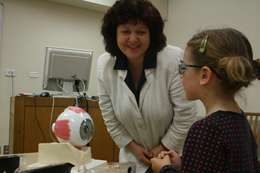
Gaining an insight into the implications of vision loss may now be as simple as donning a pair of ‘vision goggles’, thanks to a creative new teaching aid.
Despite it being one of the country’s most common long-term health problems, Australians are largely in the dark about the very real, day-to-day implications of vision loss.
Over 161 million people worldwide experience some sort of visual impairment, with 9.4 per cent of Australians aged 55 or over estimated to fit within this category. With a rapidly ageing population, the number of people affected by vision loss has been forecast to almost double by 2024.
This represents a significant future health problem for Australian health practitioners and policy makers. It also presents a challenge to researchers, to communicate effectively with the public and increase awareness of this increasingly prevalent health complication.
A group of early career researchers from the Australian Research Council (ARC) Centre for Excellence in Vision Science (The Vision Centre) at ANU has taken up this challenge. Dubbed the Young Visionaries, they have set up an interactive science outreach program that is dedicated to the cause of communicating complex scientific research to kindergarten and primary-aged school students about the importance of good eye care, and the value of ongoing vision research.
The work of the Young Visionaries was inspired by the work of Dr. Krisztina Valter, a Chief Investigator in the Vision Center, whose ‘vision goggles’ have become an integral part of this new program. The vision goggles can be custom made to mimic different visual defects, such as blurred vision arising from cataracts, tunnel vision or scotoma, as experienced by people affected by macular degeneration.
Valter originally developed the goggles to act as a teaching device in her undergraduate neuroscience classes at ANU. She explains that a major challenge was helping students identify different types of damage to the visual system – whether it be within the retina itself, or deeper in the brain.
“I prepared the goggles and had the students view images so that they could appreciate the differences between the various types of damage. What I found was that as well as being a good way to communicate information, the students really enjoyed using the vision goggles – they found the exercise really interesting.”
When she was asked to speak to a group of local Canberra kindergarten students, Valter took her vision goggles with her. This educational experiment was a huge success, allowing the children to wear the goggles while carrying out a series of simple activities.
“They were fascinated by the activity,” she says. “They didn’t just go away and talk about it with their parents; a year later they still remembered the experience of the vision goggles. What this tells us is that if you give young children an activity that they can identify with, it really sticks with them.”
Valter says that the secret to successful science communication lies in its capacity to engage young people on a level they can understand, without over-simplifying the important issues.
“If we teach science as something that is ‘out there’, and is really hard, we might not capture the interest of many students. If we can find a way to communicate with students in a way that interests them, they will be discovering how interesting science can be.”
Furthermore, in addition to aiding student learning, Valter argues that capturing the interest of students early on is in the interest of future scientific progress.
“New ideas really drive science,” she explains. “There might be some really fantastic students in a class, with lots of good ideas, who we really want to identify. It’s not just learning about things in books that is important in science, but the discovery of these new ideas.”
More information: 'When seeing is believing’ will appear in the next edition of ANU Reporter, available on 1 February 2011 both online and in The Canberra Times.


