Ancient raindrops reveal a wave of mountains sent south by sinking Farallon plate
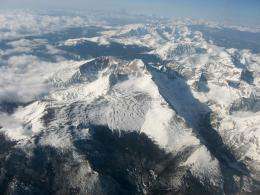
(PhysOrg.com) -- Analyzing the isotope ratios of ancient raindrops preserved in soils and lake sediments, Stanford researchers have shown that a wave of mountain building began in British Columbia, Canada about 49 million years ago and rolled south to Mexico. The finding helps put to rest the idea that there was once a Tibet-like plateau across the western US that collapsed and eroded into the mountains we see today.
50 million years ago, mountains began popping up in southern British Columbia. Over the next 22 million years, a wave of mountain building swept (geologically speaking) down western North America as far south as Mexico and as far east as Nebraska, according to Stanford geochemists. Their findings help put to rest the idea that the mountains mostly developed from a vast, Tibet-like plateau that rose up across most of the western U.S. roughly simultaneously and then subsequently collapsed and eroded into what we see today.
The data providing the insight into the mountains – so popularly renowned for durability – came from one of the most ephemeral of sources: raindrops. Or more specifically, the isotopic residue – fingerprints, effectively – of ancient precipitation that rained down upon the American west between 65 and 28 million years ago.
Atoms of the same element but with different numbers of neutrons in their nucleus are called isotopes. More neutrons make for a heavier atom and as a cloud rises, the water molecules that contain the heavier isotopes of hydrogen and oxygen tend to fall first. By measuring the ratio of heavy to light isotopes in the long-ago rainwater, researchers can infer the elevation of the land when the raindrops fell.
The water becomes incorporated into clays and carbonate minerals on the surface, or in volcanic glass, which are then preserved for the ages in the sediments.
Hari Mix, a PhD candidate in Environmental Earth System Science at Stanford, worked with the analyses of about 2,800 samples – several hundred that he and his colleagues collected, the rest from published studies – and used the isotopic ratios to calculate the composition of the ancient rain. Most of the samples were from carbonate deposits in ancient soils and lake sediments, taken from dozens of basins around the western U.S.
Using the elevation trends revealed in the data, Mix was able to decipher the history of the mountains. "Where we got a huge jump in isotopic ratios, we interpret that as a big uplift," he said.
"We saw a major isotopic shift at around 49 million years ago, in southwest Montana," he said. "And another one at 39 mya, in northern Nevada" as the uplift moved southward. Previous work by Chamberlain's group had found evidence for these shifts in data from two basins, but Mix's work with the larger data set demonstrated that the pattern of uplift held across the entire western U.S.
The uplift is generally agreed to have begun when the Farallon plate, a tectonic plate that was being shoved under the North American plate, slowly began peeling away from the underside of the continent.
"The peeling plate looked sort of like a tongue curling down," said Page Chamberlain, a professor in environmental Earth system science who is Mix's advisor.
As hot material from the underlying mantle flowed into the gap between the peeling plates, the heat and buoyancy of the material caused the overlying land to rise in elevation. The peeling tongue continued to fall off, and hot mantle continued to flow in behind it, sending a slow-motion wave of mountain-building coursing southward.
"We knew that the Farallon plate fell away, but the geometry of how that happened and the topographic response to it is what has been debated," Mix said.
Mix and Chamberlain estimate that the topographic wave would have been at least one to two kilometers higher than the landscape it rolled across and would have produced mountains with elevations up to a little over 4 kilometers (about 14,000 feet), comparable to the elevations existing today.
Mix said their isotopic data corresponds well with other types of evidence that have been documented.
"There was a big north to south sweep of volcanism through the western U.S. at the exact same time," he said.
There was also a simultaneous extension of the Earth's crust, which results when the crust is heated from below, as it would have been by the flow of hot magma under the North American plate.
"The pattern of topographic uplift we found matches what has been documented by other people in terms of the volcanology and extension," Mix said.
"Those three things together, those patterns, all point to something going on with the Farallon plate as being responsible for the construction of the western mountain ranges, the Cordillera."
Chamberlain said that while there was certainly elevated ground, it was not like Tibet.
"It was not an average elevation of 15,000 feet. It was something much more subdued," he said.
"The main implication of this work is that it was not a plateau that collapsed, but rather something that happened in the mantle, that was causing this mountain growth," Chamberlain said.
More information: Mix will present results of the study at the American Geophysical Union annual meeting in San Francisco on Friday, Dec. 17.
Provided by Stanford University


