Ability to recognize faces peaks in the 30s
December 15, 2010 by Lin Edwards
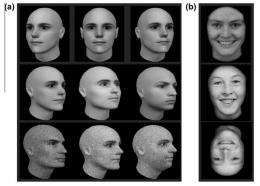
Face images from experiments. Image credit: Cognition (2010), doi:10.1016/j.cognition.2010.11.00. For more details, please see the original paper.
(PhysOrg.com) -- A new online experiment has discovered that people between the ages of 30 and 34 are best able to remember faces. This finding contradicts the traditional belief that mental faculties all begin to decline from early adulthood.
The research aims to help scientists understand how the way our brains process information changes as we age, and how we process information about people in a social context. The researchers, led by Laura Germine of Harvard University in the US devised a 25-minute online experiment using an Internet version of the Cambridge Face Memory Test to find out.
The test presents the volunteer with six computer generated images of faces and then tests the subjects ability to recall those faces when presented with a group of similar faces in different orientations and lighting conditions. All the faces are of young white males. Over 44,600 volunteers between the ages of 10 and 70 took part in the online experiments. Germine then replicated the tests with 10 white female faces and with faces of white girls and boys.
The results, to be presented in an upcoming issue of the journal Cognition showed that 30-34-year-olds of both genders performed best, when it was expected that people in their early 20s would be at the peak of performance because this is the age when the brain reaches full maturity. Germine said the preliminary results suggest the brain may need an extended period of visual tuning in early adulthood to enable people to recognize large numbers of faces, many of them similar.
The experiment did not collect information on the race or ethnicity of participants, which might have influenced their ability to recognize the white faces used in the test.
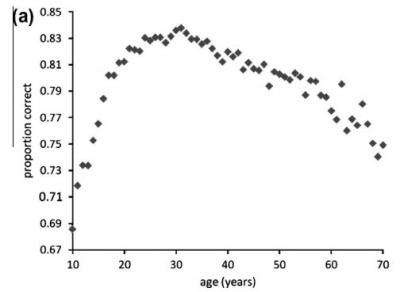
Peak estimation - Cambridge Face Memory Test (v.2). (a) Performance on the Cambridge Face Memory Test in terms of percent correct, averaged by age of participants. Image credit: Cognition (2010), doi:10.1016/j.cognition.2010.11.00
Other tests carried out by Germines research team included memorizing of upside-down faces of children, and recognition of mens names. In these tests the best performers were in the 20-30 age group.Germine, a graduate student in psychology, said the next step would be to track volunteers from childhood to adulthood to confirm the finding that face memory is at its best when people are in their early 30s.
Germine is webmaster and designer of the website Test My Brain, which is running a number of online experiments to determine how the brain works on a number of tests. Having the experiments run online allows the researchers to access a larger number of individuals from a wider cross-section of people than would otherwise be possible.
More information: Germine, L. T., et al. Where cognitive development and aging meet: Face learning ability peaks after age
30. Cognition (2010), doi:10.1016/j.cognition.2010.11.00
The research paper is available here: http://www.people. … tion2010.pdf
© 2010 PhysOrg.com
-
From lemons to lemonade: Reaction uses carbon dioxide to make carbon-based semiconductor,
28 comments
-
Thioridazine kills cancer stem cells in human while avoiding toxic side-effects of conventional cancer treatments,
3 comments
-
SpaceX private rocket blasts off for space station (Update),
41 comments
-
Climate scientists say they have solved riddle of rising sea,
30 comments
-
Scotland passes turbine test to harness tidal power,
40 comments
-
A question about drug tolerance
May 23, 2012
-
Poor nutrition leading to overeating?
May 23, 2012
-
Math and dyslexia?
May 21, 2012
-
portable metabolism meter?
May 21, 2012
-
Rare medical conditions on 20/20 tonight
May 18, 2012
-
"Good" Cholesterol in Doubt
May 17, 2012
- More from Physics Forums - Medical Sciences
More news stories
Of mice and mental models: Neuroscientific implications of risk-optimized behavior in the mouse
(Medical Xpress) -- Regardless of an organism’s biological complexity, every encephalized animal continuously makes under-informed behavioral choices that can have serious consequences. Despite its ubiquity, ...
Skp2 activates cancer-promoting, glucose-processing Akt
HER2 and its epidermal growth factor receptor cousins mobilize a specialized protein to activate a major player in cancer development and sugar metabolism, scientists report in the May 25 issue of Cell.
13 hours ago |
not rated yet |
0
|
Tongue analysis software uses ancient Chinese medicine to warn of disease
For 5,000 years, the Chinese have used a system of medicine based on the flow and balance of positive and negative energies in the body. In this system, the appearance of the tongue is one of the measures used to classify ...
10 hours ago |
1 / 5 (1) |
0
|
Cancer may require simpler genetic mutations than previously thought
Chromosomal deletions in DNA often involve just one of two gene copies inherited from either parent. But scientists haven't known how a deletion in one gene from one parent, called a "hemizygous" deletion, can contribute ...
16 hours ago |
not rated yet |
0
|
First study to suggest that the immune system may protect against Alzheimer's changes in humans
Recent work in mice suggested that the immune system is involved in removing beta-amyloid, the main Alzheimer's-causing substance in the brain. Researchers have now shown for the first time that this may apply in humans.
Medicine & Health / Alzheimer's disease & dementia
17 hours ago |
5 / 5 (3) |
0
|
Dragon arrives at space station in historic 1st (Update 2)
The privately bankrolled Dragon capsule made a historic arrival at the International Space Station on Friday, triumphantly captured by astronauts wielding a giant robot arm.
Landmark calculation clears the way to answering how matter is formed
(Phys.org) -- An international collaboration of scientists, including Thomas Blum, associate professor of physics, is reporting in landmark detail the decay process of a subatomic particle called a kaon ...
High-speed method to aid search for solar energy storage catalysts
Eons ago, nature solved the problem of converting solar energy to fuels by inventing the process of photosynthesis.
It's in the genes: Research pinpoints how plants know when to flower
Scientists believe they've pinpointed the last crucial piece of the 80-year-old puzzle of how plants "know" when to flower.
Researchers solve structure of human protein critical for silencing genes
In a study published in the journal Cell on May 24, Cold Spring Harbor Laboratory (CSHL) scientists describe the three-dimensional atomic structure of a human protein bound to a piece of RNA that "guides" the pr ...
MIT researchers devise new means to synchronize a group of robots (w/ Video)
(Phys.org) -- For several years, roboticists have been working out ways to get a group of robots to perform synchronized activities as demonstrated most often in dance routines. Its not just about trying ...
