Research uncovers extensive natural recovery after spinal cord injury
A study led by researchers in the Department of Neurosciences at the University of California, San Diego School of Medicine shows unexpected and extensive natural recovery after spinal cord injury in primates. The findings, to be published November 14 in the advance online edition of Nature Neuroscience, may one day lead to the development of new treatments for patients with spinal cord injuries.
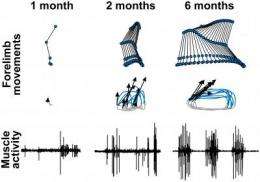
While regeneration after severe brain and spinal cord injury is limited, milder injuries are often followed by good functional recovery. To investigate how this occurs, UC San Diego and VA Medical Center San Diego researchers studied adult rhesus monkeys. The team was surprised to see that connections between circuits in the spinal cord re-grew spontaneously and extensively, restoring fully 60% of the connections 24 weeks after a mild spinal cord injury.
"The number of connections in spinal cord circuits drops by 80 percent immediately after the injury," said Ephron Rosenzweig, PhD, assistant project scientist in UCSD Department of Neurosciences. "But new growth sprouting from spared axons – the long fibers extending from the brain cells, or neurons, which carry signals to other neurons in the central nervous system – restored more than half of the original number of connections." He added that this was particularly surprising since the phenomenon does not appear in rodents – the traditional study model.
The research was led by Rosenzweig and Gregoire Courtine of the University of Zurich in Switzerland. Senior study director was Mark H. Tuszynski, MD, PhD, professor of neurosciences and director of the Center for Neural Repair at UC San Diego, and neurologist at the Veterans Affairs San Diego Health System.
It was not previously known that an injured spinal cord could naturally restore such a high proportion of connections. More profoundly, the spontaneous recovery was accompanied by extensive recovery of movement on the affected side of the body. Tuszynski said the team is now investigating how the nervous system is able to generate so much natural growth after injury. This knowledge could lead to development of drugs or genes that could transmit high-growth signals to spinal cord damage sites after more severe spinal cord injury.
The work highlights an important role for primate models in translating basic scientific research into practical, therapeutic treatments for people. The spinal cords of humans and other primates are different from rodents, both in overall anatomy and in specific functions. For example, the corticospinal tract – a collection of nerve cell fibers linking the cerebral cortex of the brain and the spinal cord – is much more important for muscle movement in primates than in rats.
"With similar injuries, rodents show much less regrowth and recovery of limb function," said Rosenzweig. The challenge now is to determine what exactly is prompting neuronal axons to sprout new connections, leading to recovered movement. That has exciting clinical relevance, Rosenzweig said, because discoveries resulting from further research could be applied to patients with severe injury to their central nervous system.


