Tiny marine creatures could help diagnose the health of Puget Sound
November 1, 2010 by Vince Stricherz
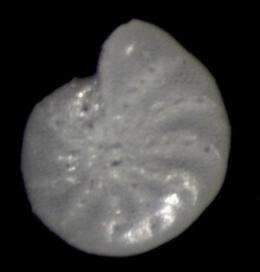
This foraminifera species, Elphidium incertum, is a half-millimeter in diameter and bears a striking resemblance to a chambered nautilus.
(PhysOrg.com) -- University of Washington researchers are using tiny sea creatures called foraminifera to help diagnose the health of Puget Sound.
From low oxygen levels in areas of Hood Canal to pollution in Elliott and Commencement bays, scientists have documented some serious environmental issues in Puget Sound, whose shores are home to more than 3 million Western Washington residents.
Now University of Washington researchers are using tiny sea creatures called foraminifera as a diagnostic tool, to determine what's wrong -- or what's right -- with the Sound.
Foraminifera are single-cell organisms typically less than half a millimeter in size. They develop shells that look remarkably similar to much larger marine organisms (a chambered nautilus, for example). Because their responses to pollution vary, foraminifera can serve as a barometer for the health of the Sound and often carry the evidence in their shells.
So far, samples have turned up a large percentage of a common foraminifera species, Buccella frigida, in Seattle's Elliott Bay and Everett's Port Gardner bay, which suggests a good marine environment, said Ruth Martin, a postdoctoral researcher at the Burke Museum of Natural History and Culture at the UW.
That species, however, makes up a much smaller percentage of the foraminifera in samples taken from Tacoma's Commencement Bay, where it is replaced by species more tolerant of degraded water quality.
Worldwide, there are perhaps 10,000 living species of foraminifera -- Martin calls them "amoebas with shells" -- but only about 30 species have been found in Puget Sound.
"What we've seen so far is that this is a pretty limited community, and there is one species that we would have expected to see that is missing," Martin said. That species, Ammonia beccari, is tolerant of a variety of conditions and is typically abundant in coastal waterways, but it is unclear why it has not been seen in Puget Sound.
Martin works in the laboratory of Liz Nesbitt, a UW associate professor of Earth and space sciences and the Burke Museum's curator of invertebrate paleontology and micropaleontology. Nesbitt began the project two years ago in the hope of establishing a baseline of data to judge long-term changes in the health of the Sound.
"One of the reasons I took this on is because it is a perfect opportunity for undergraduate students to be involved in research," Nesbitt said. "They have given us data we can use."
Martin's initial findings are being presented Monday (Nov. 1) at the Geological Society of America annual meeting in Denver.
The scientists are culling information from samples taken from the surface of the sediment on the floor of the Sound from 1997 through this year by the state Department of Ecology and the National Oceanic and Atmospheric Administration.
The samples come from throughout the Sound, but the limited time frame makes it hard to discern trends, Martin said. However, she has noted an increase in foraminifera species in Elliott Bay during the last decade, a possible sign of changing water quality.
Nesbitt and Martin hope to conduct further sediment sampling in the coming years to get a clearer picture of the Sound's overall health and how it has changed over time. They hope to include core samples from deeper in the sediment that will produce foraminifera shells, which can provide data on changes that have taken place over decades or even centuries.
"The foraminifera hang around, or their shells hang around. They respond to pollution, and to mitigation, and that information is incorporated into their shells and into their communities," Martin said. "They can give us insights on what has been happening in a given area."
Provided by
University of Washington
-
From lemons to lemonade: Reaction uses carbon dioxide to make carbon-based semiconductor,
28 comments
-
Every black hole contains a new universe: A physicist presents a solution to present-day cosmic mysteries,
217 comments
-
New silicon memory chip developed,
16 comments
-
Thioridazine kills cancer stem cells in human while avoiding toxic side-effects of conventional cancer treatments,
3 comments
-
SpaceX private rocket blasts off for space station (Update),
41 comments
-
More human population = greater mass?
12 hours ago
-
Conversion from aircraft bearing to normal degrees
May 23, 2012
-
Interpretation/Analysis of the Lab results(HEPA filter)
May 22, 2012
-
Has anyone here attended the The Urbino Summer School in Paleoclimatology?
May 22, 2012
-
Earthquakes: Mag 6 N. Italy and Mag 5.6 W. Bulgaria
May 21, 2012
-
determining time frame for most recent geological layers
May 17, 2012
- More from Physics Forums - Earth
More news stories
Dragon arrives at space station in historic 1st (Update 2)
The privately bankrolled Dragon capsule made a historic arrival at the International Space Station on Friday, triumphantly captured by astronauts wielding a giant robot arm.
Space & Earth / Space Exploration
13 hours ago |
5 / 5 (8) |
10
Dragon makes history with space station docking
The private company SpaceX made history Friday with the docking of its Dragon capsule to the International Space Station, the most impressive feat yet in turning routine spaceflight over to the commercial ...
Space & Earth / Space Exploration
6 hours ago |
4.8 / 5 (6) |
0
Aliens don't want to eat us, says former SETI director
Alien life probably isnt interested in having us for dinner, enslaving us or laying eggs in our bellies, according to a recent statement by former SETI director Jill Tarter.
Space & Earth / Space Exploration
15 hours ago |
4.8 / 5 (9) |
23
SKA super telescope to be built in Australia, South Africa (Update 2)
A long-running joust to host a radio telescope that would give mankind its farthest peek into the Universe ended on Friday with a Solomon-like judgement to split the site between Australia and South Africa.
15 hours ago |
5 / 5 (5) |
2
NASA sees Hurricane Bud threaten western Mexico's coast
NASA satellites are providing rainfall, temperature, pressure, visible and infrared data to forecasters as Hurricane Bud is expected to make a quick landfall in western Mexico this weekend before turning back ...
Space & Earth / Earth Sciences
9 hours ago |
not rated yet |
0
Of mice and mental models: Neuroscientific implications of risk-optimized behavior in the mouse
(Medical Xpress) -- Regardless of an organism’s biological complexity, every encephalized animal continuously makes under-informed behavioral choices that can have serious consequences. Despite its ubiquity, ...
Landmark calculation clears the way to answering how matter is formed
(Phys.org) -- An international collaboration of scientists, including Thomas Blum, associate professor of physics, is reporting in landmark detail the decay process of a subatomic particle called a kaon ...
High-speed method to aid search for solar energy storage catalysts
Eons ago, nature solved the problem of converting solar energy to fuels by inventing the process of photosynthesis.
It's in the genes: Research pinpoints how plants know when to flower
Scientists believe they've pinpointed the last crucial piece of the 80-year-old puzzle of how plants "know" when to flower.
Researchers solve structure of human protein critical for silencing genes
In a study published in the journal Cell on May 24, Cold Spring Harbor Laboratory (CSHL) scientists describe the three-dimensional atomic structure of a human protein bound to a piece of RNA that "guides" the pr ...
MIT researchers devise new means to synchronize a group of robots (w/ Video)
(Phys.org) -- For several years, roboticists have been working out ways to get a group of robots to perform synchronized activities as demonstrated most often in dance routines. Its not just about trying ...