Sunburnt whales: Rising UV radiation could be damaging whales' skin
November 10, 2010

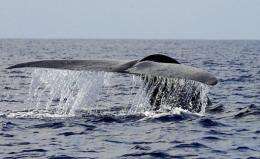
A blue whale swimming in the deep waters off the southern Sri Lankan town of Mirissa

Enlarge

A blue whale swimming in the deep waters off the southern Sri Lankan town of Mirissa. A closely-studied community of whales, including the threatened blue whale, showed worrying signs of sunburn, possibly because of ozone depletion in the atmosphere, biologists reported on Wednesday.

Whales exhibit skin damage consistent with acute sunburn in humans, and it seems to be getting worse over time, reveals research published this week in Proceedings of the Royal Society B.

Scientists from the Zoological Society of London (ZSL), Queen Mary, University of London and CICIMAR, studied blue , fin whales and in the Gulf of California to determine the effect of rising levels of ultraviolet radiation (UVR) on their health.

For a number of years scientists have observed blisters on the skin of whales. Now, using high-quality photos to give accurate counts of the blisters and analysing areas of damage in skin samples, this research has found that the three species of whale exhibit that is commonly associated with acute sunburn in humans.

Notably, the scientists also found that signs of sun damage were more severe in the paler-skinned blue whales, compared with the darker-skinned fin whales, and that in blue whales the symptoms of sunburn seem to be getting worse during the three years the study took place.

The UV index for the Gulf of California fluctuates between high and extremely high throughout the year. Lead author, Laura Martinez–Levasseur from ZSL and Queen Mary, says, "Whales need to come to the surface to breathe air, to socialise and to feed their young, meaning that they are frequently exposed to the full force of the sun.

"The increase in skin damage seen in is a matter of concern, but at this stage it is not clear what is causing this increase. A likely candidate is rising UVR as a result of either ozone depletion, or a change in the level of cloud cover."

Co-author Professor Edel O'Toole, from Queen Mary, says, "As we would expect to see in humans, the whale species that spent more 'time in the sun' suffered greater sun damage. We predict that whales will experience more severe sun damage if continues to increase."

The next phase of the research will look at the expression of genes involved in the production of skin pigmentation and DNA damage repair and try to gain a greater understanding of the consequences of sun damage in whales.

Lead author Dr Karina Acevedo-Whitehouse, from ZSL says, "We have shown that exposure to strong sun is damaging to whales' skin. We now need to understand the knock-on effects and whether whales are able to respond quickly to increasing radiation by enhancing their natural sun-protection mechanisms."

More information: The paper 'Acute sun damage and photoprotective responses in whales' ( DOI:10.1098/rspb.20101903 ) will be published online in Proceedings of the Royal Society B on Wednesday 10 November.

Provided by Zoological Society of London

4.3 /5 (3 votes)  

Rank 4.3 /5 (3 votes)
Relevant PhysicsForums posts

More news stories

It's in the genes: Research pinpoints how plants know when to flower

Scientists believe they've pinpointed the last crucial piece of the 80-year-old puzzle of how plants "know" when to flower.

Biology / Biotechnology

created 6 hours ago | popularity 4 / 5 (5) | comments 0 | with audio podcast

Researchers solve structure of human protein critical for silencing genes

In a study published in the journal Cell on May 24, Cold Spring Harbor Laboratory (CSHL) scientists describe the three-dimensional atomic structure of a human protein bound to a piece of RNA that "guides" the pr ...

Biology / Cell & Microbiology

created 6 hours ago | popularity 5 / 5 (3) | comments 0 | with audio podcast

Study uncovers secret to speedy burrowing by razor clams

(Phys.org) -- If you look at a razor burrowing clam sitting in a bucket, you’d never guess that it could burrow itself down into the soil, much less do it with any speed. Razor clams look like fat straws, ...

Biology / Plants & Animals

created 15 hours ago | popularity not rated yet | comments 3 | with audio podcast report

Copy of the genetic makeup travels in a protein suitcase

Scientists from the Institute for Physical and Theoretical Chemistry at the University of Bonn have succeeded for the first time in the real time filming of the transport of an important information carrier in biological ...

Biology / Cell & Microbiology

created 12 hours ago | popularity not rated yet | comments 0 | with audio podcast

'Transformer' protein makes different sized transport pods

These spheres may look almost identical, but subtle differences between them revealed a molecular version of the robots from Transformers. Each sphere is a vesicle, a pod that cells use to transport materials ...

Biology / Cell & Microbiology

created 12 hours ago | popularity not rated yet | comments 0


Of mice and mental models: Neuroscientific implications of risk-optimized behavior in the mouse

(Medical Xpress) -- Regardless of an organism’s biological complexity, every encephalized animal continuously makes under-informed behavioral choices that can have serious consequences. Despite its ubiquity, ...

Dragon arrives at space station in historic 1st (Update 2)

The privately bankrolled Dragon capsule made a historic arrival at the International Space Station on Friday, triumphantly captured by astronauts wielding a giant robot arm.

Landmark calculation clears the way to answering how matter is formed

(Phys.org) -- An international collaboration of scientists, including Thomas Blum, associate professor of physics, is reporting in landmark detail the decay process of a subatomic particle called a kaon – ...

High-speed method to aid search for solar energy storage catalysts

Eons ago, nature solved the problem of converting solar energy to fuels by inventing the process of photosynthesis.

MIT researchers devise new means to synchronize a group of robots (w/ Video)

(Phys.org) -- For several years, roboticists have been working out ways to get a group of robots to perform synchronized activities as demonstrated most often in dance routines. It’s not just about trying ...

Researchers demonstrate possible primitive mechanism of chemical info self-replication

(Phys.org) -- When scientists think about the replication of information in chemistry, they usually have in mind something akin to what happens in living organisms when DNA gets copied: a double-stranded molecule ...