Steam train X-rayed for first time
November 2, 2010

Steam train X-rayed for first time

Enlarge

(PhysOrg.com) -- A steam locomotive has been X-rayed by an innovative new mobile X-ray unit used for scanning cargo and vehicles for criminal activity.

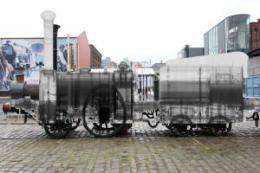
The replica 1830 Planet at MOSI (Museum of Science & Industry, Manchester) was X-rayed to test the new Rapiscan Eagle M60, which was developed by Rapiscan in association with The University of Manchester.

It now hits the road to scan cargo and unoccupied passenger vehicles to protect against threats, counter trade fraud and detect contraband such as narcotics.

The insides of Planet locomotive are revealed in a fascinating X-ray image taken by the M60, which shows its complicated system of boiler tubes, cylinders, valves and watertank. It is the first time that such an image has been taken of a steam locomotive.

The M60 was originally designed to help identify contraband and plastic explosive type materials in cargo shipments, and is able to detect different materials such as wood and metal.

It is the first Rapiscan system with a high energy X-ray imaging system in a road legal, mobile platform.

Rapiscan Systems works regularly with The University of Manchester and funds research work by mathematics postgraduates to help develop X-ray imaging, including work on the M60.

Professor Bill Lionheart, professor of Applied Mathematics at The University of Manchester, said: "Stephenson's Planet was made for the first passenger railway here in the North West so it seems fitting to make an X-ray image of it with Rapiscan's Eagle truck scanner, which has also been developed in the region.

“Unlike Stephenson's more famous rocket the cylinders of Planet are inside. With Rapiscan's huge X-ray machine we should be able to show the inside workings of the engine.”

Robin Holgate, MOSI’s Head of Interpretation and Learning said: “It’s fascinating to see the insides of Planet in the image taken by Rapiscan’s Eagle M60 and really helps us to understand the complex engineering behind this 19th century technology. We hope to display the photo in the future for our visitors to see the inner workings of our favourite steam locomotive.”

The original Planet steam locomotive was built by Robert Stephenson and ran on the Liverpool & Manchester Railway – the world’s first passenger railway, built in 1830. MOSI is based in the buildings of the former Liverpool Road railway station – the oldest surviving station on the line.

Rapiscan Systems, a division of OSI Systems, Inc. is the world’s leading security screening provider, utilizing X-ray and gamma-ray imaging, and advanced threat identification techniques such as neutron and diffraction analysis. Rapiscan Systems products are manufactured at four locations including Biddulph near Stoke-on-Trent.

More information: For more information on Rapiscan Systems, please visit http://www.rapisca … systems.com.
For more information on MOSI look up http://www.mosi.org.uk

Provided by University of Manchester search and more info website

3.3 /5 (4 votes)  

Filter


Move the slider to adjust rank threshold, so that you can hide some of the comments.


Display comments: newest first

Flakk
Nov 02, 2010

Rank: not rated yet
It now hits the road to scan cargo and unoccupied passenger vehicles to protect against threats, counter trade fraud and detect contraband such as narcotics.


So these guys can just drive down the street and "Scan" your vehicle as they see fit? Am I the only one who sees something wrong with that.
Rank 3.3 /5 (4 votes)
Relevant PhysicsForums posts

More news stories

Yahoo kills 'Livestand' just 6 months after debut

(AP) -- Yahoo is killing a tablet magazine called Livestand just six months its debut on the iPad.

Technology / Business

created 5 hours ago | popularity not rated yet | comments 1

Computers excel at identifying smiles of frustration (w/ Video)

(Phys.org) -- Researchers at the Massachusetts Institute of Technology (MIT) in the US have trained computers to recognize smiles, and they have turned out to be more adept at recognizing smiles of frustration ...

Technology / Computer Sciences

created 18 hours ago | popularity 4 / 5 (2) | comments 1 | with audio podcast report

Yahoo! ditches digital newsstand for iPads

Yahoo! shuttered its fledgling digital newsstand for iPads on Friday in what it said was the start of a product purge intended to make the floundering Internet pioneer more nimble.

Technology / Internet

created 6 hours ago | popularity not rated yet | comments 0

Facebook IPO debacle raises investor dander

The spate of complaints and investigations over the Facebook stock offering suggests big institutions had an edge over small investors, raising questions about the process.

Technology / Business

created 7 hours ago | popularity not rated yet | comments 0

Apple CEO Cook gives up $75M in stock dividends

(AP) -- Apple CEO Tim Cook is giving up $75 million in dividends on restricted stock that the company is awarding to all of its employees.

Technology / Business

created 11 hours ago | popularity 1.8 / 5 (4) | comments 2


Of mice and mental models: Neuroscientific implications of risk-optimized behavior in the mouse

(Medical Xpress) -- Regardless of an organism’s biological complexity, every encephalized animal continuously makes under-informed behavioral choices that can have serious consequences. Despite its ubiquity, ...

Dragon arrives at space station in historic 1st (Update 2)

The privately bankrolled Dragon capsule made a historic arrival at the International Space Station on Friday, triumphantly captured by astronauts wielding a giant robot arm.

Landmark calculation clears the way to answering how matter is formed

(Phys.org) -- An international collaboration of scientists, including Thomas Blum, associate professor of physics, is reporting in landmark detail the decay process of a subatomic particle called a kaon – ...

High-speed method to aid search for solar energy storage catalysts

Eons ago, nature solved the problem of converting solar energy to fuels by inventing the process of photosynthesis.

It's in the genes: Research pinpoints how plants know when to flower

Scientists believe they've pinpointed the last crucial piece of the 80-year-old puzzle of how plants "know" when to flower.

Researchers solve structure of human protein critical for silencing genes

In a study published in the journal Cell on May 24, Cold Spring Harbor Laboratory (CSHL) scientists describe the three-dimensional atomic structure of a human protein bound to a piece of RNA that "guides" the pr ...