The new sexy: Science
Barbie has become a computer engineer, with pink sensible shoes and a pink laptop. One of the most-watched sitcoms on network TV tells the story of three physicists and one engineer working at an institution that resembles Caltech in Pasadena. Last month, the White House hosted its first-ever science fair.
“When Barbie gets to be a computer scientist, you know that science has become sexy,” Ira Flatow, host of NPR’s “Science Friday,” said last week during a visit to UC San Diego.
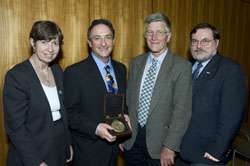
Flatow had come to campus to receive the Nierenberg Prize for Science in the Public Interest at UCSD’s Scripps Institution of Oceanography. The prize is named in honor of William A. Nierenberg, who led Scripps for 21 years.
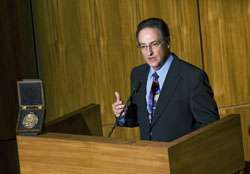
“I consider this my greatest honor to date,” Flatow told a standing-room-only audience Tuesday at the Scripps Seaside Forum. The prize rewards leaders that bring the excitement and adventure of science to the public—and Flatow is a fitting member of that group, Chancellor Marye Anne Fox said. “It’s going to be a fabulous evening,” she promised the audience before the talk. The prize is celebrating its 10th anniversary, while UCSD is celebrating its 50th. Of course, Scripps has been around for more than 100 years, Fox pointed out.
Flatow has featured on his show many Scripps scientists, from Charles David Keeling, the father of the Keeling Curve, to Miriam Goldstein, the researcher who led a trip to the Great Pacific Garbage Patch. “He makes science fun and brings energy to all his stories,” Scripps Director Tony Haymet said of Flatow.
During his four-decade career as a journalist, Flatow has gotten to know some of the world’s most renowned scientists up close and personal. He found out that neurologist Oliver Sacks has a passion for giant squid—to the point where he wore a giant squid T-shirt in the Science Friday studio. Primatologist Jane Goodall surprised Flatow by saying she believed new species of apes and primates would be discovered.
Scientists need to take advantage of their new-found popularity, Flatow said. Though the public is interested in science, challenges remain. For example, 40 percent of Americans wrongly believe that dinosaurs and humans coexisted on Earth; 53 percent don’t know that the Earth goes around the Sun in 365 days; and 51 percent believe in UFOs, Flatow said. Also, about half of the newly elected Republican members of Congress are skeptical on the issue of global warming, Flatow said.
“It’s up to scientists to speak out when they get the opportunity to talk about the truth,” he said.
This has become more difficult as media outlets, from TV networks to newspapers, have been downsizing or even eliminating their science coverage. CNN fired its whole science unit, including anchor and reporter Miles O’Brien in 2008. The Boston Globe, which is owned by The New York Times Company, last year killed its health and science section, but stopped short of laying off its staff.
At the same time, 44 percent of Americans are saying that the media isn’t covering science enough, according to the Pew Research Center for the People and the Press, Flatow pointed out. Teenagers also ranked scientists in the top three professions that make a contribution to the world. When young girls were asked this year to vote for Barbie’s next profession, computer engineer came in first. The doll features sensible shoes, albeit pink, and a pink laptop.
News outlets might not be getting the message, but Hollywood is. In the past five years, shows revolving around science have taken to the airwaves—and become quite popular. MythBusters, a weekly Discovery Channel show, which tests urban legends in the lab and in the field, is one of the most popular shows on cable. Numb3rs, a CBS show starring a mathematician who solves crimes for the FBI, was one of the most popular network TV series for six seasons, Flatow said.
Finally, “The Big Bang Theory,” a CBS sitcom, came along. “It’s like ‘Friends’ with geeky physicists,” Flatow said. The show, one of the most popular on TV today, follows three physicists and one engineer as they try to get girlfriends, deal with their parents—and do research. The series employs a consultant who makes sure that all the science in each episode is accurate, down to every single equation. Flatow and Science Friday were featured on the show.
We’ve come a long way from the stereotypical portrait of the scientist as an old, white man with crazy hair, Flatow said. He added today’s youth badly needs to be encouraged to pursue careers in the sciences in order to create the industries and jobs the country badly needs. Children are natural scientists, he also said.
“When a kid takes a pop tart and sticks it in a VCR, he’s doing an experiment,” Flatow said.
So don’t slap their wrist, just channel that curiosity toward more productive outlets, he added. “We need to foster the teaching of science,” he said.
Science is an important force for change, said Water Tschinkel, son-in-law of longtime Scripps director Nierenberg. Yet scientists are often poorly equipped to relay that message to the public. That’s when people like Flatow are key, Tschinkel said.
After the talk, Scripps graduate students Aly Fleming and Emily Kelly said they felt a renewed enthusiasm for their work. It was refreshing to see how science doesn’t just happen in the lab, Fleming said. “It’s the process of understanding ourselves and our world, “ she said.
“We’re so excited right now,” Kelly said.
“We’re pumped up on science,” Fleming said.
Provided by University of California - San Diego


