Scientists discover how the songbird's brain controls timing during singing
Nov 08, 2010
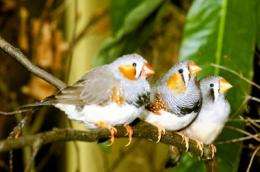
New research that reveals the activity of nerve cells in a songbird's brain as the bird sings a specific song is helping scientists to understand how birds string together sets of syllables -- and it also may provide insight into how the human brain learns language and produces speech. "Unlike dogs and cats, whose vocalizations are innate and unlearned, songbirds learn a song in much the same way as humans learn a language, explains Dezhe Jin at Penn State University. This photo shows an three adult zebra finches, a species that Jin and other members of the research team studied. Credit: Liza Gross

(PhysOrg.com) -- A team of scientists has observed the activity of nerve cells in a songbird's brain as it is singing a particular song. Dezhe Jin, an assistant professor in the Department of Physics at Penn State University and one of the study's authors, explained that understanding how birds string together sets of syllables -- or notes in a song -- may provide some insight into how the human brain learns language and produces speech. The research will be published in the print edition of the journal Nature and is available online.

"Unlike dogs and cats, whose are innate and unlearned, songbirds learn a song in much the same way as humans learn a language -- through cultural transmission," Jin said. "So we decided to study exactly what is going on -- at the level of brain cells -- in a songbird called the zebra finch." Jin explained that both humans and zebra finches arrange sets of learned syllables to communicate. This arrangement of syllables is known as syntax. Jin said that, although finch syntax is much less complicated than human syntax, finch syntax can still provide a model for human .

This video is not supported by your browser at this time.
New research that reveals the activity of nerve cells in a songbird's brain as the bird sings a specific song is helping scientists to understand how birds string together sets of syllables -- and it also may provide insight into how the human brain learns language and produces speech. "Unlike dogs and cats, whose vocalizations are innate and unlearned, songbirds learn a song in much the same way as humans learn a language, explains Dezhe Jin at Penn State University. This sound clip is of an adult zebra finch, a species that Jin and other members of the research team studied. Credit: Dezhe Jin, Penn State

Jin described the area of the brain responsible for a zebra finch's song production as a clump of neurons, which, if absent, renders the bird incapable of singing. To determine exactly how this clump is involved in syntactic production, Jin and his colleagues used special electrodes to monitor the in this neuronal clump. The electrodes recorded the pattern of neuronal firings that occurred while the finches were repeating a song. The scientists found that when a zebra finch produces its song, a specific set of neurons in this clump fire at precisely the moment when a particular syllable is being sung. "The result is a kind of domino or cascade effect," Jin said. "We saw that when one syllable was sung, a specific set of neurons in the clump fired, which in turn caused the next set of neurons to fire, and that was associated with the next syllable in the song being sung." Jin explained that the ordered firing of specific sets of neurons can be likened to a musical score. "The sequential bursts of brain-cell activity represent the sequential notes in the same piece of music," he said.
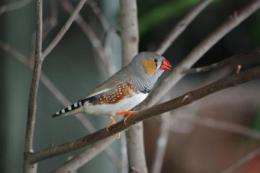
New research that reveals the activity of nerve cells in a songbird's brain as the bird sings a specific song is helping scientists to understand how birds string together sets of syllables -- and it also may provide insight into how the human brain learns language and produces speech. "Unlike dogs and cats, whose vocalizations are innate and unlearned, songbirds learn a song in much the same way as humans learn a language, explains Dezhe Jin at Penn State University. This photo shows an adult zebra finch, which Jin and other members of the research team studied. Credit: Alfonso Jr.

Jin also explained that Darwin's theory of sexual, as opposed to natural, selection could explain the songbird's musical prowess. Sexual selection is the theory that an animal chooses a member of the opposite sex based on some observable feature that signals good health and good genes. The classic example is the male peacock's elaborate and calorically expensive tail, which attracts the female peahen. In male songbirds, an elaborate tail has been replaced by an elaborate song. "A skilled singer will win the attention of more females, and, as such, he will produce more offspring," Jin explained. "It's not that the song itself varies, just the skill with which it's sung. Imagine different pianists playing the same Chopin piece. What sets one apart from the others is his sense of timing and rhythm. In the zebra finch, we found that the timing precision of singing was controlled by bursting properties of individual ."

Jin and his colleagues believe that the next step in their research will be to perform similar studies in other species of songbirds, including the Bengalese finch. "The is a simple model because the bird perfects just one song during its lifetime," Jin explained. "However, other species learn several distinct songs. They have a larger repertoire."

Explore further: Bittersweet: Bait-averse cockroaches shudder at sugar

More information: www.nature.com/nature/journal/vaop/ncurrent/full/nature09514.html

Related Stories

The Link Between Birdsong And Human Language

Nov 10, 2009

Scientists studying how Bengalese finches use sets of syllables to communicate are a step closer to understanding how humans develop and use vocabulary. After studying the neural networks in finch brains, ...

Darwin's finch and the evolution of smell

Apr 06, 2010

Darwin's finches - some 14 related species of songbirds found on the Galapagos and Cocos Islands - will forever be enshrined in history for having planted the seeds of the theory of evolution through natural selection. Today, ...

Recommended for you

Scientists take a new look at an ancient crop

13 hours ago

Though the price makes you wince, you might just buy that bottle of your favorite olive oil anyway. Perhaps it's exactly what you want for the salad dressing you're making tonight and for your special stir-fry ...

Bittersweet: Bait-averse cockroaches shudder at sugar

May 23, 2013

Sugar isn't always sweet to German cockroaches, especially to the ones that avoid roach baits. In a study published May 24 in the journal Science, North Carolina State University entomologists show the ne ...

White tiger mystery solved

May 23, 2013

White tigers today are only seen in zoos, but they belong in nature, say researchers reporting new evidence about what makes those tigers white. Their spectacular white coats are produced by a single change ...

User comments : 0

More news stories

EU bans three pesticides harmful to bees

The European Commission said Friday that it will ban for two years beginning in December pesticides blamed for killing the bees that pollinate food and fruit crops.

Galaxies fed by funnels of fuel

(Phys.org) —Computer simulations of galaxies growing over billions of years have revealed a likely scenario for how they feed: a cosmic version of swirly straws.

Google eyes emerging markets networks

Google has become deeply involved in a series of projects to build and operate wireless networks in emerging markets including sub-Saharan Africa and Southeast Asia, a report said Friday.