Danish astronomer's remains exhumed in Prague
November 15, 2010 By KAREL JANICEK , Associated Press
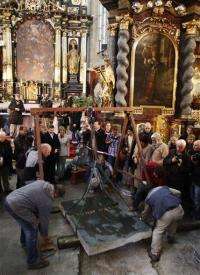
Archeologists lift a tomb stone of a grave of famous Danish astronomer Tycho Brahe at the Church of Our Lady at the Old Town Square in Prague, Czech Republic, Monday, Nov. 15, 2010. An International team of scientists plan to exhume Brahe's remains in efforts to determine the cause of his death. (AP Photo/Petr David Josek)
(AP) -- Astronomer Tycho Brahe uncovered some of the mysteries of the universe in the 16th century - and now modern-day scientists are delving into the mystery of his sudden death.
On Monday, an international team of scientists opened his tomb in the Church of Our Lady Before Tyn near Prague's Old Town Square, where the famous Dane has been buried since 1601.
Brahe's extraordinarily accurate stellar and planetary observations, which helped lay the foundations of early modern astronomy, are well known and documented but the circumstances surrounding his death at age 54 are murky.
Born in 1546 at his family's ancestral castle, Brahe was in Prague in 1601 at the invitation of the Holy Roman Emperor Rudolph II after having a disagreement with the Danish king and leaving his scientific observatory on the island of Hven.
It had been long thought that Brahe died of a bladder infection - and a famous legend said it was a result of his hesitation to break court etiquette during a reception by leaving for a toilet. Kidney disease was another suspected culprit.
But tests conducted in 1996 in Sweden and later in Denmark on samples of his mustache and hair - obtained during a previous 1901 exhumation - indicated unusually high levels of mercury, leading to a theory of mercury poisoning, even possible murder.
Jens Vellev, a professor of medieval archaeology at Aarhus University, Denmark, is leading the team of scientists from Denmark, the Czech Republic and Sweden. They have until Friday to exhume the remains of Brahe and his wife, who was buried by his side three years later, and will take the necessary samples to the department of archaeology of the Czech National Museum. The results of their analysis will be announced next year.
Brahe's tombstone was lifted from the church's floor Monday by archeologists, then a micro-camera was inserted into the tomb to check its condition. His remains had been in a one-meter (one-yard) long tin box located about 1.6 meters (5 feet, 3 inches) below the church floor.
Vellev said he decided nine years ago to seek permission from church and Prague authorities to open the tomb again because there had been no proper archaeological report on the 1901 exhumation. He also hoped to gather better samples of mustache and hair, and of bones for the first time, that could be analyzed by contemporary technology.
"As a man of science, he's important for the whole world," Vellev said.
He said the tests will include a CT-scan, an X-ray technique known as PIXE analysis and a neutron activation analysis conducted at the Nuclear Research Institute AS in Rez near Prague. Vellev said he thinks the tests will help establish that Brahe's intake of mercury in the last weeks of his life was deadly, possibly from a painkiller that contained mercury.
"Perhaps, we will be able to come close to an answer, but I don't think we will get a final answer," he said, adding that scientists might have to exhume Brahe's remains again in 200 to 300 years to complete his research.
Scientists also are interested in Brahe's skull. The astronomer had part of his nose cut off during a 1566 duel with a fellow nobleman as a student in the German city of Rostock and the missing piece was replaced by a metal plate.
The plate was not found in 1901, but the tests now should be able to determine what it was made of, possibly a silver-copper alloy, Vellev said.
"We are all excited over what will happen in next few days," said the Danish ambassador to Prague, Ole E. Moesby.
©2010 The Associated Press. All rights reserved. This material may not be published, broadcast, rewritten or redistributed.
-
From lemons to lemonade: Reaction uses carbon dioxide to make carbon-based semiconductor,
28 comments
-
Thioridazine kills cancer stem cells in human while avoiding toxic side-effects of conventional cancer treatments,
3 comments
-
SpaceX private rocket blasts off for space station (Update),
41 comments
-
Climate scientists say they have solved riddle of rising sea,
30 comments
-
Scotland passes turbine test to harness tidal power,
40 comments
-
Why Do Dogs do Strange things...
10 hours ago
-
What does exophillic and endophillic mean in terms of mosquito and their control?
May 24, 2012
-
Semen stains glows under black lights (uv light)?
May 23, 2012
-
Question on Human Chromosome 2
May 23, 2012
-
How important is composition of TBST in diluting antibodies and Western Blotting?
May 22, 2012
-
Does the medulla monitor blood pH
May 20, 2012
- More from Physics Forums - Biology
More news stories
Math predicts size of clot-forming cells
UC Davis mathematicians have helped biologists figure out why platelets, the cells that form blood clots, are the size and shape that they are. Because platelets are important both for healing wounds and in strokes and other ...
11 hours ago |
not rated yet |
0
|
Oldest Jewish archaeological evidence on the Iberian Peninsula
German archaeologists of the Friedrich Schiller University Jena found one of the oldest archaeological evidence so far of Jewish Culture on the Iberian Peninsula at an excavation site in the south of Portugal, ...
Other Sciences / Archaeology & Fossils
14 hours ago |
4.3 / 5 (4) |
12
Dinosaur with tiny arms unearthed in Argentina
Argentine experts have discovered the near-complete remains of a new species of Jurassic-era dinosaur that stood on its rear legs and had tiny arms, according to a leading paleontologist.
Other Sciences / Archaeology & Fossils
23 hours ago |
5 / 5 (2) |
0
Earliest musical instruments in Europe 40,000 years ago
The first modern humans in Europe were playing musical instruments and showing artistic creativity as early as 40,000 years ago, according to new research from Oxford and Tübingen universities.
Other Sciences / Archaeology & Fossils
17 hours ago |
5 / 5 (3) |
1
Talking works: UB professor develops method to analyze creative problem solving
(Phys.org) -- Talk -- if it's the right kind -- can increase creativity, leading students to create useful, new ideas that solve problems, a University at Buffalo professor has found by using a statistical tool that he invented.
Other Sciences / Social Sciences
20 hours ago |
not rated yet |
0
Of mice and mental models: Neuroscientific implications of risk-optimized behavior in the mouse
(Medical Xpress) -- Regardless of an organism’s biological complexity, every encephalized animal continuously makes under-informed behavioral choices that can have serious consequences. Despite its ubiquity, ...
Dragon arrives at space station in historic 1st (Update 2)
The privately bankrolled Dragon capsule made a historic arrival at the International Space Station on Friday, triumphantly captured by astronauts wielding a giant robot arm.
Landmark calculation clears the way to answering how matter is formed
(Phys.org) -- An international collaboration of scientists, including Thomas Blum, associate professor of physics, is reporting in landmark detail the decay process of a subatomic particle called a kaon ...
High-speed method to aid search for solar energy storage catalysts
Eons ago, nature solved the problem of converting solar energy to fuels by inventing the process of photosynthesis.
It's in the genes: Research pinpoints how plants know when to flower
Scientists believe they've pinpointed the last crucial piece of the 80-year-old puzzle of how plants "know" when to flower.
Researchers solve structure of human protein critical for silencing genes
In a study published in the journal Cell on May 24, Cold Spring Harbor Laboratory (CSHL) scientists describe the three-dimensional atomic structure of a human protein bound to a piece of RNA that "guides" the pr ...