Scientists look deeper for coal ash hazards
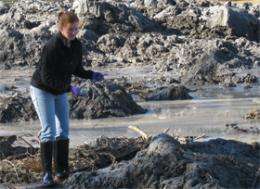
Duke scientists have been sampling the Kingston spill since it happened. Avner Vengosh
(PhysOrg.com) -- As the U.S. Environmental Protection Agency weighs whether to define coal ash as hazardous waste, a Duke University study identifies new monitoring protocols and insights that can help investigators more accurately measure and predict the ecological impacts of coal ash contaminants.
"The take-away lesson is we need to change how and where we look for coal ash contaminants," says Avner Vengosh, professor of geochemistry and water quality at Duke's Nicholas School of the Environment. "Risks to water quality and aquatic life don't end with surface water contamination, but much of our current monitoring does."
The study, published online this week in the peer-reviewed journal Environmental Science and Technology, documents contaminant levels in aquatic ecosystems over an 18-month period following a massive coal sludge spill in 2008 at a Tennessee Valley Authority power plant in Kingston, Tenn.
By analyzing more than 220 water samples collected over the 18-month period, the Duke team found that high concentrations of arsenic from the TVA coal ash remained in pore water -- water trapped within river-bottom sediment -- long after contaminant levels in surface waters dropped back below safe thresholds. Samples extracted from 10 centimeters to half a meter below the surface of sediment in downstream rivers contained arsenic levels of up to 2,000 parts per billion well above the EPA's thresholds of 10 parts per billion for safe drinking water, and 150 parts per billion for protection of aquatic life.
"It's like cleaning your house," Vengosh says of the finding. "Everything may look clean, but if you look under the rugs, that's where you find the dirt."
The potential impacts of pore water contamination extend far beyond the river bottom, he explains, because "this is where the biological food chain begins, so any bioaccumulation of toxins will start here."
The research team, which included two graduate students from Duke's Nicholas School of the Environment and Pratt School of Engineering, also found that acidity and the loss or gain of oxygen in water play key roles in controlling how arsenic, selenium and other coal ash contaminants leach into the environment. Knowing this will help scientists better predict the fate and migration of contaminants derived from coal ash residues, particularly those stored in holding ponds and landfills, as well as any potential leakage into lakes, rivers and other aquatic systems.
The study comes as the EPA is considering whether to define ash from coal-burning power plants as hazardous waste. The deadline for public comment to the EPA was Nov. 19; a final ruling -- what Vengosh calls "a defining moment" -- is expected in coming months.
"At more than 3.7 million cubic meters, the scope of the TVA spill is unprecedented, but similar processes are taking place in holding ponds, landfills and other coal ash storage facilities across the nation," he says. "As long as coal ash isn't regulated as hazardous waste, there is no way to prevent discharges of contaminants from these facilities and protect the environment."
Provided by
Duke University
-
From lemons to lemonade: Reaction uses carbon dioxide to make carbon-based semiconductor,
28 comments
-
Thioridazine kills cancer stem cells in human while avoiding toxic side-effects of conventional cancer treatments,
3 comments
-
SpaceX private rocket blasts off for space station (Update),
41 comments
-
Climate scientists say they have solved riddle of rising sea,
30 comments
-
Scotland passes turbine test to harness tidal power,
40 comments
-
More human population = greater mass?
14 hours ago
-
Conversion from aircraft bearing to normal degrees
May 23, 2012
-
Interpretation/Analysis of the Lab results(HEPA filter)
May 22, 2012
-
Has anyone here attended the The Urbino Summer School in Paleoclimatology?
May 22, 2012
-
Earthquakes: Mag 6 N. Italy and Mag 5.6 W. Bulgaria
May 21, 2012
-
determining time frame for most recent geological layers
May 17, 2012
- More from Physics Forums - Earth
More news stories
Dragon arrives at space station in historic 1st (Update 2)
The privately bankrolled Dragon capsule made a historic arrival at the International Space Station on Friday, triumphantly captured by astronauts wielding a giant robot arm.
Space & Earth / Space Exploration
15 hours ago |
5 / 5 (8) |
11
Dragon makes history with space station docking
The private company SpaceX made history Friday with the docking of its Dragon capsule to the International Space Station, the most impressive feat yet in turning routine spaceflight over to the commercial ...
Space & Earth / Space Exploration
8 hours ago |
4.8 / 5 (6) |
0
Aliens don't want to eat us, says former SETI director
Alien life probably isnt interested in having us for dinner, enslaving us or laying eggs in our bellies, according to a recent statement by former SETI director Jill Tarter.
Space & Earth / Space Exploration
16 hours ago |
4.8 / 5 (10) |
24
SKA super telescope to be built in Australia, South Africa (Update 2)
A long-running joust to host a radio telescope that would give mankind its farthest peek into the Universe ended on Friday with a Solomon-like judgement to split the site between Australia and South Africa.
16 hours ago |
5 / 5 (5) |
2
NASA sees Hurricane Bud threaten western Mexico's coast
NASA satellites are providing rainfall, temperature, pressure, visible and infrared data to forecasters as Hurricane Bud is expected to make a quick landfall in western Mexico this weekend before turning back ...
Space & Earth / Earth Sciences
10 hours ago |
not rated yet |
0
Of mice and mental models: Neuroscientific implications of risk-optimized behavior in the mouse
(Medical Xpress) -- Regardless of an organism’s biological complexity, every encephalized animal continuously makes under-informed behavioral choices that can have serious consequences. Despite its ubiquity, ...
Landmark calculation clears the way to answering how matter is formed
(Phys.org) -- An international collaboration of scientists, including Thomas Blum, associate professor of physics, is reporting in landmark detail the decay process of a subatomic particle called a kaon ...
High-speed method to aid search for solar energy storage catalysts
Eons ago, nature solved the problem of converting solar energy to fuels by inventing the process of photosynthesis.
It's in the genes: Research pinpoints how plants know when to flower
Scientists believe they've pinpointed the last crucial piece of the 80-year-old puzzle of how plants "know" when to flower.
Researchers solve structure of human protein critical for silencing genes
In a study published in the journal Cell on May 24, Cold Spring Harbor Laboratory (CSHL) scientists describe the three-dimensional atomic structure of a human protein bound to a piece of RNA that "guides" the pr ...
MIT researchers devise new means to synchronize a group of robots (w/ Video)
(Phys.org) -- For several years, roboticists have been working out ways to get a group of robots to perform synchronized activities as demonstrated most often in dance routines. Its not just about trying ...
Nov 29, 2010
Rank: not rated yet
See how easy that is?
And just think of all the billions that Big Coal will save through increased profitability! No regulatory paperwork, no special handling requirements, no special cleanup requirements when containment is breached and entire neighborhoods and water supplies are overwhelmed by a tide of merely dirty "coal ash".
I know! -we can bag it and sell it as a new surfacing material for playgrounds, parking lots, and factory floors! It's not hazardous waste -just another undervalued resource!