November 1, 2010 feature
Scientists investigate atomic-scale mechanisms of nanowire growth process
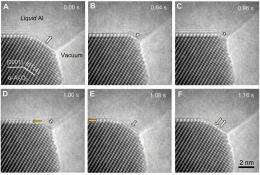
(PhysOrg.com) -- Nanowires can be grown in many ways, but one of the lesser-understood growth processes is vapor-liquid-solid (VLS) growth. In VLS, a vapor adsorbs onto a liquid droplet, and the droplet transports the vapor and deposits it as a crystal at a liquid-solid interface. As the process repeats, a nanowire is built one crystal at a time. One advantage of the VLS process is that it allows scientists to control the nanowire's growth in terms of size, shape, orientation, and composition, although this requires understanding the growth mechanisms on the atomic scale. In a new study, scientists have investigated the steps involved in VLS growth, and have observed a new oscillatory behavior that could lead to better controlled nanowire growth.
The researchers, Sang Ho Oh from the Pohang University of Science and Technology in Pohang, Korea, and coauthors from the US, Israel, and Germany have published their study on the VLS process in a recent issue of Science. Using a high-resolution transmission electron microscope, the researchers observed that the VLS growth of sapphire nanowires occurs in a layer-by-layer fashion due to oscillatory reactions that supply the oxygen needed for new layers.
“The most interesting and novel result of our study is that we observed one of most puzzling growth mechanisms of nanowire at the atomic scale in real-time, which usually occurs through a three-phase interaction at high temperatures,” Oh told PhysOrg.com. “Looking at the growth process on the atomic scale revealed that the kinetic pathway for VLS growth is more complicated than we might think and even hard to envision from possible combinations without observation.”
In their demonstration, the researchers formed liquid aluminum droplets by heating an aluminum oxide crystal and irradiating it with a focused electron beam. Because the liquid aluminum is unstable, it drives VLS growth as it interacts with the surrounding oxygen and turns into stable aluminum oxide crystals to build the nanowire.
One of the most interesting observations that the scientists made is that the liquid-solid interface at which the nanowire forms is not completely straight. Instead, this interface changes due to the formation of facets, in which a corner of the interface is “cut away” while the nanowire is growing. These facets oscillate in size from a few nanometers down to a point as they receive more oxygen. In turn, the oscillating facets supply oxygen for new building of the nanowire, promoting growth.
These observations explain why VLS nanowire growth is not continuous; the oscillating facets provide the oxygen required for nanowire growth, while the size of the facets themselves is affected by nearby oxygen. The new understanding of this process could allow researchers to better control the growth of nanowires composed of functional materials such as semiconductors, oxides, and nitrides.
“This may bring important implications to the nanowire growers to help them understand and avoid the unwanted oscillatory morphologies of nanowires, which appear as sidewall faceting, diameter modulation and the deflection in growth direction,” Oh explained. “When this result comes to the physicists who want to calculate and/or simulate the growth process based on thermodynamics, it will make them rethink the effect of surface tension, liquid ordering and crystal anisotropy on the VLS growth, which has not been considered seriously before.”
More information: “Oscillatory Mass Transport in Vapor-Liquid-Solid Growth of Sapphire Nanowires.” Sang Ho Oh, et al. Science, Vol 330, 22 October 2010. DOI:10.1126/science.1190596
Copyright 2010 PhysOrg.com.
All rights reserved. This material may not be published, broadcast, rewritten or redistributed in whole or part without the express written permission of PhysOrg.com.


