Battling rice blast disease with underground microbes
Rice is the most important grain consumed by humans, providing more than one-fifth of the calories sustaining the world's population. By some estimates, however, global production of rice could feed an additional 60 million people, if it weren't for rice blast disease, caused by the fungus Magnaporthe grisea.
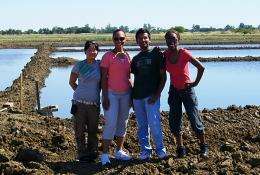
This past summer, four students from the University of Delaware and two of its partner institutions in Delaware's National Science Foundation EPSCoR program, Delaware State University and Delaware Technical and Community College, found themselves on the front lines of the battle to defeat rice blast.
Those battle lines have been drawn on opposite coasts of the United States, through a collaboration between scientists in Delaware and at the University of California at Davis, the land-grant institution of the UC system. The students therefore split their summer internship between laboratories in both states.
The project is led by Harsh Bais, professor in UD's Department of Plant and Soil Sciences and the Delaware Biotechnology Institute, and is funded by the National Science Foundation.
“California's Central Valley is one of the most productive rice-growing areas in the nation, but rice blast is a problem there, reducing production in the crop by up to 50 percent. Rice farmers currently fight the disease by burning their fields after harvest, which adds to air pollution and greenhouse gases,” Bais says.
“UC Davis is basically the biggest U.S. player in rice research. Researchers there approached me about collaborating on a project to look at the effects of rhizospheric microbes in rice due to our success in that area with another plant species, Arabidopsis.”
Rhizospheric microbes are bacteria that live in the soil in close association with plant roots -- in such close association, in fact, that they may be able to influence the expression of the nearby plant's genes. In conjunction with his colleagues at UC Davis, Bais began looking at individual microbes that could possibly enhance the growth, productivity, yield or disease resistance of rice.
“The first question we ask is whether we can identify microbes that can affect the functional phenotypes of a plant species -- the way their genes are expressed in physical and biochemical characteristics,” says Bais. “Once we've identified such a microbe, the second question we ask is whether we can culture that microbe in the lab.”
That's where the undergraduate interns stepped in this summer. They spent the first two weeks of their internship in Davis, working with professors Venkatesan Sundaresan, one of the world's leading experts on rice, and Jonathan A. Eisen, who specializes in understanding the genomic basis for how microorganisms interact with other species at the UC Davis Genome Center.
The students spent a lot of their time in Davis gathering soil samples at the base of rice plants in the field, according to Bais. They learned how to turn these samples from the field into a soil inoculum containing an assemblage of naturally occurring bacteria that they could bring back to Delaware for testing in the lab.
At UC Davis, the interns also learned about bioinformatics, the science of collecting and analyzing complex biological data, such as genetic codes. This knowledge would help them identify and characterize the many different bacteria present in their soil samples.
Clytrice Watson, assistant professor of biology at DSU, accompanied the students to Davis. “This experience was extremely rewarding to me as a professor from a smaller institution,” she says. “It allowed me the opportunity to explore a different area of research that I had never considered and to meet some really great people who were willing to sacrifice their time to train us in the laboratory and extend that same hospitality outside of the work environment. Moreover, it allowed me to be a student again, which was great because I love learning and gaining new knowledge.”
Working over the next several weeks with Bais in his lab in the Delaware Biotechnology Institute in Newark, the students succeeded in identifying a bacterium that appeared to inhibit the growth of the rice blast fungus. Their next goal was to get the microbe to grow and reproduce in the laboratory. They presented their research results at the annual Undergraduate Research and Service Learning Celebratory Symposium at the end of the summer in Clayton Hall.
The students participating in this summer research program were identified and partially supported through the Delaware EPSCoR program. According to Jeanette Miller, who coordinates the program's annual summer internships for undergraduates, the program opens doors for some 35-40 aspiring scientists each year.
As the project's principal investigator, Bais is grateful for Miller's help in pulling together the outreach and education components so often required by federal funding agencies such as NSF. Things worked out so well in this case, that one of the students, Sunrut Patel from Delaware Tech, has matriculated at UD and will continue working in Bais' lab.
“Promoting the development of new scientists is one of the greatest rewards of my job,” Bais says. “A research experience like this opens their minds to what they can really achieve. Students who work even a few short weeks in the summer see what they can do and it inspires them to continue. Working with them you see huge gains in their comfort level in the lab, the way they think, and how they present their work.”
Provided by University of Deleware


