Quantum computers may be much easier to build than previously thought: study
Nov 09, 2010
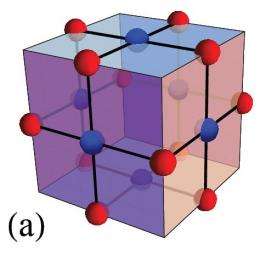
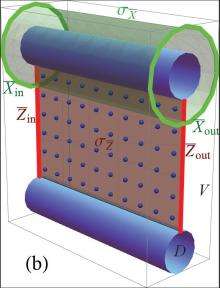
Illustration of the error correcting code used to demonstrate robustness to loss errors. Each dot represents a single qubit. The qubits are arranged on a lattice in such a way that the encoded information is robust to losing up to 25 percent of the qubits. Credit: Sean Barrett and Thomas Stace

Quantum computers should be much easier to build than previously thought, because they can still work with a large number of faulty or even missing components, according to a study published today in Physical Review Letters. This surprising discovery brings scientists one step closer to designing and building real-life quantum computing systems – devices that could have enormous potential across a wide range of fields, from drug design, electronics, and even code-breaking.

Scientists have long been fascinated with building computers that work at a quantum level – so small that the parts are made of just single atoms or electrons. Instead of 'bits', the building blocks normally used to store electronic information, quantum systems use quantum bits or 'qubits', made up of an arrangement of entangled atoms.

Materials behave very differently at this tiny scale compared to what we are used to in our everyday lives – quantum particles, for example, can exist in two places at the same time. "Quantum computers can exploit this weirdness to perform powerful calculations, and in theory, they could be designed to break public key encryption or simulate complex systems much faster than conventional computers," said Dr Sean Barrett, the lead author of the study, who is a Royal Society University Research Fellow in the Department of Physics at Imperial College London.
The machines have been notoriously hard to build, however, and were thought to be very fragile to errors. In spite of considerable buzz in the field in the last 20 years, useful quantum computers remain elusive.

Barrett and his colleague Dr. Thomas Stace, from the University of Queensland in Brisbane, Australia, have now found a way to correct for a particular sort of error, in which the qubits are lost from the computer altogether. They used a system of 'error-correcting' code, which involved looking at the context provided by the remaining qubits to decipher the missing information correctly.

"Just as you can often tell what a word says when there are a few missing letters, or you can get the gist of a conversation on a badly-connected phone line, we used this idea in our design for a quantum computer," said Dr Barrett. They discovered that the computers have a much higher threshold for error than previously thought – up to a quarter of the qubits can be lost – but the computer can still be made to work. "It's surprising, because you wouldn't expect that if you lost a quarter of the beads from an abacus that it would still be useful," he added.

The findings indicate that quantum computers may be much easier to build than previously thought, but as the results are still based on theoretical calculations, the next step is to actually demonstrate these ideas in the lab. Scientists will need to devise a way for scaling the computers to a sufficiently large number of qubits to be viable, says Barrett. At the moment the biggest quantum computers scientists have built are limited to just two or three qubits.

"We are still some way off from knowing what the true potential of a quantum computer might be, says Barrett. "At the moment quantum computers are good at particular tasks, but we have no idea what these systems could be used for in the future," he said. "They may not necessarily be better for everything, but we just don't know. They may be better for very specific things that we find impossible now."

Explore further: Superfluids: Observation of 'second sound' in a quantum gas

More information: "Fault tolerant quantum computation with very high threshold for loss errors" Physical Review Letters 09 November 2010, DOI:10.1103/PhysRevLett.105.200502 . Link to paper on pre-print server: http://arxiv.org/abs/1005.2456

Related Stories

'Self-correcting' gates advance quantum computing

Mar 12, 2009

(PhysOrg.com) -- Two Dartmouth researchers have found a way to develop more robust “quantum gates,” which are the elementary building blocks of quantum circuits. Quantum circuits, someday, will be used ...

Researchers find quantum errors do compute

Aug 05, 2009

(PhysOrg.com) -- Physicists from The University of Queensland have found the emerging field of quantum computing may be more stable than previously thought.

Three tiny qubits, another big step toward quantum computing

Sep 29, 2010

(PhysOrg.com) -- The rules that govern the world of the very small, quantum mechanics, are known for being bizarre. One of the strangest tenets is something called quantum entanglement, in which two or more objects (such ...

New supercomputer to be unveiled

Feb 12, 2007

A Canadian firm is claiming to have taken a quantum leap in technology by producing a computer that can perform 64,000 calculations at once.

Recommended for you

Promising doped zirconia

May 17, 2013

Materials belonging to the family of dilute magnetic oxides (DMOs)—an oxide-based variant of the dilute magnetic semiconductors—are good candidates for spintronics applications. This is the object of ...

Bringing life into focus

May 17, 2013

Spinning-disk confocal microscopy is an optical imaging technique that can be used to generate detailed three-dimensional fluorescence images of living cells and their contents. Although a powerful tool for ...

Nanocrystals grow from liquid interface

May 17, 2013

An international collaboration of scientists has discovered a unique crystalizing behavior at the interface between two immiscible liquids that could aid in sustainable energy development.

User comments : 5

Adjust slider to filter visible comments by rank

Display comments: newest first

otto1932
5 / 5 (1) Nov 09, 2010
they can still work with a large number of faulty or even missing components
Huh. Just like the human brain. Only our performance does unavoidably degrade over time due to damage and defect.
dtxx
not rated yet Nov 09, 2010
I don't really see that strong of a connection between this and neural plasticity?
Nichevo
not rated yet Nov 09, 2010
After reading the first image caption I found myself skipping the rest of the article; some attempt at explaining the error correcting mechanism would have been interesting. I assume some intercorrelation is at play?
antialias_physorg
not rated yet Nov 10, 2010
Only our performance does unavoidably degrade over time due to damage and defect.

Human brains achieve this through redundancy (and plasticity). It's a tiiiiiiny bit different in quantum computers
Cheerio
not rated yet Nov 15, 2010
Part of me wonders about A.I. implications.

More news stories

New principle may help explain why nature is quantum

Like small children, scientists are always asking the question 'why?'. One question they've yet to answer is why nature picked quantum physics, in all its weird glory, as a sensible way to behave. Researchers ...

German energy shift faces headwinds

Tense engineers have their eyes peeled on complex colour-coded diagrams on a wall-sized screen that makes their control room look like the inside of a spaceship.

China police billions spell profit opportunity

Mannequins in riot gear, armoured cars and drones line a police equipment and "anti-terrorism technology" trade fair in Beijing as vendors seek to profit from China's huge internal security budget.

Russia retrieves mice, newts from space

A Russian capsule filled with 45 mice and 15 newts along with other small animals returned from a month's mission in orbit on Sunday with data scientists hope will pave the way for a manned flight to Mars.

Honeybees trained in Croatia to find land mines

(AP)—Mirjana Filipovic is still haunted by the land mine blast that killed her boyfriend and blew off her left leg while on a fishing trip nearly a decade ago. It happened in a field that was supposedly ...