23 percent of young Spaniards get into fights when they go out at night
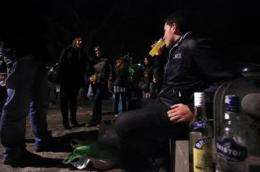
Night-time violence among young Spaniards is becoming ever more common, according to a research study carried out by the European Institute of Studies on Prevention. The study shows that 5.2 percent of young people carry weapons when they go out at night, 11.6 percent have been attacked or threatened, and 23 percent have got into a fight at some time. Credit: SINC
Night-time violence among young Spaniards is becoming ever more common, according to a research study carried out by the European Institute of Studies on Prevention. The study shows that 5.2% of young people carry weapons when they go out at night, 11.6% have been attacked or threatened, and 23% have got into a fight at some time.
"Reports about young people being attacked or injured in fights when they go out at night are becoming increasingly common", Amador Calafat, lead author of the study and a researcher at the European Institute of Studies on Prevention (IREFREA), which is at the forefront of studies into problems of childhood and adolescence and drug abuse, tells SINC.
The research, published in the latest issue of the Journal Psicothema, analyses the phenomenon of violence among young Spaniards (under the age of 25), in particular in terms of factors related to the night-time leisure context, among a selected sample of 440 participants in the Balearic Islands, Galicia and Valencia who regularly go out at night and consume alcohol or other substances.
Of this sample, 11.6% had been attacked or threatened at some time. This percentage rose to 23% for fights. The research goes further, finding that 5.2% of the young people studied carry weapons when they go out at night. "Having been threatened or hurt with a weapon was associated with having frequent arguments related to the use of alcohol and drugs", Calafat explains.
The authors state that adolescence is a risk factor itself, since young people are more prone and vulnerable to this kind of behaviour. Some important aspects for preventing night-time violence relate to the way in which environmental conditions are managed. These include preventing crowds from building up, using soft music when bars and clubs close and bright lights when it is time to leave.
"In order to prevent night-time violence, alcohol consumption among young people should be controlled by offering water and soft drinks at affordable prices, steering away from 'happy hour'-type alcohol offers, and strictly ensuring that alcohol is not sold to underage drinkers", the researcher concludes.
Violence among young tourists
Tourist destinations in southern Europe attract young people because of the good times and night-time action they promise. In another study, financed by the European Commission Daphne programme, the same research group studied the behaviour of young British and German tourists who chose to spend their 2009 holidays in Portugal, Spain, Italy, Greece and Cyprus.
The figures were impressive. Almost one-quarter of the study's participants (24%) visited bars and clubs every night during their holidays, and 95% consumed alcohol during their stay. More than two-thirds of the young respondents got drunk, and more than one in 10 took illegal drugs.
The 6,000 young tourists surveyed reported significant problems during their holidays. Almost 9% were sexually abused (7% of males and 10% of females), 6% suffered injuries and 4% were involved in cases of physical violence. More than half of the violent incidents (51%) took place in bars or nightclubs, while the rest (36%) took place on the street.
More information: Nicole Blay, Amador Calafat; Montse Juan, Elisardo Becoña, Alejandro Mantecón, Marga Ros y Antoni Far: "Violence in nightlife environments and its relationship with the consumption of alcohol and drugs among young Spaniards". Psicothema, Volúmen 22, Número 3, 2010. http://www.psicoth … pdf/3743.pdf
Provided by FECYT - Spanish Foundation for Science and Technology
-
From lemons to lemonade: Reaction uses carbon dioxide to make carbon-based semiconductor,
28 comments
-
Every black hole contains a new universe: A physicist presents a solution to present-day cosmic mysteries,
216 comments
-
New silicon memory chip developed,
16 comments
-
Thioridazine kills cancer stem cells in human while avoiding toxic side-effects of conventional cancer treatments,
3 comments
-
SpaceX private rocket blasts off for space station (Update),
41 comments
-
Consumption rivalry
4 hours ago
-
Bilateral trade between all countries
May 24, 2012
-
Is the economic foundation of social media in jeopardy?
May 20, 2012
-
Psychology: Rosenthal and Hawthorne Effect
May 15, 2012
-
Is GDP and National Income the Same Thing?
May 13, 2012
-
Difference between hourly wage and real GDP per hour worked?
May 12, 2012
- More from Physics Forums - Social Sciences
More news stories
Math predicts size of clot-forming cells
UC Davis mathematicians have helped biologists figure out why platelets, the cells that form blood clots, are the size and shape that they are. Because platelets are important both for healing wounds and in strokes and other ...
4 hours ago |
not rated yet |
0
|
Oldest Jewish archaeological evidence on the Iberian Peninsula
German archaeologists of the Friedrich Schiller University Jena found one of the oldest archaeological evidence so far of Jewish Culture on the Iberian Peninsula at an excavation site in the south of Portugal, ...
Other Sciences / Archaeology & Fossils
8 hours ago |
4.3 / 5 (3) |
12
Dinosaur with tiny arms unearthed in Argentina
Argentine experts have discovered the near-complete remains of a new species of Jurassic-era dinosaur that stood on its rear legs and had tiny arms, according to a leading paleontologist.
Other Sciences / Archaeology & Fossils
16 hours ago |
5 / 5 (1) |
0
Earliest musical instruments in Europe 40,000 years ago
The first modern humans in Europe were playing musical instruments and showing artistic creativity as early as 40,000 years ago, according to new research from Oxford and Tübingen universities.
Other Sciences / Archaeology & Fossils
11 hours ago |
5 / 5 (2) |
0
Talking works: UB professor develops method to analyze creative problem solving
(Phys.org) -- Talk -- if it's the right kind -- can increase creativity, leading students to create useful, new ideas that solve problems, a University at Buffalo professor has found by using a statistical tool that he invented.
Other Sciences / Social Sciences
13 hours ago |
not rated yet |
0
It's in the genes: Research pinpoints how plants know when to flower
Scientists believe they've pinpointed the last crucial piece of the 80-year-old puzzle of how plants "know" when to flower.
High-speed method to aid search for solar energy storage catalysts
Eons ago, nature solved the problem of converting solar energy to fuels by inventing the process of photosynthesis.
Researchers solve structure of human protein critical for silencing genes
In a study published in the journal Cell on May 24, Cold Spring Harbor Laboratory (CSHL) scientists describe the three-dimensional atomic structure of a human protein bound to a piece of RNA that "guides" the pr ...
Dragon makes history with space station docking
The private company SpaceX made history Friday with the docking of its Dragon capsule to the International Space Station, the most impressive feat yet in turning routine spaceflight over to the commercial ...
Yahoo kills 'Livestand' just 6 months after debut
(AP) -- Yahoo is killing a tablet magazine called Livestand just six months its debut on the iPad.
Tongue analysis software uses ancient Chinese medicine to warn of disease
For 5,000 years, the Chinese have used a system of medicine based on the flow and balance of positive and negative energies in the body. In this system, the appearance of the tongue is one of the measures used to classify ...