Oldest dinosaur embryos give insights into infancy and growth
November 14, 2010

Oldest dinosaur embryos give insights into infancy and growth

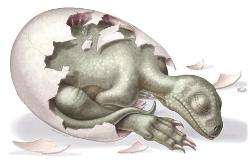
Artist’s reconstruction of a Massospondylus embryo. (Image courtesy of Heidi Richter.)

(PhysOrg.com) -- After sitting in collections for nearly 30 years, some remarkably well-preserved dinosaur eggs and their contents are offering new insights into the infancy and growth of early dinosaurs. They represent the oldest embryos of any land-dwelling vertebrate ever found.

The eggs, found in 1976 in South Africa, date from the early part of the , 190 million years ago. They belong to Massospondylus (măs-ō-spŏn-dīl-ŭs), a member of a group of dinosaurs known as prosauropods that are the ancestors to the later sauropods – the large, four-legged dinosaurs with long necks, typified by the popular ‘Brontosaurus’ and Diplodocus.

Dr. Robert Reisz of the University of Toronto and his colleagues worked on these fossils, and it was only through modern preparation techniques that these findings were brought to light. One of Dr. Reisz’s co-authors, research assistant Diane Scott, prepared the delicate fossils under high-powered microscopes and compiled the illustrations. “I don’t think anybody else could have done this job,” says Dr. Reisz.
Oldest dinosaur embryos give insights into infancy and growth

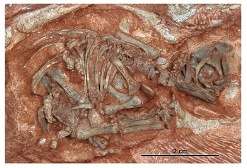
Photograph of skeleton of the first embryo of Massospondylus. White materials represent eggshell that remained around the embryonic skeleton after they had been exposed. (Image courtesy of Diane Scott, University of Toronto at Mississauga.)

These eggs contain the oldest known embryos of dinosaurs. In fact, they are the oldest of any land-dwelling backboned animal. The preservation of the embryos is exquisite, permitting a complete reconstruction of the skeleton and detailed interpretations of the anatomy.

The level of ossification – how much of the skeleton has turned to bone – reveals that the embryos were close to hatching. The fossils also reveal that the future hatchlings would have been oddly proportioned and would have looked very different from the adults of the species.

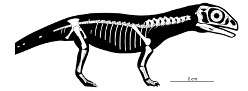
The 20 cm (8 in.) embryos were quadrupedal (they walked on all four legs), with relatively long front limbs and disproportionately large heads. In contrast, the 5 m (16.5 ft) long adults had relatively tiny heads and long necks; they mostly likely were bipedal, given that their forelimbs are much shorter than their hind limbs. This implies that as the dinosaurs matured, their necks and hind limbs grew much faster than their forelimbs and head. Later dinosaurs in this group, the sauropods, had body proportions more similar to those of the Massospondylus embryos.

In at least one way, Massospondylus development resembles that of humans; infancy is awkward, and a more erect stance and evenly proportioned body only come later.

There may be another way that Massospondylus infancy was similar to that of humans. The embryos lack teeth and this, combined with the awkward body proportions, suggests that the hatchlings may have required parental care. If true, these fossils also document the oldest record of parental care.
Oldest dinosaur embryos give insights into infancy and growth

Skeletal reconstruction of Massospondylus embryo showing which bones were preserved in the fossils. (Image courtesy of Diane Scott, University of Toronto at Mississauga.)

“This project opens an exciting window into the early history and evolution of dinosaurs,” says Reisz. “Prosauropods are the first dinosaurs to diversify extensively, and they quickly became the most widely spread group, so their biology is particularly interesting as they represent in many ways the dawn of the age of .”

The eggs and are on display at the Royal Ontario Museum in an exhibit entitled, “Dinosaur Eggs and Babies: Remarkable Fossils from South Africa.” Dr. David Evans, one of the co-authors of this research, is curator at that museum.

More information: Reisz, R.R., D.C. Evans, H.-D. Sues, D. Scott. 2010. Embryonic skeletal anatomy of the sauropodomorph dinosaur Massospondylus from the Lower Jurassic of South Africa. Journal of Vertebrate Paleontology 30(6). PDF pre-print: http://www.vertpal … preprint.pdf

Provided by Society of Vertebrate Paleontology

Filter


Move the slider to adjust rank threshold, so that you can hide some of the comments.


Display comments: newest first

scidog
Nov 14, 2010

Rank: not rated yet
i know there are vast differences but maybe this is a step in explaining the short "arms" on the T-Rex.they could have been quad rather than bipedal at hatchling stage.
Rank 5 /5 (13 votes)
Relevant PhysicsForums posts

More news stories

Math predicts size of clot-forming cells

UC Davis mathematicians have helped biologists figure out why platelets, the cells that form blood clots, are the size and shape that they are. Because platelets are important both for healing wounds and in strokes and other ...

Other Sciences / Mathematics

created 3 hours ago | popularity not rated yet | comments 0 | with audio podcast

Oldest Jewish archaeological evidence on the Iberian Peninsula

German archaeologists of the Friedrich Schiller University Jena found one of the oldest archaeological evidence so far of Jewish Culture on the Iberian Peninsula at an excavation site in the south of Portugal, ...

Other Sciences / Archaeology & Fossils

created 7 hours ago | popularity 4.3 / 5 (3) | comments 12

Dinosaur with tiny arms unearthed in Argentina

Argentine experts have discovered the near-complete remains of a new species of Jurassic-era dinosaur that stood on its rear legs and had tiny arms, according to a leading paleontologist.

Other Sciences / Archaeology & Fossils

created 15 hours ago | popularity 5 / 5 (1) | comments 0

Earliest musical instruments in Europe 40,000 years ago

The first modern humans in Europe were playing musical instruments and showing artistic creativity as early as 40,000 years ago, according to new research from Oxford and Tübingen universities.

Other Sciences / Archaeology & Fossils

created 10 hours ago | popularity 5 / 5 (1) | comments 0

Oldest art even older

New dates from Geißenklösterle Cave in Southwest Germany document the early arrival of modern humans and early appearance of art and music.

Other Sciences / Archaeology & Fossils

created 23 hours ago | popularity 5 / 5 (2) | comments 4


It's in the genes: Research pinpoints how plants know when to flower

Scientists believe they've pinpointed the last crucial piece of the 80-year-old puzzle of how plants "know" when to flower.

Tongue analysis software uses ancient Chinese medicine to warn of disease

For 5,000 years, the Chinese have used a system of medicine based on the flow and balance of positive and negative energies in the body. In this system, the appearance of the tongue is one of the measures used to classify ...

Yahoo kills 'Livestand' just 6 months after debut

(AP) -- Yahoo is killing a tablet magazine called Livestand just six months its debut on the iPad.

Dragon makes history with space station docking

The private company SpaceX made history Friday with the docking of its Dragon capsule to the International Space Station, the most impressive feat yet in turning routine spaceflight over to the commercial ...

Most occupational injury and illness costs are paid by the government and private payers

UC Davis researchers have found that workers' compensation insurance is not used nearly as much as it should be to cover the nation's multi-billion dollar price tag for workplace illnesses and injuries. Instead, almost 80 ...

High-speed method to aid search for solar energy storage catalysts

Eons ago, nature solved the problem of converting solar energy to fuels by inventing the process of photosynthesis.