Neutron stars may be too weak to power some gamma-ray bursts
November 3, 2010

Neutron stars may be too weak to power some gamma-ray bursts

Enlarge

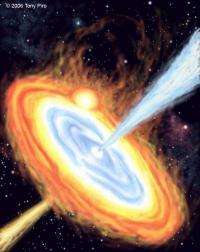
This is an illustration of the collapse of a massive star in which the large envelope forms a rotationally supported disk and may even lead to a relativistic jet. This "collapsar" picture may explain at least one class of gamma-ray bursts, cosmic explosions that are a million trillion times as bright as the sun! Gamma-ray bursts last for anywhere from a few milliseconds to several minutes, and for that time they are the brightest source of gamma-rays in the entire observable Universe. The energy from one event is enough to supply the entire world's electrical energy needs for approximately a hundred million billion billion years. Credit: Tony Piro/Caltech

A gamma-ray burst is an immensely powerful blast of high-energy light thought to be generated by a collapsing star in a distant galaxy, but what this collapse leaves behind has been a matter of debate.

A new analysis of four extremely bright bursts observed by NASA's Fermi satellite suggests that the remnant from a long-duration gamma-ray burst is most likely a black hole – not a rapidly spinning, highly magnetized neutron star, or magnetar since such a burst emits more energy than is theoretically possible from a magnetar.

"Some of the events we have been finding seem to be pushing right up against this total limit for a neutron star progenitor system," said S. Bradley Cenko, a post-doctoral fellow from the University of California, Berkeley.

Cenko will present these findings on Wednesday, Nov. 3, at the Nov. 1-4 Gamma Ray Bursts 2010 conference in Annapolis, Md. Cenko is a member of an international team that includes astronomers from UC Berkeley and the National Radio Astronomy Observatory (NRAO) in New Mexico.

The group has submitted a paper detailing its analysis to The Astrophysical Journal.

Long-duration gamma-ray bursts (GRBs) are presumed to be created by the explosive collapse in distant galaxies of massive stars. The explosion is visible from Earth because the light is emitted in a narrow cone, like a beam from a lighthouse. First discovered in 1967 by satellites looking for nuclear blasts on Earth, gamma-ray bursts have been the focus of several satellite missions, most recently NASA's Fermi gamma-ray space telescope, launched in 2008, and NASA's Swift satellite, launched in 2004.

With accumulating observations, astronomers have been able to create models of how the collapse of a rapidly rotating, massive star can accelerate matter to nearly the speed of light and collimate it into two oppositely directed, tightly focused beams along the spin axis. They have also studied how these particles generate gamma rays and other emissions.

The two leading candidates for powering these long-duration bursts are a magnetar and a black hole, sometimes referred to as a collapsar. In both cases, material from the star falls inward and is catapulted out by the spinning neutron star or black hole. What distinguishes these models is that magnetar-powered bursts cannot be as powerful as black hole-powered bursts.

"The question we have been trying to answer is: What is the true energy release from these events?" Cenko said. "We can measure all the light emitted – very high energy gamma rays, and, at later times, X-ray, optical and radio afterglow emissions – but that doesn't provide a very good estimate, because GRBs emit in relatively narrow jets. We have to get an idea of the geometry of this outflow, that is, how collimated the jets are."

Previous studies have shown that light measured in the afterglow begins to drop steeply at a certain point, and the sooner this drop-off, called a jet break, the narrower the jet. Typically, the gamma-ray burst itself lasts from a few seconds to as long as 100 seconds, but the afterglow, produced when the jets interact with gas and dust surrounding the star, emits visible light for a couple of weeks and radio radiation for several months.

While Swift has observed hundreds of bursts in the past five years and notified astronomers within seconds of detection, the instruments aboard the satellite detect mostly medium-sized bursts that are not as highly collimated and that have a jet break many days or weeks after the burst.

Fermi's Large Area Telescope, however, is sensitive to very bright bursts with jet breaks within several days of the burst, making follow-up observations easier with Swift's X-ray and ultraviolet-optical telescopes and the ground-based Very Large Array, a radio telescope operated by NRAO.

Fermi detects few extremely bright bursts, however – only four in 2009, Cenko said – and does not notify astronomers for nearly a day afterward. Once alerted, however, Cenko's team was able to observe the optical, X-ray and radio afterglow of these four events, find the jet break and use this information, along with the star's distance calculated from its redshift, to estimate the total energy output.

If the energy from these bright bursts were emitted in all directions, it would be equivalent to the mass of the sun being converted instantaneously into pure energy. Because the gamma-ray burst was focused in a cone only a few degrees wide, however, the energies for all four bursts were about 100𔂿,000 times less than this.

Theoretical models of how these beams are produced place a limit on how much energy a magnetar can generate in one of these explosive bursts: about 100 times less than if one converted the sun entirely into energy. Several of these bright bursts exceed this limit.

"The magnetar model is in serious trouble for such incredibly powerful events," noted coauthor Alex Filippenko, UC Berkeley professor of astronomy. "Even if the magnetar energy limit is not strictly violated, the tremendous efficiency required by this process strains credulity."

"In the future, we will be trying to make more precise measurements and be looking for more events to rule out a neutron star model," Cenko said.

Provided by University of California - Berkeley search and more info website

4.6 /5 (5 votes)  

Filter


Move the slider to adjust rank threshold, so that you can hide some of the comments.


Display comments: newest first

Slotin
Nov 03, 2010

Rank: 1 / 5 (2)
Some GRB's bear the energy, corresponding the whole mass of Sun in relativistic sense - so it's evident, such bursts cannot originate from stars, where the upper limit of mass is limited to some three solar masses.
eachus
Nov 03, 2010

Rank: 2.5 / 5 (2)
Some GRB's bear the energy, corresponding the whole mass of Sun in relativistic sense - so it's evident, such bursts cannot originate from stars, where the upper limit of mass is limited to some three solar masses.


Umm, I think you meant to say that the mass of neutron stars is limited to about 3 solar masses. Known stars go up to 160x the mass of the sun or so.

The problem in sorting all this out, though, is that if a large star explodes in a supernova, a lot of energy (and mass) can go into the GRB. But the math problem is obvious. Take the energy released, divde by the efficiency of the process and you get the minimum assumed mass of the original star just before the supernova. Even at a 1% to 2% total conversion efficiency, the limit on initial stellar mass is more restrictive than that on the size of the resulting neutron star.

My guess is that you drop a star (relatively) straight into an intermediate (or larger) mass black hole to get a GRB.
genastropsychicallst
Nov 04, 2010

Rank: 1 / 5 (3)
A neutron is unlightspeeding Neptune, thank you Pi.
omatumr
Nov 05, 2010

Rank: 2 / 5 (4)
Unless the experimental evidence for neutron repulsion is taken into account ["Nuclear systematics: III. The source of solar luminosity", J. Radioanal. Nucl. Chem. 252, 3-7 (2002); "Neutron repulsion confirmed as energy source", J. Fusion Energy 20, 197-201 (2003)], neutron stars will continue to be an enigma

With kind regards,
Oliver K. Manuel
Former NASA Principal
Investigator for Apollo
denijane
Nov 26, 2010

Rank: not rated yet
I don't see what's scientifically new in this article. We already know how big is the energy of a GRB. We already know that neutron stars do not possess the energy needed for a lGRB. Just as we know, that a black hole cannot explain the variability of the lGRB. So, nothing new here. Only a very good publicity for Berkley, of course.
Rank 4.6 /5 (5 votes)
Relevant PhysicsForums posts
  • revamping general concept and cosmological principle
    created4 hours ago
  • Transiting Exoplanet Light Curve
    created14 hours ago
  • Math behind Theoretical Physics
    createdMay 24, 2012
  • Do we know whats at the center of galaxies yet?
    createdMay 23, 2012
  • Structure of the Milky Way?
    createdMay 20, 2012
  • What would it take to terraform Pluto and Charon?
    createdMay 19, 2012
  • More from Physics Forums - General Astronomy

More news stories

Dragon makes history with space station docking

The private company SpaceX made history Friday with the docking of its Dragon capsule to the International Space Station, the most impressive feat yet in turning routine spaceflight over to the commercial ...

Space & Earth / Space Exploration

created 35 minutes ago | popularity 5 / 5 (1) | comments 0

Dragon arrives at space station in historic 1st (Update 2)

The privately bankrolled Dragon capsule made a historic arrival at the International Space Station on Friday, triumphantly captured by astronauts wielding a giant robot arm.

Space & Earth / Space Exploration

created 7 hours ago | popularity 5 / 5 (6) | comments 8

SKA super telescope to be built in Australia, South Africa (Update 2)

A long-running joust to host a radio telescope that would give mankind its farthest peek into the Universe ended on Friday with a Solomon-like judgement to split the site between Australia and South Africa.

Space & Earth / Astronomy

created 9 hours ago | popularity 5 / 5 (2) | comments 2

Get ready for the transit of Venus

Scientists and amateur astronomers around the world are preparing to observe the rare occurrence of Venus crossing the face of the Sun on 5-6 June, an event that will not be seen again for over a hundred years.

Space & Earth / Space Exploration

created 9 hours ago | popularity 5 / 5 (1) | comments 0

Aliens don't want to eat us, says former SETI director

Alien life probably isn’t interested in having us for dinner, enslaving us or laying eggs in our bellies, according to a recent statement by former SETI director Jill Tarter.

Space & Earth / Space Exploration

created 9 hours ago | popularity 5 / 5 (6) | comments 10


It's in the genes: Research pinpoints how plants know when to flower

Scientists believe they've pinpointed the last crucial piece of the 80-year-old puzzle of how plants "know" when to flower.

Tongue analysis software uses ancient Chinese medicine to warn of disease

For 5,000 years, the Chinese have used a system of medicine based on the flow and balance of positive and negative energies in the body. In this system, the appearance of the tongue is one of the measures used to classify ...

Yahoo kills 'Livestand' just 6 months after debut

(AP) -- Yahoo is killing a tablet magazine called Livestand just six months its debut on the iPad.

Most occupational injury and illness costs are paid by the government and private payers

UC Davis researchers have found that workers' compensation insurance is not used nearly as much as it should be to cover the nation's multi-billion dollar price tag for workplace illnesses and injuries. Instead, almost 80 ...

High-speed method to aid search for solar energy storage catalysts

Eons ago, nature solved the problem of converting solar energy to fuels by inventing the process of photosynthesis.

Researchers solve structure of human protein critical for silencing genes

In a study published in the journal Cell on May 24, Cold Spring Harbor Laboratory (CSHL) scientists describe the three-dimensional atomic structure of a human protein bound to a piece of RNA that "guides" the pr ...