Nanoscale probe reveals interactions between surfaces and single molecules
November 17, 2010

Nanoscale probe reveals interactions between surfaces and single molecules

Enlarge

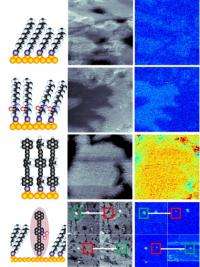
Simultaneously acquired images and polarizability maps of four different families of molecules, including single-molecule switches (bottom panels), which can be both manipulated and imaged using the scanning tunneling microscope (STM).

(PhysOrg.com) -- As electronics become smaller and smaller the need to understand nanoscale phenomena becomes greater and greater. Because materials exhibit different properties at the nanoscale than they do at larger scales, new techniques are required to understand and to exploit these new phenomena. A team of researchers led by Paul Weiss, UCLA's Fred Kavli Chair in NanoSystems Sciences, has developed a tool to study nanoscale interactions. Their device is a dual scanning tunneling and microwave-frequency probe that is capable of measuring the interactions between single molecules and the surfaces to which the molecules are attached.

"Our probe can generate data on the physical, chemical, and electronic interactions between single and substrates, the contacts to which they are attached. Just as in , contacts are critical here," remarked Weiss, who directs UCLA's California Institute and is also a distinguished professor of chemistry and biochemistry & materials science and engineering.

The team, which also includes theoretical chemist Mark Ratner from Northwestern University and synthetic chemist James Tour from Rice University, published their findings in the peer-reviewed journal ACS Nano.

For the past 50 years, the electronics industry has endeavored to keep up with Moore's Law, the prediction made by Gordon E. Moore in 1965 that the size of transistors in integrated circuits would halve approximately every two years. The pattern of consistent decrease in the size of electronics is approaching the point where transistors will have to be constructed at the nanoscale to keep pace. However, researchers have encountered obstacles in creating devices at the nanoscale because of the difficulty of observing phenomena at such minute sizes.

The connections between components are a vital element of nanoscale electronics. In the case of molecular devices, polarizability measures the extent to which electrons of the contact interact with those of the single molecule. Two key aspects of polarizability measurements are the ability to do the measurement on a surface with subnanometer resolution, and the ability to understand and to control molecular switches in both the on and off states.

To measure the polarizability of single molecules the research team developed a probe capable of simultaneous scanning tunneling microscopy (STM) measurements and microwave difference frequency (MDF) measurements. With the MDF capabilities of the probe, the team was able to locate single molecule switches on substrates, even when the switches were in the off state, a key capability lacking in previous techniques. Once the team located the switches, they could use the STM to change the state to on or off and to measure the interactions in each state between the single molecule switches and the substrate.

The new information provided by the team's probe focuses on what the limits of electronics will be, rather than targeting devices for production. Also, because the probe is capable of a wide variety of measurements — including physical, chemical and electronic — it could enable researchers to identify submolecular structures in complex biomolecules and assemblies.

Provided by University of California - Los Angeles


Rank not rated yet
Relevant PhysicsForums posts
  • I need help with understanding of Inertia of a slender rod and plate?
    created1 hour ago
  • Voltage and current in a series circuit
    created2 hours ago
  • Force on the top hinge of an open door
    created3 hours ago
  • Specular reflection from moving mirrors
    created6 hours ago
  • Setting Up a Nitrogen Laser
    created8 hours ago
  • Can sound fall?
    created9 hours ago
  • More from Physics Forums - General Physics

More news stories

Synthetic nano-waste does not disappear

(Phys.org) -- Tiny particles of cerium oxide do not burn or change in the heat of a waste incineration plant. They remain intact on combustion residues or in the incineration system, as a new study by Swiss ...

Nanotechnology / Bio & Medicine

created 9 hours ago | popularity not rated yet | comments 0 | with audio podcast

Nanotechnology for solar energy conversion systems

EU researchers extensively characterised the self-organisation of nanotubes and developed novel compositions particularly appropriate to solar energy conversion applications.

Nanotechnology / Nanomaterials

created 8 hours ago | popularity not rated yet | comments 0

Nano-structured polymer-based materials from scrap

EU researchers developed polymer blends and processing techniques facilitating recovery of scrap from industrial processes. Advances in this area have the potential to decrease costs and waste while protecting ...

Nanotechnology / Nanomaterials

created 9 hours ago | popularity not rated yet | comments 0

Dopant gives graphene solar cells highest efficiency yet

(Phys.org) -- By taking advantage of graphene’s favorable electrical and optical properties, and then adding an organic dopant, researchers have achieved the highest power conversion efficiency yet for ...

Nanotechnology / Nanophysics

created May 21, 2012 | popularity 5 / 5 (10) | comments 14 | with audio podcast feature

Nanomedicine: Quantum dots appear safe in pioneering study on primates

A pioneering study to gauge the toxicity of quantum dots in primates has found the tiny crystals to be safe over a one-year period, a hopeful outcome for doctors and scientists seeking new ways to battle diseases ...

Nanotechnology / Bio & Medicine

created May 20, 2012 | popularity 4.3 / 5 (3) | comments 8 | with audio podcast


It's in the genes: Research pinpoints how plants know when to flower

Scientists believe they've pinpointed the last crucial piece of the 80-year-old puzzle of how plants "know" when to flower.

Tongue analysis software uses ancient Chinese medicine to warn of disease

For 5,000 years, the Chinese have used a system of medicine based on the flow and balance of positive and negative energies in the body. In this system, the appearance of the tongue is one of the measures used to classify ...

Yahoo kills 'Livestand' just 6 months after debut

(AP) -- Yahoo is killing a tablet magazine called Livestand just six months its debut on the iPad.

Dragon makes history with space station docking

The private company SpaceX made history Friday with the docking of its Dragon capsule to the International Space Station, the most impressive feat yet in turning routine spaceflight over to the commercial ...

Most occupational injury and illness costs are paid by the government and private payers

UC Davis researchers have found that workers' compensation insurance is not used nearly as much as it should be to cover the nation's multi-billion dollar price tag for workplace illnesses and injuries. Instead, almost 80 ...

High-speed method to aid search for solar energy storage catalysts

Eons ago, nature solved the problem of converting solar energy to fuels by inventing the process of photosynthesis.