More than a million Atlantic sharks killed yearly: study

November 22, 2010 by Marlowe Hood
A diver takes a photo of a hammerhead shark. North Atlantic populations of the oceanic white tip, for example, have declined by 70 percent, and hammerheads by more than 99 percent, according to the International Union for the Conservation of Nature (IUCN).
At least 1.3 million sharks, many listed as endangered, were harvested from the Atlantic in 2008 by industrial-scale fisheries unhampered by catch or size limits, according to a tally released Monday.
The actual figure may be several fold higher due to under-reporting, said the study, released by advocacy group Oceana on the sidelines of a meeting of the International Commission for the Conservation of Atlantic Tunas (ICCAT).
Convening in Paris through November 27, the 48-member ICCAT is charged with ensuring that commercial fisheries are sustainable. It has the authority to set catch quotas and restrictions.
While the global spotlight has been trained on the plight of Atlantic bluefin tuna, many species of high-value sharks are in even more dire straits, say marine biologists.
"Sharks are virtually unmanaged at the international level," said Elizabeth Griffin Wilson of Oceana. "ICCAT has a responsibility to protect our oceans' top predators."
Under the UN Convention on the Law of the Sea, "highly migratory" sharks must be managed by international bodies.
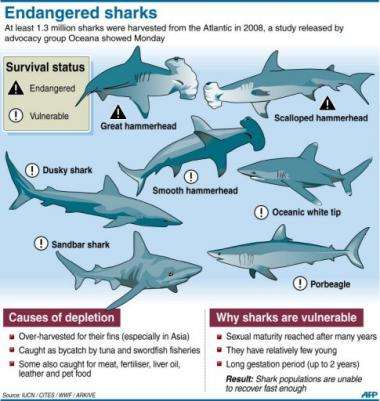
Of the 21 species found in the Atlantic, three-quarters are classified as threatened with extinction.
North Atlantic populations of the oceanic white tip, for example, have declined by 70 percent, and hammerheads by more than 99 percent, according to the International Union for the Conservation of Nature (IUCN).
Graphic on endangered shark species. Of the 21 species of shark found in the Atlantic, three-quarters are classified as threatened with extinction.
Other species -- including the porbeagle, common thresher and shortfin mako -- have also been overexploited, and may be teetering on the brink of viability.Many are fished for their fins -- prized as a delicacy in Chinese cuisine -- and then tossed, dead or dying, back into the sea once the choice morsels have been sliced off.
The practice is prohibited, but loopholes in the regulation have allowed the ban to be widely ignored.
Oceana and several conservation groups, backed by some governments, have called upon ICCAT to set catch quotas and other protective measures for these and other vulnerable sharks.
The United States has proposed requiring that all sharks be brought back to shore whole, which would boost enforcement of the finning ban and help scientists measure population levels.
Japan -- which quashed a drive earlier this year to protect four threatened shark species under the UN Convention on International Trade in Endangered Species (CITES) -- is now urging ICCAT to prohibit fishing one of them, the oceanic white tip.
The initiative "is an example showing our commitment for conservation of shark resources," the head of the Japanese delegation said in an opening statement.
Sharks have reigned at the top of the ocean food chain for hundreds of millions of years.
But the consummate predators are especially vulnerable to industrial-scale overfishing because they mature slowly and produce few offspring.
"The classic fisheries management approach of 'fishing down' a given population to its so-called maximum sustainable yield, and then assuming it can recover, does not work for sharks," said Matt Rand, a shark expert at the Washington-based Pew Environment Group.
Tens of millions of the open-water hunters are extracted from global seas every year.
Regional studies have shown that when shark populations crash the impact cascades down through the food chain, often in unpredictable and deleterious ways.
(c) 2010 AFP
-
From lemons to lemonade: Reaction uses carbon dioxide to make carbon-based semiconductor,
28 comments
-
Every black hole contains a new universe: A physicist presents a solution to present-day cosmic mysteries,
215 comments
-
New silicon memory chip developed,
16 comments
-
Thioridazine kills cancer stem cells in human while avoiding toxic side-effects of conventional cancer treatments,
3 comments
-
SpaceX private rocket blasts off for space station (Update),
41 comments
-
Why Do Dogs do Strange things...
1 hour ago
-
What does exophillic and endophillic mean in terms of mosquito and their control?
May 24, 2012
-
Semen stains glows under black lights (uv light)?
May 23, 2012
-
Question on Human Chromosome 2
May 23, 2012
-
How important is composition of TBST in diluting antibodies and Western Blotting?
May 22, 2012
-
Does the medulla monitor blood pH
May 20, 2012
- More from Physics Forums - Biology
More news stories
Researchers solve structure of human protein critical for silencing genes
In a study published in the journal Cell on May 24, Cold Spring Harbor Laboratory (CSHL) scientists describe the three-dimensional atomic structure of a human protein bound to a piece of RNA that "guides" the pr ...
27 minutes ago |
not rated yet |
0
|
Copy of the genetic makeup travels in a protein suitcase
Scientists from the Institute for Physical and Theoretical Chemistry at the University of Bonn have succeeded for the first time in the real time filming of the transport of an important information carrier in biological ...
5 hours ago |
not rated yet |
0
|
Study uncovers secret to speedy burrowing by razor clams
(Phys.org) -- If you look at a razor burrowing clam sitting in a bucket, youd never guess that it could burrow itself down into the soil, much less do it with any speed. Razor clams look like fat straws, ...
'Transformer' protein makes different sized transport pods
These spheres may look almost identical, but subtle differences between them revealed a molecular version of the robots from Transformers. Each sphere is a vesicle, a pod that cells use to transport materials ...
6 hours ago |
not rated yet |
0
A new invading sea crab reaches the Ebro Delta
Originally endemic to the Atlantic Coast of North America, over the past 30 years Dyspanopeus sayi has been involuntarily introduced in the UK, France, the Netherlands, the Black Sea and the Adriatic Sea. A ...
6 hours ago |
not rated yet |
0
High-speed method to aid search for solar energy storage catalysts
Eons ago, nature solved the problem of converting solar energy to fuels by inventing the process of photosynthesis.
Yahoo! ditches digital newsstand for iPads
Yahoo! shuttered its fledgling digital newsstand for iPads on Friday in what it said was the start of a product purge intended to make the floundering Internet pioneer more nimble.
Of mice and mental models: Neuroscientific implications of risk-optimized behavior in the mouse
(Medical Xpress) -- Regardless of an organism’s biological complexity, every encephalized animal continuously makes under-informed behavioral choices that can have serious consequences. Despite its ubiquity, ...
Dragon arrives at space station in historic 1st (Update 2)
The privately bankrolled Dragon capsule made a historic arrival at the International Space Station on Friday, triumphantly captured by astronauts wielding a giant robot arm.
Landmark calculation clears the way to answering how matter is formed
(Phys.org) -- An international collaboration of scientists, including Thomas Blum, associate professor of physics, is reporting in landmark detail the decay process of a subatomic particle called a kaon ...
MIT researchers devise new means to synchronize a group of robots (w/ Video)
(Phys.org) -- For several years, roboticists have been working out ways to get a group of robots to perform synchronized activities as demonstrated most often in dance routines. Its not just about trying ...