Meteosat Third Generation development to start
November 19, 2010

Meteosat Third Generation development to start

Enlarge

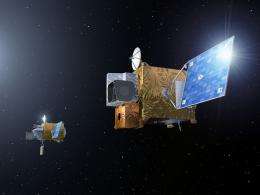
Meteosat Third Generation imager and sounder

Marking a significant milestone for Europe's next fleet of meteorological satellites, ESA has given the go-ahead to Thales Alenia Space in France to start work on developing the Meteosat Third Generation.

The 'Preliminary Authorisation To Proceed' was signed today after a kick-off meeting between ESA and Thales Alenia . This approval follows several months of negotiations that has resulted in a final industrial team of Thales Alenia Space (FR) and the initial consortium members, OHB (DE) and Kayser Threde (DE), together with, in a range of complementary functions, Astrium (DE/FR).

Formal introduction of Astrium into the consortium will take place over the next six months.

Following on from Meteosat Second Generation, the Meteosat Third Generation (MTG) is being created through cooperation between Eumetsat and ESA to ensure continuity of high-resolution meteorological data to beyond 2037.

This next series of geostationary weather satellites will be a step change by providing significant improvements over the capabilities of the current Meteosat generation.


The series will comprise six satellites: four MTG-I imaging and two MTG-S sounding satellites. The two types will be positioned over the same longitude in their geostationary orbits.

The sounding element, which also carries the Sentinel-4 for the Global Monitoring for Environment and Security programme as a guest payload, is a key innovation. For the first time, satellites will not only image weather systems, but also analyse the atmosphere layer by layer and provide deeper insight into the complexities of its chemical composition.

The first MTG-I satellite is expected in late 2017, with the first MTG-S following in early 2019.

Provided by European Space Agency search and more info website


Rank not rated yet
Relevant PhysicsForums posts
  • revamping general concept and cosmological principle
    created3 hours ago
  • Transiting Exoplanet Light Curve
    created13 hours ago
  • Math behind Theoretical Physics
    createdMay 24, 2012
  • Do we know whats at the center of galaxies yet?
    createdMay 23, 2012
  • Structure of the Milky Way?
    createdMay 20, 2012
  • What would it take to terraform Pluto and Charon?
    createdMay 19, 2012
  • More from Physics Forums - General Astronomy

More news stories

Dragon arrives at space station in historic 1st (Update 2)

The privately bankrolled Dragon capsule made a historic arrival at the International Space Station on Friday, triumphantly captured by astronauts wielding a giant robot arm.

Space & Earth / Space Exploration

created 6 hours ago | popularity 5 / 5 (6) | comments 8

SKA super telescope to be built in Australia, South Africa (Update 2)

A long-running joust to host a radio telescope that would give mankind its farthest peek into the Universe ended on Friday with a Solomon-like judgement to split the site between Australia and South Africa.

Space & Earth / Astronomy

created 8 hours ago | popularity 5 / 5 (2) | comments 2

Typhoon Sanvu affecting Iwo To, then expected to fade over weekend

Infrared and visible imagery from NASA's Aqua satellite taken on May 25, 2012, showed an impressive Typhoon Sanvu already affecting the islands of Iwo To and Chichi Jima, Japan. The typhoon is expected to ...

Space & Earth / Earth Sciences

created 2 hours ago | popularity not rated yet | comments 0

NASA sees Hurricane Bud threaten western Mexico's coast

NASA satellites are providing rainfall, temperature, pressure, visible and infrared data to forecasters as Hurricane Bud is expected to make a quick landfall in western Mexico this weekend before turning back ...

Space & Earth / Earth Sciences

created 2 hours ago | popularity not rated yet | comments 0

Get ready for the transit of Venus

Scientists and amateur astronomers around the world are preparing to observe the rare occurrence of Venus crossing the face of the Sun on 5-6 June, an event that will not be seen again for over a hundred years.

Space & Earth / Space Exploration

created 8 hours ago | popularity 5 / 5 (1) | comments 0


Researchers solve structure of human protein critical for silencing genes

In a study published in the journal Cell on May 24, Cold Spring Harbor Laboratory (CSHL) scientists describe the three-dimensional atomic structure of a human protein bound to a piece of RNA that "guides" the pr ...

High-speed method to aid search for solar energy storage catalysts

Eons ago, nature solved the problem of converting solar energy to fuels by inventing the process of photosynthesis.

Yahoo! ditches digital newsstand for iPads

Yahoo! shuttered its fledgling digital newsstand for iPads on Friday in what it said was the start of a product purge intended to make the floundering Internet pioneer more nimble.

Of mice and mental models: Neuroscientific implications of risk-optimized behavior in the mouse

(Medical Xpress) -- Regardless of an organism’s biological complexity, every encephalized animal continuously makes under-informed behavioral choices that can have serious consequences. Despite its ubiquity, ...

Landmark calculation clears the way to answering how matter is formed

(Phys.org) -- An international collaboration of scientists, including Thomas Blum, associate professor of physics, is reporting in landmark detail the decay process of a subatomic particle called a kaon – ...

MIT researchers devise new means to synchronize a group of robots (w/ Video)

(Phys.org) -- For several years, roboticists have been working out ways to get a group of robots to perform synchronized activities as demonstrated most often in dance routines. It’s not just about trying ...