Luminous jellyfish cells help with early cancer diagnosis
November 3, 2010

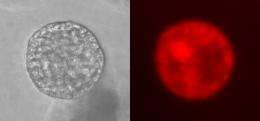
Red fluorescent cells inside an experimental tumour.

Enlarge

Red fluorescent cells inside an experimental tumour.

(PhysOrg.com) -- It sounds like an idea plucked from the realms of science fiction writing. But in this case, there is nothing fictional about it. Scientists in Yorkshire have developed a process that uses the luminous cells from jellyfish to diagnose cancers deep within the human body.

The method has been developed at the Yorkshire Cancer Research Laboratory at The University of York and the man who leads the York team, Professor Norman Maitland, believes it will revolutionise the way some cancers are diagnosed.

"Cancers deep within the body are difficult to spot at an early stage, and early diagnosis is critical for the successful treatment of any form of cancer," he said.

"What we have developed is a process which involves inserting proteins derived from luminous cells into human cancer cells. Then, when we illuminate the tissue, a special camera detects these proteins as they light up, indicating where the tumours are."

The process is an extension of the work done by American chemist Dr Roger Y Tsien who won a Nobel Prize in 2008 for taking luminous cells from a common jellyfish called the crystal jelly and isolating the (GFP).

The GFP is the substance that allows jellyfish to glow in the dark.

"When we heard about Dr Tsien's work, we realised how that advance might be useful in the diagnosis of cancer," said Prof Maitland.

"X-Rays, for example, struggle to penetrate well deeply into tissues and bone, so diagnosing dangerous microscopic is difficult. Our process should allow earlier diagnosis to take place."

What the Yorkshire Cancer Research team has done is to use an altered form of the so that it shows up as red or blue, rather than its original green. Colour is important for these tests, as most colours in the spectrum are rapidly absorbed, and tumours deep within the body become invisible. You can try this for yourself by shining a torch light through your hand - the only colour which you can see is red.

In the procedure, viruses containing the proteins are targeted to home in on tiny bundles of cancer cells scattered throughout the body (metastases).

Normally this would not be enough to see the minute tumours which are too small to be seen by conventional scanning techniques, but the viruses then start to grow, and while doing so make more of the red fluorescent proteins.

Thousands of copies are made in each cancer cell, a process, which is repeated in the surrounding cells, as the virus infection spreads and then stops.

"When a specially developed camera is switched on, the proteins just flare up and you can see where the are." said Prof Maitland, "We call the process 'Virimaging' ".

If the research continues to go according to plan, the method is expected to be ready for clinical trials within five years and could be ready for diagnostic use by clinicians a few years after this. It has to be tested thoroughly, as a failure to detect such small cancers has serious consequences for patients.

However, while the system works in the laboratory, one major hurdle is a shortage of specialised cameras.

Only one company, based in the United States, has so far designed and built a camera system which allows the jellyfish proteins to be seen with the desired resolution deep in the body. The camera costs around half a million pounds and Prof Maitland is currently raising the funds to be able to buy one.

Provided by University of York

4.9 /5 (7 votes)  

Rank 4.9 /5 (7 votes)
Relevant PhysicsForums posts
  • A question about drug tolerance
    createdMay 23, 2012
  • Poor nutrition leading to overeating?
    createdMay 23, 2012
  • Math and dyslexia?
    createdMay 21, 2012
  • portable metabolism meter?
    createdMay 21, 2012
  • Rare medical conditions on 20/20 tonight
    createdMay 18, 2012
  • "Good" Cholesterol in Doubt
    createdMay 17, 2012
  • More from Physics Forums - Medical Sciences

More news stories

Of mice and mental models: Neuroscientific implications of risk-optimized behavior in the mouse

(Medical Xpress) -- Regardless of an organism’s biological complexity, every encephalized animal continuously makes under-informed behavioral choices that can have serious consequences. Despite its ubiquity, ...

Medicine & Health / Neuroscience

created 13 hours ago | popularity not rated yet | comments 0 | with audio podcast feature

Skp2 activates cancer-promoting, glucose-processing Akt

HER2 and its epidermal growth factor receptor cousins mobilize a specialized protein to activate a major player in cancer development and sugar metabolism, scientists report in the May 25 issue of Cell.

Medicine & Health / Cancer

created 7 hours ago | popularity not rated yet | comments 0 | with audio podcast

Tongue analysis software uses ancient Chinese medicine to warn of disease

For 5,000 years, the Chinese have used a system of medicine based on the flow and balance of positive and negative energies in the body. In this system, the appearance of the tongue is one of the measures used to classify ...

Medicine & Health / Other

created 5 hours ago | popularity not rated yet | comments 0 | with audio podcast

Cancer may require simpler genetic mutations than previously thought

Chromosomal deletions in DNA often involve just one of two gene copies inherited from either parent. But scientists haven't known how a deletion in one gene from one parent, called a "hemizygous" deletion, can contribute ...

Medicine & Health / Cancer

created 11 hours ago | popularity not rated yet | comments 0 | with audio podcast

First study to suggest that the immune system may protect against Alzheimer's changes in humans

Recent work in mice suggested that the immune system is involved in removing beta-amyloid, the main Alzheimer's-causing substance in the brain. Researchers have now shown for the first time that this may apply in humans.

Medicine & Health / Alzheimer's disease & dementia

created 12 hours ago | popularity 5 / 5 (2) | comments 0 | with audio podcast


It's in the genes: Research pinpoints how plants know when to flower

Scientists believe they've pinpointed the last crucial piece of the 80-year-old puzzle of how plants "know" when to flower.

Dragon arrives at space station in historic 1st (Update 2)

The privately bankrolled Dragon capsule made a historic arrival at the International Space Station on Friday, triumphantly captured by astronauts wielding a giant robot arm.

High-speed method to aid search for solar energy storage catalysts

Eons ago, nature solved the problem of converting solar energy to fuels by inventing the process of photosynthesis.

Landmark calculation clears the way to answering how matter is formed

(Phys.org) -- An international collaboration of scientists, including Thomas Blum, associate professor of physics, is reporting in landmark detail the decay process of a subatomic particle called a kaon – ...

Researchers solve structure of human protein critical for silencing genes

In a study published in the journal Cell on May 24, Cold Spring Harbor Laboratory (CSHL) scientists describe the three-dimensional atomic structure of a human protein bound to a piece of RNA that "guides" the pr ...

MIT researchers devise new means to synchronize a group of robots (w/ Video)

(Phys.org) -- For several years, roboticists have been working out ways to get a group of robots to perform synchronized activities as demonstrated most often in dance routines. It’s not just about trying ...