Key Parkinson's clue could be protein aggregate
November 3, 2010 By Anne Ju
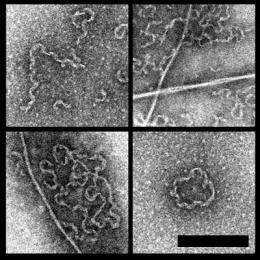
Transmission electron micrographs of classically rigid amyloid fibers and other, differently shaped aggregates formed from the Parkinson's disease-associated protein alpha-synuclein. The study of alternative aggregation pathways of alpha-synuclein may be crucial for understanding the initiation of the disease.
(PhysOrg.com) -- Proteins perform almost every function our bodies require for life. But, they also can misbehave in myriad ways. By retracing the history of each abnormal reaction, biochemists aim to determine the events that lead to disease and to intervene in the process.
Collaborative research between Ithaca-based Cornell applied physicists and biochemists at Weill Cornell Medical College has yielded new clues into what happens when the Parkinson's disease-associated protein alpha-synuclein undergoes abnormal aggregation. These findings are published in the Nov. 2 edition of Proceedings of the National Academy of Sciences (online Oct. 14).
Parkinson's disease patients have dense lesions in their midbrains called Lewy bodies, which involve aggregates of alpha-synuclein. But it is still unclear whether Lewy bodies are a symptom of the disease or are themselves responsible for cell death. Many researchers surmise that smaller clusters (known as oligomers or aggregates) of alpha-synuclein protein could be responsible for initiating neurodegeneration.
The Cornell group, led by applied and engineering physics professor Watt W. Webb and Weill Cornell biochemistry professor David Eliezer, aimed to shed light on structural changes in alpha-synuclein. Using chemical solutions of fluorinated alcohol to trigger protein structural transitions, the researchers observed the formation of irregular, helical aggregates that may be similar to formations in the brain of Parkinson's disease patients. These structures, some long and thin, and others inter-wound or spooled, could suggest alternative pathways to alpha-synuclein aggregation in the brain.
"These ringlike annular aggregates have been seen with atomic force microscopy before, and people have been interested in them for a long time," said Valerie Anderson, first author and a graduate student in Webb's lab. The research shows that the aggregates maybe involved in infiltrating healthy cells and causing disease, which could result in toxicity. (See accompanying electron nanoscopic images.)
The new Cornell experiments paint stunning visual evidence of a wide array of protein aggregates with varying molecular structures, some of which might be key to understanding Parkinson's disease. In addition, the researchers identified early events in the assembly of these structures. By examining the interaction of types of polarized light with the alpha-synuclein protein, they observed rearrangements of the protein on the molecular level prior to aggregation. Additional changes in the molecular conformation occurred when the proteins stuck together; alpha-synuclein adopts a helical structure that converts to an aligned, sheetlike molecular assembly early in the aggregation process.
Understanding disease is like solving a mystery -- a million clues yield nothing, but the right one could lead to new treatments. These latest results shed light on early events that occur when alpha-synuclein behaves badly, although more research must be done to determine whether similar events take place in the brains of Parkinson's disease patients.
The researchers made use of microscopy and spectroscopy equipment at the Cornell Center for Materials Research, which is supported by the National Science Foundation. The research was also funded by the National Institutes of Health and the NSF Science and Technology Center program.
Provided by
Cornell University
-
From lemons to lemonade: Reaction uses carbon dioxide to make carbon-based semiconductor,
28 comments
-
Every black hole contains a new universe: A physicist presents a solution to present-day cosmic mysteries,
216 comments
-
New silicon memory chip developed,
16 comments
-
Thioridazine kills cancer stem cells in human while avoiding toxic side-effects of conventional cancer treatments,
3 comments
-
SpaceX private rocket blasts off for space station (Update),
41 comments
-
oxidation of I- by KMnO4
11 hours ago
-
Invesion temp
14 hours ago
-
Hybridization of SnCl3 -
15 hours ago
-
Electrons And Radiation
19 hours ago
-
Acid Base Theories
May 24, 2012
-
Stability of phenyl cation
May 23, 2012
- More from Physics Forums - Chemistry
More news stories
High-speed method to aid search for solar energy storage catalysts
Eons ago, nature solved the problem of converting solar energy to fuels by inventing the process of photosynthesis.
4 hours ago |
5 / 5 (2) |
1
|
Researchers demonstrate possible primitive mechanism of chemical info self-replication
(Phys.org) -- When scientists think about the replication of information in chemistry, they usually have in mind something akin to what happens in living organisms when DNA gets copied: a double-stranded molecule ...
12 hours ago |
5 / 5 (3) |
2
|
Building a better solar panel -- one molecule at a time
(Phys.org) -- One of the fundamental building blocks in modern chemistry, an organometallic chemical compound called ferrocene, has never been structurally defined - until now.
13 hours ago |
5 / 5 (1) |
0
|
From lemons to lemonade: Reaction uses carbon dioxide to make carbon-based semiconductor
(Phys.org) -- A materials scientist at Michigan Technological University has discovered a chemical reaction that not only eats up the greenhouse gas carbon dioxide, it also creates something useful. And, by ...
May 21, 2012 |
4.7 / 5 (88) |
28
|
New CO2-removing catalyst can take the heat
(Phys.org) -- The current method of removing the greenhouse gas carbon dioxide (CO2) from the flues of coal-fired power plants uses so much energy that no one bothers to use it. So says Roger Aines, principal ...
May 24, 2012 |
5 / 5 (7) |
7
|
It's in the genes: Research pinpoints how plants know when to flower
Scientists believe they've pinpointed the last crucial piece of the 80-year-old puzzle of how plants "know" when to flower.
Of mice and mental models: Neuroscientific implications of risk-optimized behavior in the mouse
(Medical Xpress) -- Regardless of an organism’s biological complexity, every encephalized animal continuously makes under-informed behavioral choices that can have serious consequences. Despite its ubiquity, ...
Researchers solve structure of human protein critical for silencing genes
In a study published in the journal Cell on May 24, Cold Spring Harbor Laboratory (CSHL) scientists describe the three-dimensional atomic structure of a human protein bound to a piece of RNA that "guides" the pr ...
Dragon arrives at space station in historic 1st (Update 2)
The privately bankrolled Dragon capsule made a historic arrival at the International Space Station on Friday, triumphantly captured by astronauts wielding a giant robot arm.
Landmark calculation clears the way to answering how matter is formed
(Phys.org) -- An international collaboration of scientists, including Thomas Blum, associate professor of physics, is reporting in landmark detail the decay process of a subatomic particle called a kaon ...
MIT researchers devise new means to synchronize a group of robots (w/ Video)
(Phys.org) -- For several years, roboticists have been working out ways to get a group of robots to perform synchronized activities as demonstrated most often in dance routines. Its not just about trying ...