Intel teams up with leading researchers to make football helmets safer
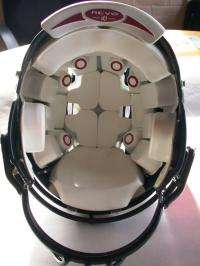
This is an image of the Riddell HITS* sensor system installed in a Riddell Revo* helmet. These sensors are placed inside a helmet and they record the impacts that the player sustains during practice or during games. This image was provided courtesy of Riddell.
Intel today announced that it is collaborating with industry experts and several universities to tackle the issue of football-related head injuries.
Using supercomputers and workstations based on present and future Intel processor technology, researchers are simulating collisions to study the impact on the brain, and use that information to design new football helmets that reduce the risk of short- and long-term injuries.
Intel, working with Riddell, the premier designer and developer of helmets and protective equipment, and researchers from the Thayer School of Engineering (Dartmouth), Wayne State University, University of Northern Colorado and Texas State University-San Marcos, demonstrated simulations during an event at the SC10 conference in New Orleans.
In this demonstration, simulated impacts are processed on Intel Xeon Processor-based Workstations and Clusters, or a group of linked computers, to rapidly compute, visualize and assess the risk of injury in an impact event. The simulations are based on computer models from partner universities, some of which include actual data from on-field impacts using the Riddell HITS (Head Impact Telemetry System), a proprietary in-helmet technology that provides real-time data regarding head impacts. These models show visualization of the stresses on the brain and can allow for comparisons between impacts that are found to result in a concussion and similar impacts that cause no injury.
This video is not supported by your browser at this time.
"Computer simulations have been instrumental in designing improved brain injury criteria, said Dr. Igor Szczyrba with the University of Northern Colorado. In the near future, they can also help doctors diagnose actual brain injuries.Separately, attending the event and discussing the importance of using safe equipment to prevent injuries, was Drew Brees, quarterback of the New Orleans Saints and Super Bowl XLIV MVP.
While no equipment can prevent 100 percent of injuries, Intel is also working with Mayo Clinic to accelerate the ability to process medical scans. In this application, cranial scans running on Intel Many Integrated Core (MIC) architecture co-processors were accelerated by up to 18 times.
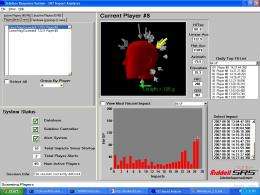
This is an image of the Sideline Response System* from Riddell, which takes the HITS data from instrumented helmets and saves the data for later analysis, or alerts sideline staff if a dangerous impact was detected by a player’s helmet. The software can show the angle and force of each impact. This image was provided courtesy of Riddell.
During the event, Intel also discussed future technologies, based on its Intel Atom processors, which could be embedded in helmets and wirelessly feed data into servers and cloud networks that measure injury risk and impact in real-time. When combined with impact simulation, this could better safeguard players by identifying potential injuries quickly so that medical personnel can respond faster and have information as soon as they reach the player on the field.Intel, with its top-ranked Intel Xeon chip-based supercomputers, has been a leader in using parallel processing to solve complex problems. Some of this urgent and groundbreaking research is made possible by Intel MIC architecture, which could run up to trillions of calculations per second, and includes in its targets high-performance computing segments such as scientific research, exploration and climate modeling. The first Intel MIC product, codenamed Knights Corner, will be made on Intels 22-nanometer (nm) manufacturing process transistor structures packed as small as 22 billionths of a meter -- and will use Moores Law to scale tens of Intel processing cores on a single chip. While the vast majority of workloads will still run best on award-winning Intel Xeon processors, Intel MIC architecture will add more business opportunities for highly parallel applications.
Source:
Intel
-
From lemons to lemonade: Reaction uses carbon dioxide to make carbon-based semiconductor,
28 comments
-
Every black hole contains a new universe: A physicist presents a solution to present-day cosmic mysteries,
216 comments
-
New silicon memory chip developed,
16 comments
-
Thioridazine kills cancer stem cells in human while avoiding toxic side-effects of conventional cancer treatments,
3 comments
-
SpaceX private rocket blasts off for space station (Update),
41 comments
-
length of wire in a coil of known dimensions?
8 hours ago
-
India Engineering Powerhouse
15 hours ago
-
electromagnet core dereference between hard and soft iron
16 hours ago
-
Measuring water pressure in an open tank
May 24, 2012
-
Question from a non-engineer: Pulley Systems
May 24, 2012
-
Formula to calculate psi required to deliver gpm through nozzel
May 23, 2012
- More from Physics Forums - General Engineering
More news stories
Yahoo kills 'Livestand' just 6 months after debut
(AP) -- Yahoo is killing a tablet magazine called Livestand just six months its debut on the iPad.
3 hours ago |
not rated yet |
1
Yahoo! ditches digital newsstand for iPads
Yahoo! shuttered its fledgling digital newsstand for iPads on Friday in what it said was the start of a product purge intended to make the floundering Internet pioneer more nimble.
4 hours ago |
not rated yet |
0
Computers excel at identifying smiles of frustration (w/ Video)
(Phys.org) -- Researchers at the Massachusetts Institute of Technology (MIT) in the US have trained computers to recognize smiles, and they have turned out to be more adept at recognizing smiles of frustration ...
Facebook IPO debacle raises investor dander
The spate of complaints and investigations over the Facebook stock offering suggests big institutions had an edge over small investors, raising questions about the process.
5 hours ago |
not rated yet |
0
Shareholders vote to take China's Alibaba unit private
Minority shareholders of Alibaba.com on Friday voted in favour of a proposal by its parent Alibaba Group Holding to take the Hong Kong-listed online trading unit private, the company said.
5 hours ago |
not rated yet |
0
It's in the genes: Research pinpoints how plants know when to flower
Scientists believe they've pinpointed the last crucial piece of the 80-year-old puzzle of how plants "know" when to flower.
High-speed method to aid search for solar energy storage catalysts
Eons ago, nature solved the problem of converting solar energy to fuels by inventing the process of photosynthesis.
Researchers solve structure of human protein critical for silencing genes
In a study published in the journal Cell on May 24, Cold Spring Harbor Laboratory (CSHL) scientists describe the three-dimensional atomic structure of a human protein bound to a piece of RNA that "guides" the pr ...
Of mice and mental models: Neuroscientific implications of risk-optimized behavior in the mouse
(Medical Xpress) -- Regardless of an organism’s biological complexity, every encephalized animal continuously makes under-informed behavioral choices that can have serious consequences. Despite its ubiquity, ...
Dragon arrives at space station in historic 1st (Update 2)
The privately bankrolled Dragon capsule made a historic arrival at the International Space Station on Friday, triumphantly captured by astronauts wielding a giant robot arm.
Landmark calculation clears the way to answering how matter is formed
(Phys.org) -- An international collaboration of scientists, including Thomas Blum, associate professor of physics, is reporting in landmark detail the decay process of a subatomic particle called a kaon ...
