Indian tech firms link with China to take on Western brands
November 30, 2010 by Adam Plowright

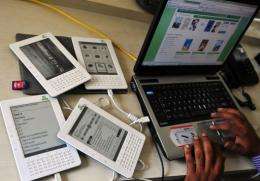
A man works on his laptop as he uploads e-books and synchronises with the attached Kindle-style tablet called Wink

Enlarge

A man works on his laptop as he uploads e-books and synchronises with the attached Kindle-style tablet called Wink at the EC Media International Private Limited office in Bangalore on November 27. Indian technology companies are growing in confidence and new brands are launching thick and fast, determined to take on established Western names with help from cheap Chinese factories.

Indian technology companies are growing in confidence. New brands are launching thick and fast, determined to take on established Western names with help from cheap Chinese factories.

Many of them have made significant inroads into the rocketing in India, and others already have their eye on bigger prizes in the international tablet computer and PC industry.

The boss of Bangalore-based Notion Ink, Rohan Shravan, is a man in a hurry. The fast-talking 25-year-old co-founded the group three years ago and will start taking orders for his "Adam" within weeks.

Shipping of the sleek iPad wannabee to the United States and Europe could begin at the end of the year, with domestic sales starting soon after.

"What we want to do is set a standard in the international market with the Adam," Shravan, a graduate of one of India's prestigious technical universities, told AFP.

"There's going to be exponential growth for us," he said, adding that an updated version of the device was already in development.

Elsewhere, electronics group Olive and online Indian shopping site Infibeam -- which models itself on US-based Amazon, even down to its very similar logo -- have both launched their own tablet computers.

Amazon has other admirers in India and the concept of its top-selling Kindle, designed specifically for reading books and magazines, has also been copied by another ambitious Bangalore-based company, EC Media.

In August, it launched Wink, which is about 40 dollars cheaper than the Kindle in India, though it has received mixed reviews.

EC Media has signed up deals with local publishers to supply books in English as well as 15 vernacular languages -- a key part of their sales strategy.

"We thought that even though the market is not there yet, if you are in the market then it has good scope for growth," Pradeep Palazhi, chief operating officer, told AFP at a launch event in New Delhi.

"Wink is designed for the Indian reader. The Kindle is available here, but it's still dependent on the US store," he said.

In the mobile phone sector, competition is fierce and the impact of Indian companies could presage developments in other parts of the electronics market, where demand is being driven by India's rapidly expanding economy.

Rising incomes, access to credit, and the falling costs of technology mean sales of electronic goods are booming across the country.

In the mobile sector, Indian brands Micromax, Lava, Spice, Karbonn and Zen have mushroomed over the last 12 months, grabbing share from Nokia through aggressive marketing and products adapted for the local market.

In a study published in September, research firm IDC estimated domestic handset makers had grabbed a market share of 33 percent from just 0.9 percent two years ago.

Their road to success, like everyone else's in the electronics sector, reaches back into China where large-scale, hi-tech and cheap contract manufacturers have been tapped as suppliers.

Though relations between the two Asian superpowers are prickly at a diplomatic level, collaboration between India's skilled software engineers and device designers and China's factories is developing at pace.
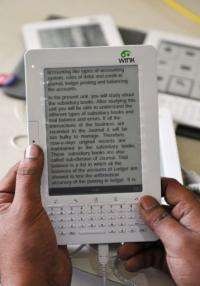
A man works on his Kindle-style tablet called Wink
Enlarge

A man works on his Kindle-style tablet called Wink at the EC Media International Private Limited office in Bangalore on November 27. Indian technology companies are growing in confidence and new brands are launching thick and fast, determined to take on established Western names with help from cheap Chinese factories.

"There are vendors in China that can do just about anything you want," said Amit Aggerwal, respected Indian technology writer and chief of the Digital Inspiration blog.

"You give them the price they are asking for and you get a product ready to go to stores.

"If you have an idea, getting it executed is quite easy now, so that's helping a lot of vendors," he added.

Shravan from Notion Ink said getting his devices manufactured in India made no sense because production capacity is small, meaning prices are high, and factories lack the latest hi-tech equipment.

"China is the one that has invested in nano technology. They have the scale," he told AFP.

He says he would like to see his devices being assembled in India -- mobile phone firms such as Micromax and Nokia already have such facilities -- but manufacturing will not be a possibility for the "next five to ten years".

"It takes a lot for the investment in the infrastructure in electronics," he said.

Consultancy Frost & Sullivan recently carried out a study of the Indian electronics market and concluded that the country had good prospects for manufacturing in several product areas.

Mobile handsets and mobile phone base stations have potential, as well as computer desktops and laptops, memory products and screens for televisions and computer monitors, Frost said.

Ameya Dalvi, editor of consumer electronics website http://www.techtree.com, says many in the industry expect a tablet PC boom after the success of the Apple iPad, which could present Indian companies with an opportunity.

He says the market has shown how Indian brands are capable of challenging international groups in the low-end mass market once demand has been established.

"Indian companies are not pioneers. They'll wait, watch and then jump in at the right time if the market is sizeable," he says.

(c) 2010 AFP

Filter


Move the slider to adjust rank threshold, so that you can hide some of the comments.


Display comments: newest first

jjoensuu
Nov 30, 2010

Rank: 1 / 5 (1)
hahaha

One thing India has a lot of is corruption. And people living on less than a $1 a day. So just like the countries in Africa, only on a larger scale. Of course they can always talk like what is done in this article, because talk is cheap.

Some countries had very little manufacturing in the 50's because they got bombed in second World War. India has had very little manufacturing even though they never got bombed. Thousands of years on that subcontinent and they haven't even learned the basic concepts of organizing their society. So the needed infrastructure will be in the "future" for a looong time, just like Notion Inks tablet.

innovator116
Nov 30, 2010

Rank: not rated yet
India has over a billion people, and diversity is overwhelming, whatever you think and see, its opposite is also true. India will only become a manufacturing power, when it will use open hardware with distributed, personal fabbing.

Indians can innovate, but its rigid social structure and political situation discourages people.

Outsourcing is indeed sweatshop, though chinese factories appear to be sweatshops where labour does not have much rights. In India, though outsourcing appears a clean job with decent facilities it involves cognitive sweatshop approach.
Rank not rated yet
Relevant PhysicsForums posts

More news stories

Yahoo kills 'Livestand' just 6 months after debut

(AP) -- Yahoo is killing a tablet magazine called Livestand just six months its debut on the iPad.

Technology / Business

created 3 hours ago | popularity not rated yet | comments 1

Yahoo! ditches digital newsstand for iPads

Yahoo! shuttered its fledgling digital newsstand for iPads on Friday in what it said was the start of a product purge intended to make the floundering Internet pioneer more nimble.

Technology / Internet

created 4 hours ago | popularity not rated yet | comments 0

Computers excel at identifying smiles of frustration (w/ Video)

(Phys.org) -- Researchers at the Massachusetts Institute of Technology (MIT) in the US have trained computers to recognize smiles, and they have turned out to be more adept at recognizing smiles of frustration ...

Technology / Computer Sciences

created 16 hours ago | popularity 4 / 5 (2) | comments 1 | with audio podcast report

Facebook IPO debacle raises investor dander

The spate of complaints and investigations over the Facebook stock offering suggests big institutions had an edge over small investors, raising questions about the process.

Technology / Business

created 5 hours ago | popularity not rated yet | comments 0

Shareholders vote to take China's Alibaba unit private

Minority shareholders of Alibaba.com on Friday voted in favour of a proposal by its parent Alibaba Group Holding to take the Hong Kong-listed online trading unit private, the company said.

Technology / Business

created 5 hours ago | popularity not rated yet | comments 0


It's in the genes: Research pinpoints how plants know when to flower

Scientists believe they've pinpointed the last crucial piece of the 80-year-old puzzle of how plants "know" when to flower.

High-speed method to aid search for solar energy storage catalysts

Eons ago, nature solved the problem of converting solar energy to fuels by inventing the process of photosynthesis.

Researchers solve structure of human protein critical for silencing genes

In a study published in the journal Cell on May 24, Cold Spring Harbor Laboratory (CSHL) scientists describe the three-dimensional atomic structure of a human protein bound to a piece of RNA that "guides" the pr ...

Of mice and mental models: Neuroscientific implications of risk-optimized behavior in the mouse

(Medical Xpress) -- Regardless of an organism’s biological complexity, every encephalized animal continuously makes under-informed behavioral choices that can have serious consequences. Despite its ubiquity, ...

Dragon arrives at space station in historic 1st (Update 2)

The privately bankrolled Dragon capsule made a historic arrival at the International Space Station on Friday, triumphantly captured by astronauts wielding a giant robot arm.

Landmark calculation clears the way to answering how matter is formed

(Phys.org) -- An international collaboration of scientists, including Thomas Blum, associate professor of physics, is reporting in landmark detail the decay process of a subatomic particle called a kaon – ...