How hummingbirds fight the wind: Robotic device helps analyze hovering birds
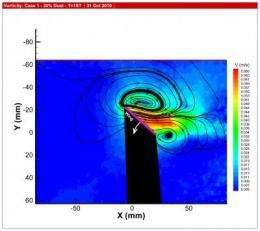
In the presence of a strong gust (30 percent from left to right), both leading and trailing edge vortices were observed during downstroke at a Reynolds number of 1400 (Strouhal number = 0.28). Credit: Courtesy: New Mexico State University.
Hummingbirds rank among the world's largest and most accomplished hovering animals, but how do they manage it in gusty winds?
A team of researchers at New Mexico State University, Los Alamos National Laboratory, Technische Universiteit Eindhoven, and Continuum Dynamics Inc. has built a robotic hummingbird wing to discover the answer, which they describe today at the American Physical Society Division of Fluid Dynamics (DFD) meeting in Long Beach, CA
Hummingbirds do not fly like other birds, whose wings flap up and down, explained B.J. Balakumar of the Extreme Fluids Lab at Los Alamos National Laboratory. Instead, their wings oscillate in a figure eight pattern to produce lift on both the downstroke and upstroke. They achieve the extra lift they need to hover by creating a vortex on the leading edges of their wings.
Such vortices are inherently unstable. "The birds, though, are very clever," Balakumar said. "Their wings create the vortex with a high angle of attack on the downstroke. Then they flip their wings around on the upstroke, so as they shed one vortex, they create another on the other side of the wing, thereby managing to maintain high lift forces."
A gust of wind could pull those vortices off the wing. Instead, hummingbirds continually readjust their wing angles to maintain high lift forces.
The researchers' robotic wing will attempt to replicate that feat in gusty conditions. They hope to identify robust algorithms that will allow the creation of stable ornithopters that can operate reliably under real-life conditions for surveillance and other applications.
More information: The presentation, "Effect of gust on flow patterns around a robotic hummingbird wing" is on Sunday, November 21, 2010. Abstract: http://meetings.ap … Event/132368
Provided by American Institute of Physics
-
From lemons to lemonade: Reaction uses carbon dioxide to make carbon-based semiconductor,
28 comments
-
Every black hole contains a new universe: A physicist presents a solution to present-day cosmic mysteries,
216 comments
-
New silicon memory chip developed,
16 comments
-
Thioridazine kills cancer stem cells in human while avoiding toxic side-effects of conventional cancer treatments,
3 comments
-
SpaceX private rocket blasts off for space station (Update),
41 comments
-
Rotational Inertia of a disc
45 minutes ago
-
How does B=μH really work?
1 hour ago
-
I need help with understanding of Inertia of a slender rod and plate?
3 hours ago
-
Voltage and current in a series circuit
5 hours ago
-
Force on the top hinge of an open door
5 hours ago
-
Specular reflection from moving mirrors
9 hours ago
- More from Physics Forums - General Physics
More news stories
Landmark calculation clears the way to answering how matter is formed
(Phys.org) -- An international collaboration of scientists, including Thomas Blum, associate professor of physics, is reporting in landmark detail the decay process of a subatomic particle called a kaon ...
12 hours ago |
4.8 / 5 (9) |
24
|
Is a classical electrodynamics law incompatible with special relativity?
(Phys.org) -- The laws of classical electromagnetism that were developed in the 19th century are the same laws that scientists use today. They include Maxwell’s four equations along with the Lorentz la ...
Lying in wait for WIMPs: Researchers seek to dramatically increase sensitivity of Large Underground Xenon detector
Although it's invisible, dark matter accounts for at least 80 percent of the matter in the universe. No one knows what it is, but most scientists would bet on weakly interacting massive particles, or WIMPs.
May 23, 2012 |
4 / 5 (5) |
13
|
Cloak of invisibility: Engineers use plasmonics to create an invisible photodetector
A team of engineers at Stanford and the University of Pennsylvania has for the first time used "plasmonic cloaking" to create a device that can see without being seen - an invisible machine that detects light. It is the first ...
May 21, 2012 |
4.8 / 5 (16) |
7
|
Hall effect at the speed of light: How can you demonstrate relativistic effects with your mobile phone?
The relativistic Hall effect describing objects rotating at speeds comparable with the speed of light has been reported.
May 21, 2012 |
4.3 / 5 (3) |
8
It's in the genes: Research pinpoints how plants know when to flower
Scientists believe they've pinpointed the last crucial piece of the 80-year-old puzzle of how plants "know" when to flower.
High-speed method to aid search for solar energy storage catalysts
Eons ago, nature solved the problem of converting solar energy to fuels by inventing the process of photosynthesis.
Researchers solve structure of human protein critical for silencing genes
In a study published in the journal Cell on May 24, Cold Spring Harbor Laboratory (CSHL) scientists describe the three-dimensional atomic structure of a human protein bound to a piece of RNA that "guides" the pr ...
Of mice and mental models: Neuroscientific implications of risk-optimized behavior in the mouse
(Medical Xpress) -- Regardless of an organism’s biological complexity, every encephalized animal continuously makes under-informed behavioral choices that can have serious consequences. Despite its ubiquity, ...
Dragon arrives at space station in historic 1st (Update 2)
The privately bankrolled Dragon capsule made a historic arrival at the International Space Station on Friday, triumphantly captured by astronauts wielding a giant robot arm.
Math predicts size of clot-forming cells
UC Davis mathematicians have helped biologists figure out why platelets, the cells that form blood clots, are the size and shape that they are. Because platelets are important both for healing wounds and in strokes and other ...
Nov 23, 2010
Rank: not rated yet