A high-yield biomass alternative to petroleum for industrial chemicals
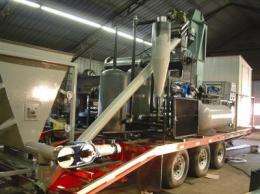
A team of University of Massachusetts Amherst chemical engineers have developed a way to produce high-volume chemical feedstocks including benzene, toluene, xylenes and olefins from pyrolytic bio-oils, the cheapest liquid fuels available today derived from biomass. The new process could reduce or eliminate industry’s reliance on fossil fuels to make industrial chemicals worth an estimated $400 billion annually. Credit: Phil Badger, Renewable Oil Internatiional
A team of University of Massachusetts Amherst chemical engineers report in today's issue of Science that they have developed a way to produce high-volume chemical feedstocks including benzene, toluene, xylenes and olefins from pyrolytic bio-oils, the cheapest liquid fuels available today derived from biomass. The new process could reduce or eliminate industry's reliance on fossil fuels to make industrial chemicals worth an estimated $400 billion annually.
Instead of buying petroleum by the barrel, chemical manufacturers will now be able to use relatively cheaper, widely available pyrolysis oils made from waste wood, agricultural waste and non-food energy crops to produce the same high-value materials for making everything from solvents and detergents to plastics and fibers.
As principal investigator George Huber, associate professor of chemical engineering at UMass Amherst, explains, "Thanks to this breakthrough, we can meet the need to make commodity chemical feedstocks entirely through processing pyrolysis oils. We are making the same molecules from biomass that are currently being produced from petroleum, with no infrastructure changes required."
He adds, "We think this technology will provide a big boost to the economy because pyrolysis oils are commercially available now. The major difference between our approach and the current method is the feedstock; our process uses a renewable feedstock, that is, plant biomass. Rather than purchasing petroleum to make these chemicals, we use pyrolysis oils made from non-food agricultural crops and woody biomass grown domestically. This will also provide United States farmers and landowners a large additional revenue stream."
In the past, these compounds were made in a low-yield process, the chemical engineer adds. "But here we show how to achieve three times higher yields of chemicals from pyrolysis oil than ever achieved before. We've essentially provided a roadmap for converting low-value pyrolysis oils into products with a higher value than transportation fuels."
In the paper, he and doctoral students Tushar Vispute, Aimaro Sanno and Huiyan Zhang show how to make olefins such as ethylene and propylene, the building blocks of many plastics and resins, plus aromatics such as benzene, toluene and xylenes found in dyes, plastics and polyurethane, from biomass-based pyrolysis oils. They use a two-step, integrated catalytic approach starting with a "tunable," variable-reaction hydrogenation stage followed by a second, zeolite catalytic step. The zeolite catalyst has the proper pore structure and active sites to convert biomass-based molecules into aromatic hydrocarbons and olefins.
Huber, Vispute and colleagues discuss how to choose among three options including low- and high-temperature hydrogenation steps as well as the zeolite conversion for optimal results. Their findings indicate that "the olefin-to-aromatic ratio and the types of olefins and aromatics produced can be adjusted according to market demand." That is, using the new techniques, chemical producers can manage the carbon content from biomass they need, as well as hydrogen amounts. Huber and colleagues provide economic calculations for determining the optimal mix of hydrogen and pyrolytic oils, depending on market prices, to yield the highest-grade product at the lowest cost.
A pilot plant on the UMass Amherst campus is now producing these chemicals on a liter-quantity scale using this new method. The technology has been licensed to Anellotech Corp., co-founded by Huber and David Sudolsky of New York City. Anellotech is also developing UMass Amherst technology invented by the Huber research team to convert solid biomass directly into chemicals. Thus, pyrolysis oil represents a second renewable feedstock for Anellotech.
Sudolsky, Anellotech's CEO, says, "There are several companies developing technology to produce pyrolysis oil from biomass. The problem has been that pyrolysis oils must be upgraded to be useable. But with the new UMass Amherst process, Anellotech can now convert these pyrolysis oils into valuable chemicals at higher efficiency and with very attractive economics. This is very exciting."
More information: http://www.science … 222.abstract
Provided by University of Massachusetts at Amherst
-
From lemons to lemonade: Reaction uses carbon dioxide to make carbon-based semiconductor,
28 comments
-
Every black hole contains a new universe: A physicist presents a solution to present-day cosmic mysteries,
216 comments
-
New silicon memory chip developed,
16 comments
-
Thioridazine kills cancer stem cells in human while avoiding toxic side-effects of conventional cancer treatments,
3 comments
-
SpaceX private rocket blasts off for space station (Update),
41 comments
-
oxidation of I- by KMnO4
10 hours ago
-
Invesion temp
13 hours ago
-
Hybridization of SnCl3 -
13 hours ago
-
Electrons And Radiation
17 hours ago
-
Acid Base Theories
May 24, 2012
-
Stability of phenyl cation
May 23, 2012
- More from Physics Forums - Chemistry
More news stories
High-speed method to aid search for solar energy storage catalysts
Eons ago, nature solved the problem of converting solar energy to fuels by inventing the process of photosynthesis.
3 hours ago |
5 / 5 (2) |
1
|
Researchers demonstrate possible primitive mechanism of chemical info self-replication
(Phys.org) -- When scientists think about the replication of information in chemistry, they usually have in mind something akin to what happens in living organisms when DNA gets copied: a double-stranded molecule ...
11 hours ago |
5 / 5 (3) |
2
|
Building a better solar panel -- one molecule at a time
(Phys.org) -- One of the fundamental building blocks in modern chemistry, an organometallic chemical compound called ferrocene, has never been structurally defined - until now.
11 hours ago |
5 / 5 (1) |
0
|
From lemons to lemonade: Reaction uses carbon dioxide to make carbon-based semiconductor
(Phys.org) -- A materials scientist at Michigan Technological University has discovered a chemical reaction that not only eats up the greenhouse gas carbon dioxide, it also creates something useful. And, by ...
May 21, 2012 |
4.7 / 5 (88) |
28
|
New CO2-removing catalyst can take the heat
(Phys.org) -- The current method of removing the greenhouse gas carbon dioxide (CO2) from the flues of coal-fired power plants uses so much energy that no one bothers to use it. So says Roger Aines, principal ...
May 24, 2012 |
5 / 5 (7) |
7
|
It's in the genes: Research pinpoints how plants know when to flower
Scientists believe they've pinpointed the last crucial piece of the 80-year-old puzzle of how plants "know" when to flower.
Researchers solve structure of human protein critical for silencing genes
In a study published in the journal Cell on May 24, Cold Spring Harbor Laboratory (CSHL) scientists describe the three-dimensional atomic structure of a human protein bound to a piece of RNA that "guides" the pr ...
Of mice and mental models: Neuroscientific implications of risk-optimized behavior in the mouse
(Medical Xpress) -- Regardless of an organism’s biological complexity, every encephalized animal continuously makes under-informed behavioral choices that can have serious consequences. Despite its ubiquity, ...
Dragon makes history with space station docking
The private company SpaceX made history Friday with the docking of its Dragon capsule to the International Space Station, the most impressive feat yet in turning routine spaceflight over to the commercial ...
Dragon arrives at space station in historic 1st (Update 2)
The privately bankrolled Dragon capsule made a historic arrival at the International Space Station on Friday, triumphantly captured by astronauts wielding a giant robot arm.
Yahoo kills 'Livestand' just 6 months after debut
(AP) -- Yahoo is killing a tablet magazine called Livestand just six months its debut on the iPad.
Nov 25, 2010
Rank: not rated yet
Nov 25, 2010
Rank: not rated yet
Nov 25, 2010
Rank: not rated yet
am i missing something here, or do people actually raise cattle on benzene ...
Nov 25, 2010
Rank: 5 / 5 (1)
And I Love Tanker Stocks-Equities!
Roy J Stewart,
Phoenix AZ
Nov 26, 2010
Rank: 5 / 5 (1)
{Cough}
It is also the term for input to refineries etc...