Researchers hope to harness power of spider silk
(PhysOrg.com) -- When Peter Parker was bitten by a radioactive spider in a laboratory, he became Spider-Man, a superhero with the ability to spin strong, flexible webs. Jeff Yarger and Gregory Holland are hoping to harness spider power in their research lab, as well. But these real-world spider men aren’t waiting around for bizarre lab accidents. The ASU chemists are studying the molecular structure of spider silk in an effort to produce materials ranging from bulletproof vests to artificial tendons. They also want to mimic spiders’ eco-friendly methods in the process.
“Everybody’s familiar with silk, because they’re familiar with silkworm silk. The silk trade has been around for a long time. But spider silk has a much larger variety in its properties,” says Yarger, a professor of chemistry and biochemistry in the College of Liberal Arts and Sciences.
While silkworms produce only one kind of fiber, a single spider can produce up to six different varieties. For instance, there is ultra-strong dragline silk, used to make the framework of a web. Some spiders produce draglines that have more tensile strength than Kevlar. Then there is flagelliform, a highly elastic silk that makes up the spirals of a web. This fiber can sometimes stretch up to 200 times its original length. Spiders use other silks for wrapping their prey, making egg sacs for their young, and other purposes.
None of this is new information. “So why if it’s been known for hundreds of years has it never been used?” asks Yarger.
The reason is that spiders don’t produce silk in large quantities.
“You can put lots of silkworms in a small area and genetically modify them to go from the larval state to a moth in 20-30 days. Spiders take longer. But let’s get to the crux of it—spiders don’t like each other. They eat each other,” he explains.
This of course eliminates the possibility of farming them en masse.
Scientists have come up with ingenious ways to get around this problem. They have genetically engineered silkworms, E. coli, and even goats to produce spider silk. Unfortunately, while these organisms produce the same proteins that spiders make, they don’t have the same mechanical properties as the natural product. They aren’t as strong, for instance, or as flexible.
This is where the ASU researchers’ expertise comes in. Yarger is the director of the Magnetic Resonance Research Center at ASU. Holland is an assistant research professor in the Department of Chemistry and Biochemistry. Both scientists examine the molecular structure of spider silks.
“We use a suite of magnetic resonance tools—NMR and MRI—along with other physical characterization methods such as x-ray diffraction, Raman, and infrared spectroscopy,” explains Holland.
Many groups are interested in the results of this work. Holland has received a grant from the Department of Defense to study ultra-strong materials that could be used for products like body armor. Yarger collaborates with Randy Lewis, a molecular biologist at the University of Wyoming, on a grant from the National Institutes of Health. Lewis is leading a study of flagelliform silk for use in making artificial tendons. In addition to being very flexible, spider silk is highly biocompatible, meaning that it doesn’t produce allergic reactions in humans.
Additionally, Yarger is funded by the National Science Foundation to develop new NMR techniques for analyzing biopolymers. Yarger has spent his career seeking ways to understand amorphous materials like polymers on a molecular level. While crystalline materials are highly structured, amorphous materials are largely disordered. Polymers are a type of amorphous material. Biopolymers are polymers produced by living things.
“Spider silk is the one we focus on in the grant, but the goal is to make these techniques applicable to a range of biopolymers,” says Yarger. “The two that we’re most familiar with in the human body are collagen and elastin—both protein-based biopolymers.”
The main focus of Yarger’s work is using NMR to determine how artificial silk differs from natural silk, and why. The goal is to help scientists reproduce it more accurately, with the desired characteristics.
To understand how the same molecule can have different properties, think of diamonds and graphite. Both have the same composition – carbons connected together – but they have incredibly different characteristics. You don’t see jewelers selling graphite engagement rings, after all.
“They are made up of the same constituent. Carbon is carbon, you would say—but it’s not. How carbon is arranged in three-dimensional space can greatly affect its structure, whether you have graphite or diamonds or buckyballs,” explains Yarger.
Spiders work some rather interesting chemistry within their tiny bodies. They hold the proteins for making webs inside glands in their abdomens, where they are dissolved in solution. When the spider wants to spin a web, it pulls the proteins through a series of ducts and out a set of spinnerets at the base of its abdomen.
“They’ve taken this aqueous protein solution and they’ve pulled an ultra-strong fiber that is no longer soluble in the medium it was in,” says Yarger. “When it rains outside, webs don’t dissolve.”
“One of the main goals of the research is to understand the biochemistry involved in transforming the soluble proteins in the spider’s gland to an insoluble super-fiber at the spider’s spinneret,” adds Holland. “It is our hope that a better understanding of this process will help our group and research groups around the world spin fibers that more closely resemble native spider silk.”
Spider silk offers benefits beyond simply providing useful materials. Imitating the natural process will allow scientists to create products in an environmentally friendly way.
“Most of the strong polymer materials we make right now—things like Kevlar and Teflon—very few of these are made using sustainable, environmentally friendly chemistry methods,” notes Yarger. “They usually use toxic organic solvents and lots of them. Spiders do it out of a very natural, green aqueous solution. If we could reproduce some of that, it would go a long way to an environmentally friendly, sustainable way of producing ultra-strong polymers.”
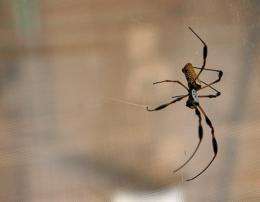
Behind the Magnetic Resonance Research Center, in the basement of ASU’s Interdisciplinary Science and Technology 1 building, there is a room full of spiders. Each spider has a name taped to its cage, like “Beyonce,” the golden orb weaver. These big, yellow-bellied arachnids create intricate webs that can span several meters. Because of their size, the webs need to be incredibly strong to resist breaking when faced with struggling prey.
There are also silver-backed Argiopes, common garden spiders found in California. These build smaller webs than the orb weavers, but their silk is highly elastic.
Across the aisle are collections of two local spiders, captured by students. One is the bright green lynx spider, a jumping spider you can find on cactus leaves. These spiders only produce dragline silk. Yarger is looking at whether the dragline silk from more primitive spiders, which only produce one type of silk, is evolutionarily conserved among later spiders that produce many.
The other local catch is the infamous black widow, highly venomous with dragline silk similar to that of the orb weavers. While imported spiders can only be obtained during certain seasons, the researchers can collect local spiders like black widows all year long.
Yarger says he often receives requests to analyze silk from other species of spiders, as well.
“We’re one of the few groups in the world that’s studying the molecular structure of silk. We have entomologists and arachnologists contact us quite often with some unique spider species, asking if we would be interested in looking at their silk,” he says. “What they don’t realize is that these are big proteins with very complicated structures, and there are multiple proteins in one silk. We don’t spend a day determining the structure—we spend a year or two.”
As a result, the group has to be extremely choosy about what kinds of silk it will analyze. Yarger also adds that spiders and silkworms aren’t the only silk-producing creatures. He raises insects called webspinners, for example. These creatures enshroud themselves in an extremely fine silk so that predators can’t get at them.
“It’s a very strong silk and much thinner than spider silk – nanoscopic in size. We’d like to understand the nanostructure of these,” he says.
Graduate and undergraduate students help with the work in Yarger’s lab. They learn to do everything from collecting spiders and “milking” them for silk, as well as working with the instruments and analyzing data.
“I look at it as, you need a complete education,” says Yarger, who received his own Ph.D. at ASU. “You can’t just say, ‘I worked with spider silk’ and not have done some of the basics involved in that.”
Provided by Arizona State University


