The end of hamburger disease
November 26, 2010

The end of hamburger disease

Enlarge

Hamburger disease, a debilitating form of food poisoning, may be a thing of the past. New findings from an international research collaboration conducted by the French National Institute for Agronomic Research (INRA), involving the Université de Montréal are the first to show how the contaminating E.coli bacterium is able to survive in the competitive environment of a cow's intestine by scavenging specific food sources.

Published in this month's Environmental Microbiology, and featured in Nature Reviews Microbiology, this study may lead to non-medicinal methods for eradicating this invasive bug.

“We studied E.coli O157:H7, which is the most prevalent species of bacteria associated with larger outbreaks,” says Josée Harel, co-author of the study and director of the Groupe de Recherche sur les Maladies Infectieuses du Porc at the Université de Montréal's Faculty of Veterinary Medicine. “These outbreaks have been associated with direct contact with the farm environment and with the consumption of meat, raw milk and dairy products. Reduction or eradication of O157:H7 in cows will lead to a substantial decrease in food contamination and consequential human infections.”

The intestine is a complex environment with a high number and diversity of bacteria. Most of these bugs are not harmful and many contribute to proper bowel function. However, your guts are a battleground for wars between these species as they engage in a struggle to obtain carbon, nitrogen and other energy sources. Those that win the battle for resources survive and multiply while the losers disappear.

Harel and her collaborators' from France's Institut National de la Recherche Agronomique and Lallemand Animal Nutrition, first step was to demonstrate that O157:H7 does in fact thrive in the bovine intestine. Once this was established, they went on to determine why these particular bacteria find the cow intestine such a great place to live. They found that O157:H7 is unusual because it can forage nitrogen from ethanolamine, a chemical present in the cow's intestine. Because other bacteria cannot process ethanolamine, O157:H7 has this source of nutrition to itself. “The ability of O157:H7 to use ethanolamine as a source of nitrogen gives it the nutritional and competitive advantage to survive,” says Harel.

It is all in the genes

The final step for Harel and colleagues was to determine how O157:H7 was able to process the ethanolamine so it could be used as a nitrogen source. Genetic analyses revealed that 0157:H7 had specific genes that allowed it to do so.
The end of hamburger disease
Enlarge

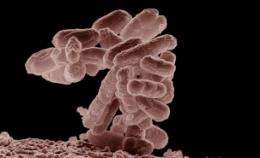
E. coli bacteria

“We now know that this bacteria has evolved a genetic program that allows it to process ethanolamine and therefore outcompete its neighbors and survive and multiply in the intestine,” says Harel. “This new-found knowledge will help us select appropriate feed or probiotics in an attempt to eliminate the food source of this contaminating bug. This in turn, should limit the spread of this bug into the food chain.”

About hamburger disease

Hamburger disease, otherwise known as haemolytic uremic syndrome, can occur after a person has been infected with the E. coli O157:H7. It can result in the destruction of cells that cause clotting of the blood and red blood cells. Kidney failure may result due to the damage of the small blood vessels and tubules in the kidneys. It usually affects children between the ages of 1 and 10 years, but may also occur in adults. HUS affects 2 to 4 people per 100 000 and occurs all over the world.

Provided by University of Montreal search and more info website

4.7 /5 (7 votes)  

Filter


Move the slider to adjust rank threshold, so that you can hide some of the comments.


Display comments: newest first

Karmasura
Nov 26, 2010

Rank: not rated yet
Why don't the same symptoms as hamburger disease not appear in the cows that get infested with the bacteria? Maybe studying those defense mechanisms may help in designing a cure for the disease.
tkjtkj
Nov 26, 2010

Rank: 5 / 5 (2)
Why don't the same symptoms as hamburger disease not appear in the cows that get infested with the bacteria? Maybe studying those defense mechanisms may help in designing a cure for the disease.


There could be a million reasons why a given disease affects only a single species.. That is the reason why, when we experiment with vaccines on Rhesus monkeys we can not simply say "if it works on the monkey, 'nuff said" Species are different: we might share 95% of our DNA with a cat, but we dont catch 'feline leukemia'. Species' bodies contain different proteins, eg, that can act as receptors for some pathogen, whereas another even closely related species lacks the protein: hence, no pathogen can get a hold. This is a huge topic but i hope these points are helpful.

(but consistent with your thought, I don't think anyone has ever found a shark that had cancer .. Now, there's an opportunity !)
yyz
Nov 26, 2010

Rank: not rated yet
I totally agree with your post except for that last part. Sharks DO get cancer: http://www.scienc...t_cancer

(But don't feel too bad, it is a widely held myth)
thingumbobesquire
Nov 27, 2010

Rank: not rated yet
Bravo! Great news! (Sorry, Prince Phillip, if this works you won't be able to be reincarnated as E. coli, at least.)
Rank 4.7 /5 (7 votes)
Relevant PhysicsForums posts

More news stories

Copy of the genetic makeup travels in a protein suitcase

Scientists from the Institute for Physical and Theoretical Chemistry at the University of Bonn have succeeded for the first time in the real time filming of the transport of an important information carrier in biological ...

Biology / Cell & Microbiology

created 5 hours ago | popularity not rated yet | comments 0 | with audio podcast

Study uncovers secret to speedy burrowing by razor clams

(Phys.org) -- If you look at a razor burrowing clam sitting in a bucket, you’d never guess that it could burrow itself down into the soil, much less do it with any speed. Razor clams look like fat straws, ...

Biology / Plants & Animals

created 8 hours ago | popularity not rated yet | comments 2 | with audio podcast report

'Transformer' protein makes different sized transport pods

These spheres may look almost identical, but subtle differences between them revealed a molecular version of the robots from Transformers. Each sphere is a vesicle, a pod that cells use to transport materials ...

Biology / Cell & Microbiology

created 5 hours ago | popularity not rated yet | comments 0

A new invading sea crab reaches the Ebro Delta

Originally endemic to the Atlantic Coast of North America, over the past 30 years Dyspanopeus sayi has been involuntarily introduced in the UK, France, the Netherlands, the Black Sea and the Adriatic Sea. A ...

Biology / Ecology

created 6 hours ago | popularity not rated yet | comments 0

Looking out for the Myanmar snub-nosed monkey

A new genetic study has shed light on how the newly discovered Myanmar snub-nosed monkey evolved.

Biology / Plants & Animals

created 7 hours ago | popularity not rated yet | comments 0


Yahoo! ditches digital newsstand for iPads

Yahoo! shuttered its fledgling digital newsstand for iPads on Friday in what it said was the start of a product purge intended to make the floundering Internet pioneer more nimble.

Of mice and mental models: Neuroscientific implications of risk-optimized behavior in the mouse

(Medical Xpress) -- Regardless of an organism’s biological complexity, every encephalized animal continuously makes under-informed behavioral choices that can have serious consequences. Despite its ubiquity, ...

Dragon arrives at space station in historic 1st (Update 2)

The privately bankrolled Dragon capsule made a historic arrival at the International Space Station on Friday, triumphantly captured by astronauts wielding a giant robot arm.

Math predicts size of clot-forming cells

UC Davis mathematicians have helped biologists figure out why platelets, the cells that form blood clots, are the size and shape that they are. Because platelets are important both for healing wounds and in strokes and other ...

Skp2 activates cancer-promoting, glucose-processing Akt

HER2 and its epidermal growth factor receptor cousins mobilize a specialized protein to activate a major player in cancer development and sugar metabolism, scientists report in the May 25 issue of Cell.

MIT researchers devise new means to synchronize a group of robots (w/ Video)

(Phys.org) -- For several years, roboticists have been working out ways to get a group of robots to perform synchronized activities as demonstrated most often in dance routines. It’s not just about trying ...