Growth of sole is sped up by selective breeding
Nov 11, 2010 By Robbert Blonk

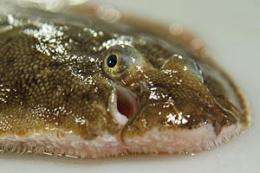
Dutch doctoral researcher Robbert Blonk has found a way of speeding up the growth of North Sea sole considerably. This may make sole farming more viable.

Solea is the only company in the world farming sole. It was set up around breeding facilities established by IMARES in IJmuiden eight years ago, when it became apparent that sole had all but disappeared from the North Sea. It was not as simple as it seemed - Solea has recently gone bankrupt. But doctoral researcher Robbert Blonk, who has been testing at Solea in the past few years, is confident that it would be worth reviving the company. 'I would invest in Solea myself.'

Sole is difficult to farm. does not work, so the fish have to reproduce naturally in groups, using parent fish caught at sea. This way it takes on average two years for the sole to reach the target weight of 200 grams. That is too long and therefore too expensive.

Twenty percent more

Blonk wanted to speed up this growth by selecting the fastest-breeding sole, but he ran into obstacles here too. A showed that more than half the had come from just six parent fish. Blonk used to select parent fish that were genetically varied, and he also selected the fastest growing parent fish. In two years, this produced sole with a 20 percent higher average weight. In other words: with his selection method the sole reached their target weight in one and a half years instead of two. Blonk also looked into how far the growth of the sole was determined by heredity. It turned out that 25 percent of the growth rate was genetically determined. Another big factor is , as well as the conditions at the fish farm.

Blonk's breeding programme will not produce results in the short term. 'We selected the parents two years ago with this method. Sole reaches reproductive maturity only after four years. The initial results of the breeding programme can therefore only be expected in two years' time.' Blonk's research was funded by Dutch research organization NWO. He will received his PhD on 5 November and then set to work at IMARES.

Explore further: Serengeti road divides biologists: Will a road across the northern tier of Serengeti National Park ruin it?

Provided by Wageningen University

4 /5 (1 vote)
add to favorites email to friend print save as pdf

Related Stories

Intensive fishing leads to smaller fish

May 07, 2010

(PhysOrg.com) -- Intensive fishery activities in the North Sea have resulted in evolutionary changes in fish. Fish remain smaller, grow slower and mature sexually earlier. This is postulated by Fabian Mollet, fishery researcher ...

Who's most likely to be swept away?

Dec 01, 2008

If you think the person most likely to be involved in an avalanche this winter will be a young hot-dogger who doesn't know any better, think again.

Gender-changing fish are studied

Apr 11, 2006

A University of New Hampshire scientist is trying to determine what causes sex reversals among black sea bass and how to prevent it.

EU sets fish quotas for 2007

Dec 22, 2006

The European Union fisheries ministers have set the 2007 limits for fish catches in European waters.

Recommended for you

Wildlife losses now stabilising

21 hours ago

Efforts to conserve biodiversity in the UK, Belgium and Netherlands may be working, despite the widespread perception that wildlife is in terminal decline, a new study suggests.

User comments : 0

More news stories

White tiger mystery solved

White tigers today are only seen in zoos, but they belong in nature, say researchers reporting new evidence about what makes those tigers white. Their spectacular white coats are produced by a single change ...

Hormone replacement therapy—clarity at last

The British Menopause Society and Women's Health Concern have today released updated guidelines on Hormone Replacement Therapy (HRT) to provide clarity around the role of HRT, the benefits and the risks. The new guidelines ...

Controlling mood through the motions of mitochondria

(Medical Xpress)—Regulating the distribution of power in neurons is done by a system that makes the national electric grid look simple by comparison. Each neuron has several thousand mitochondria confined ...

A hidden population of exotic neutron stars

(Phys.org) —Magnetars – the dense remains of dead stars that erupt sporadically with bursts of high-energy radiation - are some of the most extreme objects known in the Universe. A major campaign using ...