November 12, 2010 report
Learning to read is good for the brain
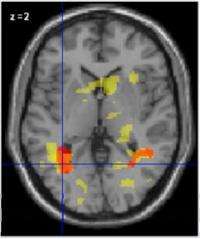
(PhysOrg.com) -- A new study from researchers in Europe has found literacy improves brain function even in people who learn to read as adults.
Cognitive neuroscientist Stanislas Dehaene from the Institut National de la Santé et de la Recherche Medicale in Gif-sur-Yvette in France and colleagues from Belgium, Brazil and Portugal, used functional magnetic resonance imaging (fMRI) to study the brains of 63 adults, of whom 10 were illiterate, 22 learned to read as adults, and 31 who learned to read as children.
They found the brains of subjects who were literate showed more vigorous responses to written words in brain regions known to process visual information and in areas of the left temporal lobe, which is known to respond to spoken language. These changes were seen in both groups of literate people.
Reading and writing have been human activities for only around 5,000 years, which is not long enough for major evolutionary changes. The ability to read therefore is likely to lie in brain circuits that originally evolved for other purposes, and the new study suggests these circuits evolved in support of spoken language.
There is something of a trade-off however, as the illiterate volunteers used a larger area of the left occipital-temporal cortex region of the brain to respond to images of faces than in the literate subjects. This may mean literate people are less adept at recognizing faces, and experiments are underway to see if this is true.
The new study follows on from earlier research by psychologist Marcel Just from Carnegie Mellon University in Pittsburgh that showed 100 hours of remedial training for children who were poor readers resulted in a corresponding growth of the white matter fibers in the frontal lobe of the brain. White matter is the brain tissue that transports signals between regions of gray matter where information is processed. As the children improved at reading the amount of white matter increased and its efficiency also improved.
Just’s research was the first to demonstrate that repeated cognitive exercises altered the cortical connectivity in the human brain. In other words, learning to read better basically re-wired the children's brains.
More information: How Learning to Read Changes the Cortical Networks for Vision and Language, Stanislas Dehaene et al., Published Online November 11, 2010. Science, DOI:10.1126/science.1194140
© 2010 PhysOrg.com


