German physicists create a 'super-photon'

This is an illustration of the "super-photon." (c) Jan Klaers, University of Bonn
Physicists from the University of Bonn have developed a completely new source of light, a so-called Bose-Einstein condensate consisting of photons. Until recently, expert had thought this impossible. This method may potentially be suitable for designing novel light sources resembling lasers that work in the X-ray range. Among other applications, they might allow building more powerful computer chips. The scientists are reporting on their discovery in the upcoming issue of the journal Nature.
By cooling Rubidium atoms deeply and concentrating a sufficient number of them in a compact space, they suddenly become indistinguishable. They behave like a single huge "super particle." Physicists call this a Bose-Einstein condensate.
For "light particles," or photons, this should also work. Unfortunately, this idea faces a fundamental problem. When photons are "cooled down," they disappear. Until a few months ago, it seemed impossible to cool light while concentrating it at the same time. The Bonn physicists Jan Klärs, Julian Schmitt, Dr. Frank Vewinger, and Professor Dr. Martin Weitz have, however, succeeded in doing this a minor sensation.
How warm is light?
When the tungsten filament of a light bulb is heated, it starts glowing first red, then yellow, and finally bluish. Thus, each color of the light can be assigned a "formation temperature." Blue light is warmer than red light, but tungsten glows differently than iron, for example. This is why physicists calibrate color temperature based on a theoretical model object, a so-called black body. If this body were heated to a temperature of 5,500 centigrade, it would have about the same color as sunlight at noon. In other words: noon light has a temperature of 5,500 degrees Celsius or not quite 5,800 Kelvin (the Kelvin scale does not know any negative values; instead, it starts at absolute zero or -273 centigrade; consequently, Kelvin values are always 273 degrees higher than the corresponding Celsius values).
When a black body is cooled down, it will at some point radiate no longer in the visible range; instead, it will only give off invisible infrared photons. At the same time, its radiation intensity will decrease. The number of photons becomes smaller as the temperature falls. This is what makes it so difficult to get the quantity of cool photons that is required for Bose-Einstein condensation to occur.
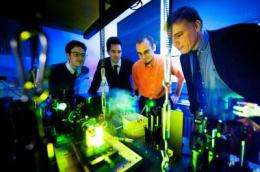
The creators of the "super-photon" are Julian Schmitt (left), Jan Klaers, Dr. Frank Vewinger and professor Dr. Martin Weitz (right). (c) Volker Lannert / University of Bonn
And yet, the Bonn researchers succeeded by using two highly reflective mirrors between which they kept bouncing a light beam back and forth. Between the reflective surfaces there were dissolved pigment molecules with which the photons collided periodically. In these collisions, the molecules 'swallowed' the photons and then 'spit' them out again. "During this process, the photons assumed the temperature of the fluid," explained Professor Weitz. "They cooled each other off to room temperature this way, and they did it without getting lost in the process."
A condensate made of light
The Bonn physicists then increased the quantity of photons between the mirrors by exciting the pigment solution using a laser. This allowed them to concentrate the cooled-off light particles so strongly that they condensed into a "super-photon."
This photonic Bose-Einstein condensate is a completely new source of light that has characteristics resembling lasers. But compared to lasers, they have a decisive advantage, "We are currently not capable of producing lasers that generate very short-wave light i.e. in the UV or X-ray range," explained Jan Klärs. "With a photonic Bose-Einstein condensate this should, however, be possible."
This prospect should primarily please chip designers. They use laser light for etching logic circuits into their semiconductor materials. How fine these structures can be is limited by the wavelength of the light, among other factors. Long-wavelength lasers are less well suited to precision work than short-wavelength ones it is as if you tried to sign a letter with a paintbrush.
X-ray radiation has a much shorter wavelength than visible light. In principle, X-ray lasers should thus allow applying much more complex circuits on the same silicon surface. This would allow creating a new generation of high-performance chips - and consequently, more powerful computers for end users. The process could also be useful in other applications such as spectroscopy or photovoltaics.
Provided by
University of Bonn
-
From lemons to lemonade: Reaction uses carbon dioxide to make carbon-based semiconductor,
28 comments
-
Every black hole contains a new universe: A physicist presents a solution to present-day cosmic mysteries,
215 comments
-
New silicon memory chip developed,
16 comments
-
Thioridazine kills cancer stem cells in human while avoiding toxic side-effects of conventional cancer treatments,
3 comments
-
SpaceX private rocket blasts off for space station (Update),
41 comments
-
Force on the top hinge of an open door
1 hour ago
-
Specular reflection from moving mirrors
4 hours ago
-
Setting Up a Nitrogen Laser
6 hours ago
-
Can sound fall?
7 hours ago
-
AC Electric field in the conducting media
9 hours ago
-
The physics of the greenhouse effect.
9 hours ago
- More from Physics Forums - General Physics
More news stories
Landmark calculation clears the way to answering how matter is formed
(Phys.org) -- An international collaboration of scientists, including Thomas Blum, associate professor of physics, is reporting in landmark detail the decay process of a subatomic particle called a kaon ...
7 hours ago |
4.8 / 5 (8) |
12
|
Thousands of invisibility cloaks trap a rainbow
Many people anticipating the creation of an invisibility cloak might be surprised to learn that a group of American researchers has created 25 000 individual cloaks.
21 hours ago |
4.8 / 5 (6) |
0
|
Is a classical electrodynamics law incompatible with special relativity?
(Phys.org) -- The laws of classical electromagnetism that were developed in the 19th century are the same laws that scientists use today. They include Maxwell’s four equations along with the Lorentz la ...
Slip-and-slide power generators
Researchers from Vestfold University College in Norway have created a simple, efficient energy harvesting device that uses the motion of a single droplet to generate electrical power.
21 hours ago |
4 / 5 (1) |
0
Lying in wait for WIMPs: Researchers seek to dramatically increase sensitivity of Large Underground Xenon detector
Although it's invisible, dark matter accounts for at least 80 percent of the matter in the universe. No one knows what it is, but most scientists would bet on weakly interacting massive particles, or WIMPs.
May 23, 2012 |
4 / 5 (5) |
13
|
Skp2 activates cancer-promoting, glucose-processing Akt
HER2 and its epidermal growth factor receptor cousins mobilize a specialized protein to activate a major player in cancer development and sugar metabolism, scientists report in the May 25 issue of Cell.
Math predicts size of clot-forming cells
UC Davis mathematicians have helped biologists figure out why platelets, the cells that form blood clots, are the size and shape that they are. Because platelets are important both for healing wounds and in strokes and other ...
Early physical therapist treatment associated with reduced risk of healthcare utilization and reduced overall healthcare
A new study published in Spine shows that early treatment by a physical therapist for low back pain (LBP), as compared to delayed treatment, was associated with reduced risk of subsequent healthcare utilization and lower ...
Typhoon Sanvu affecting Iwo To, then expected to fade over weekend
Infrared and visible imagery from NASA's Aqua satellite taken on May 25, 2012, showed an impressive Typhoon Sanvu already affecting the islands of Iwo To and Chichi Jima, Japan. The typhoon is expected to ...
NASA sees Hurricane Bud threaten western Mexico's coast
NASA satellites are providing rainfall, temperature, pressure, visible and infrared data to forecasters as Hurricane Bud is expected to make a quick landfall in western Mexico this weekend before turning back ...
Shareholders vote to take China's Alibaba unit private
Minority shareholders of Alibaba.com on Friday voted in favour of a proposal by its parent Alibaba Group Holding to take the Hong Kong-listed online trading unit private, the company said.

Nov 24, 2010
Rank: 5 / 5 (9)
Nov 24, 2010
Rank: 1 / 5 (14)
http://www.physor...uid.html
Nov 24, 2010
Rank: not rated yet
Nov 25, 2010
Rank: not rated yet
Nov 25, 2010
Rank: not rated yet
I'm trying to get a sense of what's going on here, but I'm drawing a blank. Is there anyone here who could enlighten me as to what is meant by the 'temperature' of a photon? From my physics courses, I was left with the sense that temperature is more or less defined as the average ambient vibrational kinetic energy of matter in a localized space. How does this apply to photons, and what does it mean? Photons have a wavelength, yes (as do 'particles' of matter, though it's very hard to detect.. and this is the best hint at an answer that I have).. and that wavelength should be expected to be longer if the body that gave it off is cold.. but is does this 'temperature' arise from an independent property of which I'm unaware?
Nov 25, 2010
Rank: not rated yet
Nov 25, 2010
Rank: not rated yet
Nonetheless, the feat to make a BE condensate from light is pretty cool.
Nov 25, 2010
Rank: 5 / 5 (1)
Am I misreading this? I worked with excimer lasers in college in the 1970's. There are several types of x-ray lasers including free-electron lasers(FELs).
http://en.wikiped...er_laser
http://en.wikiped...ay_laser
http://en.wikiped...ray_uses
Some of these short wavelength lasers have been used for biomedical, medical(LASIK), and industrial purposes for some time.
Nov 25, 2010
Rank: not rated yet
Loved this part!
Nov 25, 2010
Rank: 1 / 5 (9)
Nov 25, 2010
Rank: 1 / 5 (9)
Nov 25, 2010
Rank: not rated yet
it has nothing do with wavelenght).
Now You can see what is temperature of photon.
Its basically the temperature of Photon Gas.Now when you bring them closer at low temperature they will behave like Helium(boson) bose einstein condensate.
Please correct me if anyanybody know it better.(Research problem was to confine low energy Photon for a long enough time)
Nov 25, 2010
Rank: 5 / 5 (2)
Temperature of light is determined by wavelength, primarily intensity.
So when they say the "temperature" of a photon, they're referring to the amount of energy contained in the photon. Cooling a photon is removing energy from the photon. Expressed in Kelvin, longer wavelengths due to lower energy== cooling photon. That's incorrect.Because the lower the energy of a photon, the more rapidly that energy will disappate into the background environment.
Nov 25, 2010
Rank: not rated yet
I'm preferring the wavelength interpretation, since that most directly describes the energy of the photon and I now think it can work well enough. However, thinking of pV=nRT is interesting anyway. Though photons do not appear to interact with one another in the way that the particles in a gas would, they can transfer momentum to the matter of the containing walls.. and I believe this momentum is inversely proportional to the wavelength. So perhaps the interpretations aren't entirely different anyway.
Nov 25, 2010
Rank: not rated yet
Nov 25, 2010
Rank: not rated yet
Nov 26, 2010
Rank: not rated yet
From a Macro scale perspective, terminology does not directly apply to Micro scale physics; Such as the term temperature describing the state of a photon. However it can help describe or develop a new perspective.
The researchers claim that by concentrating a sufficient number of the photons in a compact space, (of fluid containing dissolved pigment molecules which absorbed and emit photons from a laser), allowed the photons to condense into a super-photon behaving like a single huge super particle.
It appears that the cooling lingo is simply the result of lowering the energy of the photons by the absorption and emitting of the pigment molecules.
What's interesting is the possibility of making a space craft behave like a photon!!!
Nov 27, 2010
Rank: 1 / 5 (4)
Nov 27, 2010
Rank: 1 / 5 (5)
Actually not. In the dye medium, the transversal decay is of subpicosecond timescale. The distance traveled by light in one ps is 0.23 mm, which is still pretty large distance in comparison to distance between molecules of dye. It can serve as an evidence, the EM field is mediated in plasmons (i.e. surface waves of charge density along surfaces of atom orbitals) through dye, not via normal photons. You may want to repeat these experiments with "photons" in vacuum - and you would see the difference immediately.
So no - whereas I can argument the concept of material photons easily, these experiments cannot serve as a conclusive evidence for it, because matter of environment remains involved in them.
Nov 27, 2010
Rank: 1 / 5 (6)
I do believe, the true super-photons can exist and they were even observed in nature like gamma ray bursts of photons, which can propagate collectively at the large distance - but to create them in terrestrial conditions would require a much larger effort.
Nov 27, 2010
Rank: 4.7 / 5 (3)
Nov 27, 2010
Rank: 4.8 / 5 (26)
First, Maxwell determined c, yes. If it turns out that photons go less than c by having mass, Relativity would not be effected, as c would still be an intrinsic upper limit, just not matching the photon velocity,... there would still exist "gravitational" waves, waves of space-time distortions.
Nov 27, 2010
Rank: 1 / 5 (5)
Nov 27, 2010
Rank: 5 / 5 (27)
Ya I said if the photon turned out to have mass (Which you wrongly suggested) it would NOT effect relativity. I was responding to this,...
BE-C does not imply photon mass.
Nov 27, 2010
Rank: 1 / 5 (7)
It would, if BE-C would be formed with photons. Which isn't, in the particular case of article disputed.
Nov 27, 2010
Rank: 1 / 5 (6)
Actually it's nothing, which couldn't be observed at the water surface deformed with Brownian noise. Quantum field theory interprets the same phenomena with temporal formation of particle-antiparticle pairs, which are materializing and annihilating alternatively along path of light.
The superluminal speed of photon tunneling can be actually observed during tunneling of photons between prisms (Hartman, Enders, Nimtz..). The material character of photons can be illustrated with their own gravity field, which keeps the gamma ray bursts together at large distance.
Nov 27, 2010
Rank: 5 / 5 (25)
Nov 27, 2010
Rank: 1 / 5 (6)
The experiment showing photon mass has been done by shining of gamma ray photons to atom nuclei. At the proper wavelength such photon can bounce inside of nuclei like wave trapped into glass sphere and you can compare the mass of excited atom nuclei with these normal ones in mass spectrometer.
Nov 27, 2010
Rank: 5 / 5 (25)
Nov 27, 2010
Rank: 1 / 5 (6)
Nov 27, 2010
Rank: not rated yet
Nov 27, 2010
Rank: 1 / 5 (1)
Try thinking of Space and Matter as two opposite manifestations of one Energy. At one end of the spectrum you have matter (a photon of light) moving through space and at the other end of the spectrum you have space moving through matter (a Black Hole). Now, in the middle of the spectrum you have the buoyancy of these two manifestations (Space and Matter) as electrons, beta, gamma etc.
The ideal here with the Space-Mass Spectrum is that each quantum of mass interacts with a gradient of space that is equal in energy and is an integral to the constant C (the speed of light). These gradients of space are known as fields and are what makes up space like the colors of a rainbow make up the white light, metaphorically speaking. Some of these gradients or fields are known as the electric field, magnetic field, gravity field, strong force, weak force, etc.
Nov 28, 2010
Rank: 5 / 5 (2)
First regular lasers already produce a state of light which can be though of as Bose-Einstein condensation of photons.
Second the whole talk about photon temperature makes little sense, if you "cool" visible light photons you will end up with infrared or if you keep "cooling" radio-frequency photons. How the hell is that supposed to result in x-ray lasers?
Whatever the original result might be it was certainly lost in this attempt to popularize it.
Nov 28, 2010
Rank: not rated yet
Certainly not enough info given to understand what is going on. If it is possible to create a BEC of photons, would it be possible that upon its collapse, all the energy is emitted as a few coherent high energy photons?
Nov 29, 2010
Rank: not rated yet
Nov 29, 2010
Rank: 1 / 5 (2)
You're right, but the same effect, which leads to first and second order optical effects in lasers will lead to the autofocusation of light up to level, an analogy of clouds of atoms, glueballs or photonballs in gamma ray flashes will be created - i.e. a spatially constrained ball of plasmons within matherial. Under this situation, the density of photon condensate is independent to the size of resonator - the bosons are held together with their own forces, not by bouncing of/reflection from resonator mirrors.
To convince themselves that the peak is related to a BEC, rather than the cavity behaving like a laser, the researchers repeated the experiment at several different separation distances. They found that the peak always emerged at the same photon density - something that would not be seen in a laser.