Gene transfer from transgenic crops: A more realistic picture
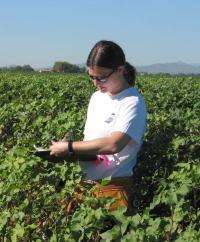
A new data-driven statistical model that incorporates the surrounding landscape in unprecedented detail describes the transfer of an inserted bacterial gene via pollen and seed dispersal in cotton plants more accurately than previously available methods.
Shannon Heuberger, a graduate student at the University of Arizona's College of Agriculture and Life Sciences, and her co-workers will publish their findings in PLoS ONE on Nov. 30.
The transfer of genes from genetically modified crop plants is a hotly debated issue. Many consumers are concerned about the possibility of genetic material from transgenic plants mixing with non-transgenic plants on nearby fields. Producers, on the other side, have a strong interest in knowing whether the varieties they are growing are free from unwanted genetic traits.
Up until now, realistic models were lacking that could help growers and legislators assess and predict gene flow between genetically modified and non-genetically modified crops with satisfactory detail.
This study is the first to analyze gene flow of a genetically modified trait at such a comprehensive level. The new approach is likely to improve assessment of the transfer of genes between plants other than cotton as well.
"The most important finding was that gene flow in an agricultural landscape is complex and influenced by many factors that previous field studies have not measured," said Heuberger. "Our goal was to put a tool in the hands of growers, managers and legislators that allows them to realistically assess the factors that affect gene flow rates and then be able to extrapolate from that and decide how they can manage gene flow."
The researchers measured many factors in the field and developed a geographic information system-based analysis that takes into account the whole landscape surrounding a field to evaluate how it influences the transfer of genes between fields. Genes can be transferred in several ways, for example by pollinators such as bees, or through accidental seed mixing during farming operations.
Surprisingly, the team found that pollinating insects, widely believed to be the key factor in moving transgenic pollen into neighboring crop fields, had a small impact on gene flow compared to human farming activity, with less than one percent of seeds collected around the edges of non-Bt cotton fields resulting from bee pollination between Bt and non-Bt cotton.
Most previous studies focused on the distance between the non-transgenic crop field and the nearest source of transgenic plants.
"Although this approach is simple, it is potentially less useful for understanding gene flow in commercial agriculture where there can be many sources of transgenic plants," Heuberger said.
Heuberger and her co-workers broadened the scope to include flower-pollinating bees, humans moving seeds around and the area of all cotton fields in a three-kilometer (1.9 mile) radius. This approach turned out to be more powerful in understanding the effect of surrounding fields than using the customary model based solely on distance.
For the study, the scientists chose 15 fields across the state of Arizona planted with cotton that did not have the transgenic protein encoded by a gene from the bacterium Bacillus thuringiensis, or Bt. They assessed the number of pollinators visiting cotton flowers through field observations and determined the transfer of genes by collecting samples of cotton bolls and determining their genetic identity.
"We saw a need for a spatially explicit model that would account for the whole surrounding landscape," Heuberger said. "Our model takes into account the distance and area of all relevant neighboring fields, the effect of pollinators like bees and human factors that can result in the mixing of seed types."
Heuberger's findings have implications not just for genetically engineered traits but also more generally for seed production.
"When you grow a crop and want the variety to be pure, just being able to know how far gene flow will occur and how it is affected by pollinators and human farming activity in the area is very valuable."
More information: The study, "Pollen- and Seed-Mediated Transgene Flow in Commercial Cotton Seed Production Fields" will be published in PLoS ONE on Tuesday, November 30th. dx.plos.org/10.1371/journal.pone.0014128
Provided by University of Arizona


