Fruit fly larvae detect light via body's network of photoreceptors
November 12, 2010 by Lin Edwards report

Fruit fly larvae detect light via body's network of photoreceptors

Enlarge

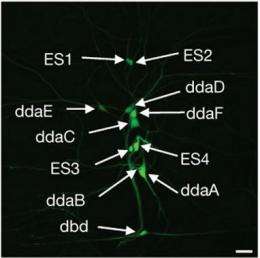
Light activates class IV dendritic arborization neurons. Pre-stimulation image showing larval dorsal cluster sensory neurons. Image credit: Nature, doi:10.1038/nature09576

(PhysOrg.com) -- New research in the U.S. has discovered that fruit fly larvae have a series of photoreceptors covering the body that can detect light even when their primitive "eyes" are covered or removed.

The ability to sense light is important for fruit fly because they burrow into rotting fruit, covering their rudimentary eyes (known as Bolwig organs) on their heads as they do so. If their entire body is buried in the fruit there is less chance of predation, and so having a way of detecting light alerts them to the fact the body is exposed and therefore vulnerable. Young larvae can also die if exposed to bright light for too long.

The researchers, Yang Xian and colleagues from the University of California at San Franciso, New York University and the Janelia Farm Research Campus in Virginia, compared the reactions to light of intact wild-type (Drosophila melanogaster) and those with non-functioning Bolwig organs.

Their results showed both groups of larvae moved away from light at intensities of 0.57 mW mm-2 or higher, but at lower light intensities those lacking Bolwig organs were less sensitive to the light. (A typical bright sunny day represents of around 1 mW mm-2.) Both groups of larvae were highly sensitive to short wavelengths (blue, violet and ultraviolet) and less sensitive to longer wavelengths (red and green).

This video is not supported by your browser at this time.

This movie shows photoavoidance of a wt larva to the light spot of 0.57 mW/mm2. Video: Nature, doi:10.1038/nature09576

The scientists identified the mechanism by which the larvae detect light, which is a network of of a type called class IV dendritic arborization neurons covering the larva’s body. They tagged the neurons with a fluorescent molecule that glows green in the presence of calcium, which is released when the neurons fire, and this made the network visible when a light was shone on the larvae. They found the neurons were sensitive to light even when dissected from the larvae, and no other factors such as touch, temperature or reactive oxygen concentrations are involved.

The report, published in the journal Nature concludes that in dim light the Bolwig organs are the primary light sensors but in bright light the array of neurons becomes the main light sensing mechanism. The authors said further research is needed to reveal the molecular mechanism that enables the neurons to respond to light, and to find out if any other animals use a similar network of .

More information: Light-avoidance-mediating photoreceptors tile the Drosophila larval body wall, Nature advance online publication 10 November 2010. doi:10.1038/nature09576

© 2010 PhysOrg.com

4.2 /5 (5 votes)  

Rank 4.2 /5 (5 votes)
Relevant PhysicsForums posts

More news stories

Copy of the genetic makeup travels in a protein suitcase

Scientists from the Institute for Physical and Theoretical Chemistry at the University of Bonn have succeeded for the first time in the real time filming of the transport of an important information carrier in biological ...

Biology / Cell & Microbiology

created 4 hours ago | popularity not rated yet | comments 0 | with audio podcast

Study uncovers secret to speedy burrowing by razor clams

(Phys.org) -- If you look at a razor burrowing clam sitting in a bucket, you’d never guess that it could burrow itself down into the soil, much less do it with any speed. Razor clams look like fat straws, ...

Biology / Plants & Animals

created 7 hours ago | popularity not rated yet | comments 2 | with audio podcast report

'Transformer' protein makes different sized transport pods

These spheres may look almost identical, but subtle differences between them revealed a molecular version of the robots from Transformers. Each sphere is a vesicle, a pod that cells use to transport materials ...

Biology / Cell & Microbiology

created 4 hours ago | popularity not rated yet | comments 0

A new invading sea crab reaches the Ebro Delta

Originally endemic to the Atlantic Coast of North America, over the past 30 years Dyspanopeus sayi has been involuntarily introduced in the UK, France, the Netherlands, the Black Sea and the Adriatic Sea. A ...

Biology / Ecology

created 5 hours ago | popularity not rated yet | comments 0

A mating dance with Popeye arms

A research team at Bielefeld University headed by the evolutionary biologist Dr. Holger Schielzeth is now studying how far a comparable mechanism is involved in mate choice among locusts. The male Siberian ...

Biology / Plants & Animals

created 3 hours ago | popularity not rated yet | comments 0


Skp2 activates cancer-promoting, glucose-processing Akt

HER2 and its epidermal growth factor receptor cousins mobilize a specialized protein to activate a major player in cancer development and sugar metabolism, scientists report in the May 25 issue of Cell.

Math predicts size of clot-forming cells

UC Davis mathematicians have helped biologists figure out why platelets, the cells that form blood clots, are the size and shape that they are. Because platelets are important both for healing wounds and in strokes and other ...

Early physical therapist treatment associated with reduced risk of healthcare utilization and reduced overall healthcare

A new study published in Spine shows that early treatment by a physical therapist for low back pain (LBP), as compared to delayed treatment, was associated with reduced risk of subsequent healthcare utilization and lower ...

Flesh-Eating bacteria no cause for panic, experts say

(HealthDay) -- Despite scary headlines by the score, most people don't have to fear that they'll be the next victim of the so-called flesh-eating bacteria disease, experts say.

Typhoon Sanvu affecting Iwo To, then expected to fade over weekend

Infrared and visible imagery from NASA's Aqua satellite taken on May 25, 2012, showed an impressive Typhoon Sanvu already affecting the islands of Iwo To and Chichi Jima, Japan. The typhoon is expected to ...

NASA sees Hurricane Bud threaten western Mexico's coast

NASA satellites are providing rainfall, temperature, pressure, visible and infrared data to forecasters as Hurricane Bud is expected to make a quick landfall in western Mexico this weekend before turning back ...